European tortoises are solitary animals by nature and will aggressively and fiercely compete over territory, food, and hierarchy. However, there are several strategies that can help to reduce these problems.
Aggressive behaviour in the animal kingdom
First of all, it is important to understand that aggression is nothing unusual in biological terms. Aggressive behaviour is widespread throughout the animal kingdom and serves a variety of functions. Behavioural biologists primarily view it as a strategy for competing over resources and food — both between different species (interspecific competition) and within the same species (intraspecific competition). Other triggers include territorial defence, the establishment or restructuring of hierarchies, and competition for mating partners.
In ethology, aggressive behaviour is often grouped under the term agonistic behaviour, which includes both attacks and threat displays. Such behaviour is frequently triggered by so-called key stimuli. Both animals and humans possess instinctive mechanisms that inhibit aggressive impulses — known as aggression inhibition.
Aggression inhibition in forced cohabitation
In tortoises, this inhibition of aggression is often observed in situations of forced cohabitation. When several animals are confined to very limited space for long periods, they may cope with the situation through apathetic behaviour. Examples include tortoises kept together in a small terrarium or confined to an extremely small outdoor area. There are documented cases of two tortoises being kept for decades in less than one square metre in survival-based cohabitation.
End of forced cohabitation ends aggression inhibition
However, once tortoises are moved from such conditions into improved housing, their natural instincts re-emerge and the new territory is fiercely contested. A similar pattern can be observed in previously harmonious groups with an established hierarchy when they are moved to a new enclosure. In these cases, dominance over the new territory is often aggressively renegotiated.
Conclusion: Tortoises taken over from poor housing conditions and introduced to a new enclosure will very likely re-establish their hierarchy — even if they previously “got along well”. The same applies when the group composition changes, for example when new animals are introduced.
What can be done?
To ease the situation as much as possible, keepers should provide the largest possible enclosure with plenty of structure and hiding places, allowing each animal individual retreat options. It is essential that visual barriers allow tortoises to completely avoid one another. This can significantly reduce territorial conflicts. Careful monitoring of the new situation is crucial, for example by using a surveillance camera.
Aggression in tortoises
In the wild, European tortoises are solitary animals, and males fiercely defend their large territories against intruders. The damaged and scarred carapaces found on the backs of male tortoises in their natural habitat clearly demonstrate how violently territories are defended — often to the death. Contrary to popular belief, tortoises are not “peaceful” animals.
A common problem arising from the widespread practice of keeping multiple tortoises together in captivity is the display of aggressive behaviour. The more confined the space, the more severe these issues tend to become.
In addition, males may commit forced copulation and cause cloacal injuries.
What can keepers do?
Based on experience, mixed-sex groups should be provided with at least twice as much space as single animals. If a minimum of 10 m² per tortoise is assumed for solitary housing, mixed-sex groups require approximately 20 m² per animal. Enclosure structure, visual barriers, and hiding places are equally important. In general, mixed-sex housing functions better in significantly larger, well-structured enclosures.
This should always include access to a sufficiently large greenhouse and, where necessary, a sex-segregated, species-appropriate alternative enclosure, especially during transitional seasons, in order to keep stress levels as low as possible.
Escalation
What often begins subtly usually escalates quickly. Aggression may intensify within a short time, leading to constant ramming, biting, and flipping rivals onto their backs. If this behaviour becomes excessive or an animal is injured, the aggressor should be separated immediately. Tortoises can inflict severe injuries on one another, and aroused males frequently injure themselves on the plastron and genital area.
Injured animals should be examined by a reptile veterinarian. Minor abrasions can be treated by the keeper. After a cooling-off period, cautious reintroduction under constant supervision may be attempted.
Males
Male tortoises fiercely defend their territory and usually tolerate no rivals within or near the enclosure.
In rare exceptional cases, all-male groups can be kept successfully — but only in very large, extremely well-structured enclosures with numerous hiding places. Such attempts are more likely to succeed if the males have grown up together from a young age and have had little or no contact with females. Groups of several males generally work better than pairs or trios. Nevertheless, there are no guarantees, and permanent separation must always remain an option.
Even in male-only groups, forced copulation and cloacal injuries may occur. Mediterranean aromatic herbs can help mask the scent of rivals. A very large, well-structured enclosure with ample hiding places is essential.

Photo: Tortoise Rescue Centre Kitzingen
De-escalation and separation
In addition to the measures described above, the option to separate animals must always be available. In male groups, forced copulation and cloacal injuries may occur, and there have been cases in which males have killed their rivals.
Mediterranean aromatic herbs can help mask the scent of rivals if separate enclosures are located close together. Where possible, males should be housed as far away from other tortoises as possible.
Females
Aggressive behaviour also occurs in female-only groups, particularly when establishing hierarchy and dominating subordinate animals. These groups are often especially restless prior to egg-laying.
In most cases, the situation settles after successful egg-laying as hormone levels decline. If not, particularly aggressive females must be separated temporarily or permanently. Otherwise, stress-induced egg retention may occur.
Mixed-sex housing
During courtship, males may behave very roughly towards females. Ramming and biting are part of the mating ritual to a certain extent, but should not become excessive. Females should not suffer injuries or constant stress.
Keepers of mixed-sex groups should briefly check both males and females daily for mating injuries and closely monitor group dynamics. It is advisable to inspect the plastron and cloaca regularly. Over time, repeated ramming can cause injuries to the rear edge of the female’s shell, often leading to necrosis. Constant mounting can severely damage and ultimately mutilate the female’s cloaca.
Males often need to live separately from females and should — if at all — only be allowed brief visits. While a very large, well-structured enclosure with many hiding places may allow peaceful coexistence, this is never guaranteed. A permanent separation option for the male must always be available. The male enclosure should be located as far away as possible to prevent chronic stress caused by the scent of females.
Some species appear to tolerate permanent cohabitation better than others. For example, Testudo marginata is often easier to keep in groups in large, well-structured enclosures than Testudo graeca. In all cases, the enclosure should be large enough for animals to easily avoid one another.
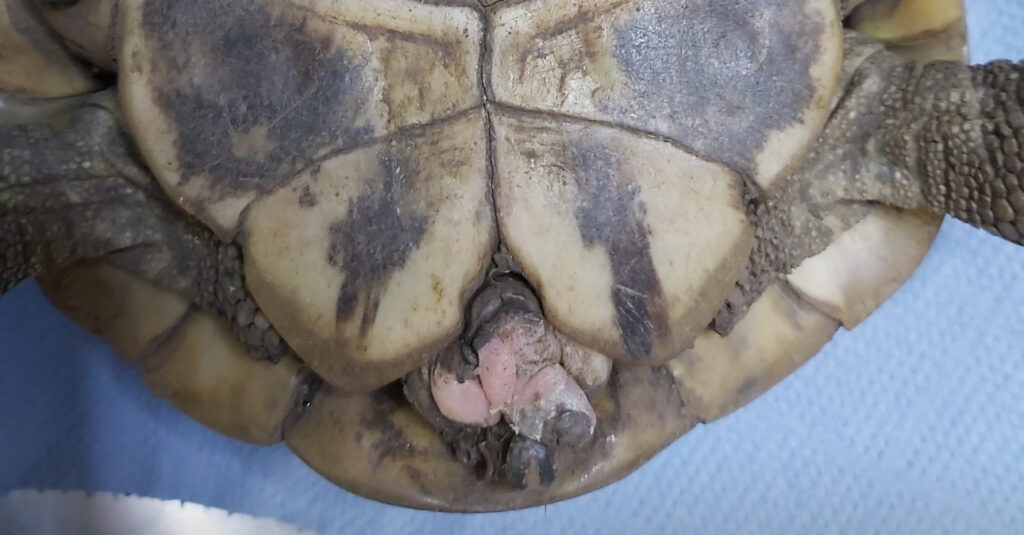
Photo: Tortoise Rescue Centre Kitzingen
Minimally invasive castration as a last resort
If neither de-escalation nor permanent separation is feasible, minimally invasive castration of males may be considered. This procedure is used relatively frequently in Switzerland. Many keepers report harmonious group dynamics following surgery.
Conclusion: Better alone than stressed
In summary, males and tortoises that have lived alone for long periods are generally difficult to socialise. In both males and females, some individuals are temperamentally unsuitable for group housing due to high aggression levels.
It must not be forgotten that tortoises are naturally territorial solitary animals, and forced cohabitation runs counter to their nature. Not without reason, females are capable of storing male sperm for many years to fertilise eggs. Even in large enclosures, the available space remains extremely limited compared to the vastness of their natural habitat.