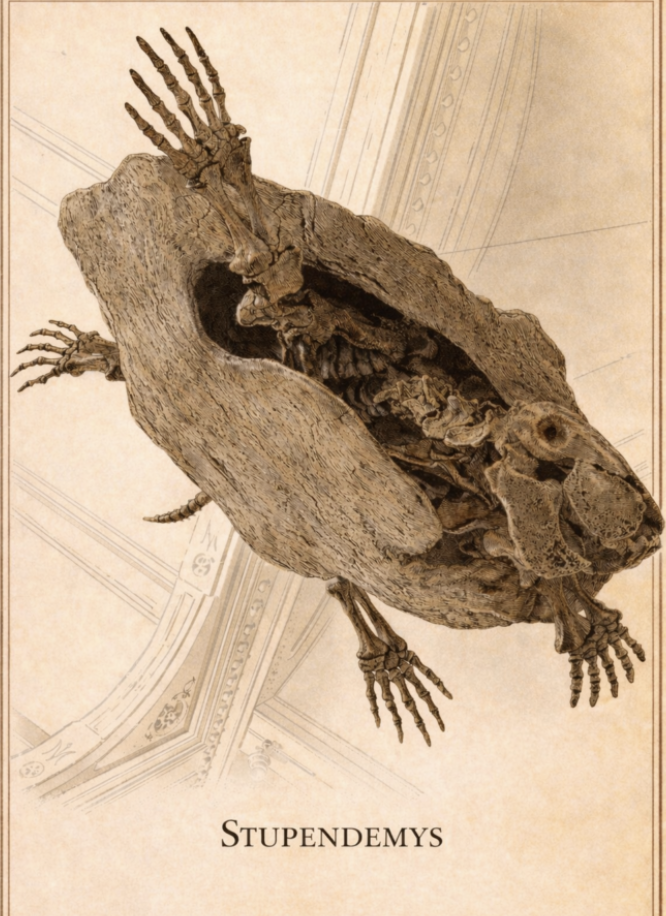
Schildkröten gehören zu den ältesten heute lebenden Wirbeltieren und blicken auf eine über 220 Millionen Jahre lange Evolutionsgeschichte zurück. Aufgrund ihres ruhigen Erscheinungsbildes zählen sie zu den faszinierendsten Tiergruppen der Erde. Ihre einzigartige Anatomie, ihre enorme Anpassungsfähigkeit und ihre außergewöhnliche Lebensdauer machen sie zu echten Überlebenskünstlern.
Heute umfasst die Ordnung der Testudines 364 Arten, die nahezu alle Lebensräume besiedeln – von trockenen Wüsten über Süßgewässer bis hin zu den Weltmeeren.
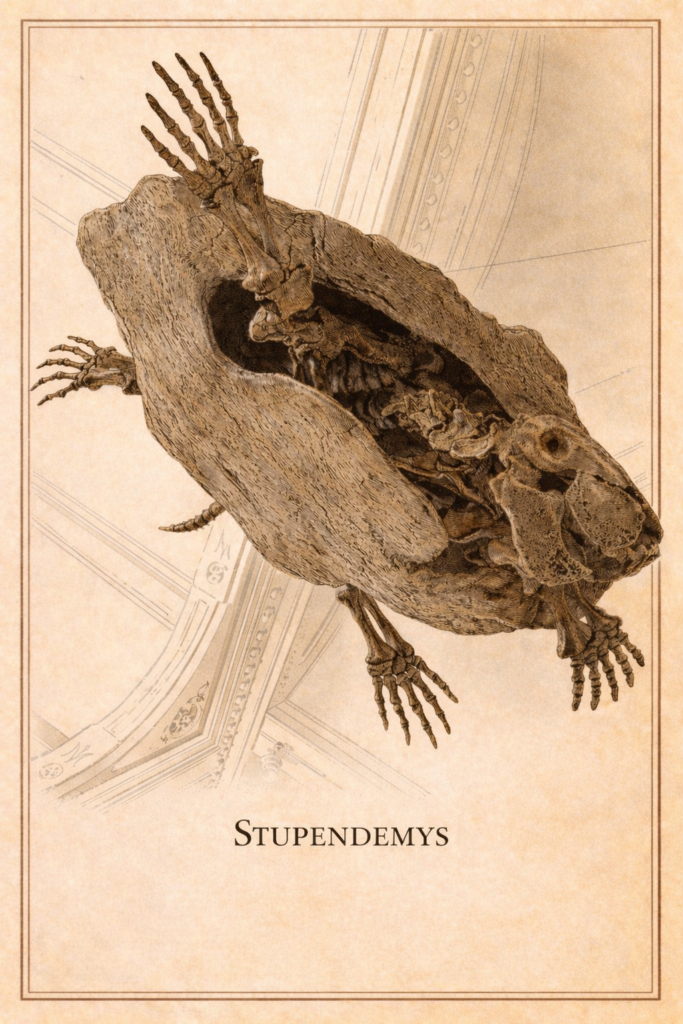
Evolution – eine Erfolgsgeschichte seit der Trias
Die Ursprünge der Schildkröten reichen bis in die Obertrias zurück. Fossilfunde wie Odontochelys semitestacea zeigen, dass bereits frühe Vertreter dieser Gruppe charakteristische Merkmale entwickelten.
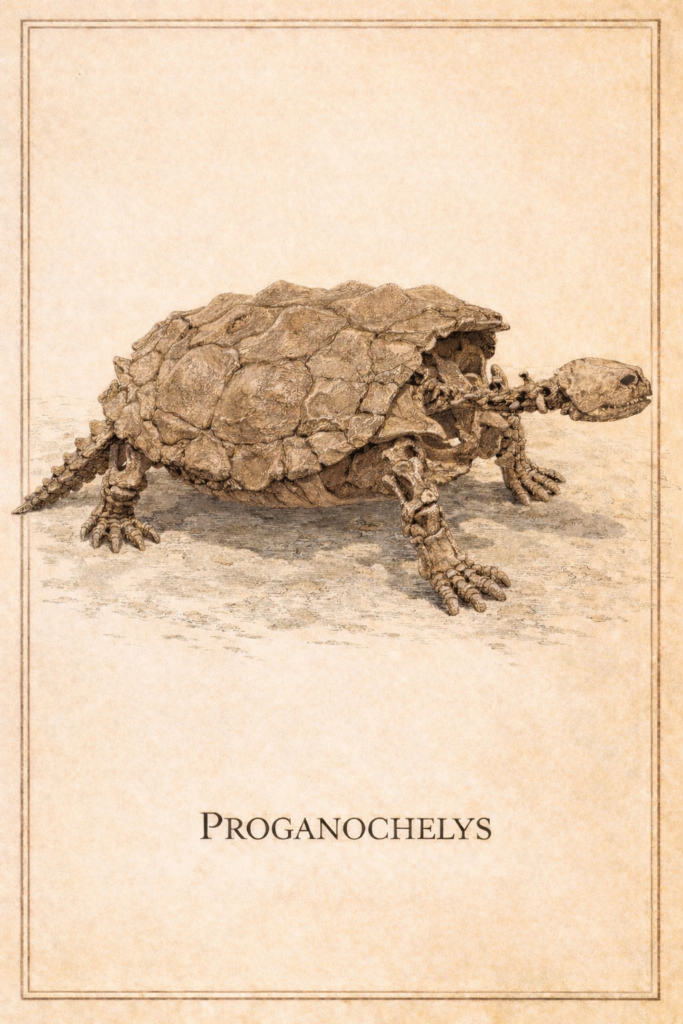
Lange war unklar, wie Schildkröten innerhalb der Reptilien einzuordnen sind. Heute gilt als gesichert, dass sie zu den Diapsiden gehören und näher mit Krokodilen und Vögeln verwandt sind als mit Echsen und Schlangen. Wichtige Hinweise liefert unter anderem Pappochelys rosinae, ein früher Verwandter mit typischem diapsiden Schädelbau.
Im Verlauf ihrer Evolution entwickelten Schildkröten ihren einzigartigen Panzer aus Rippen und anderen Skelettelementen – ein Bauplan, der sich bis heute kaum verändert hat.
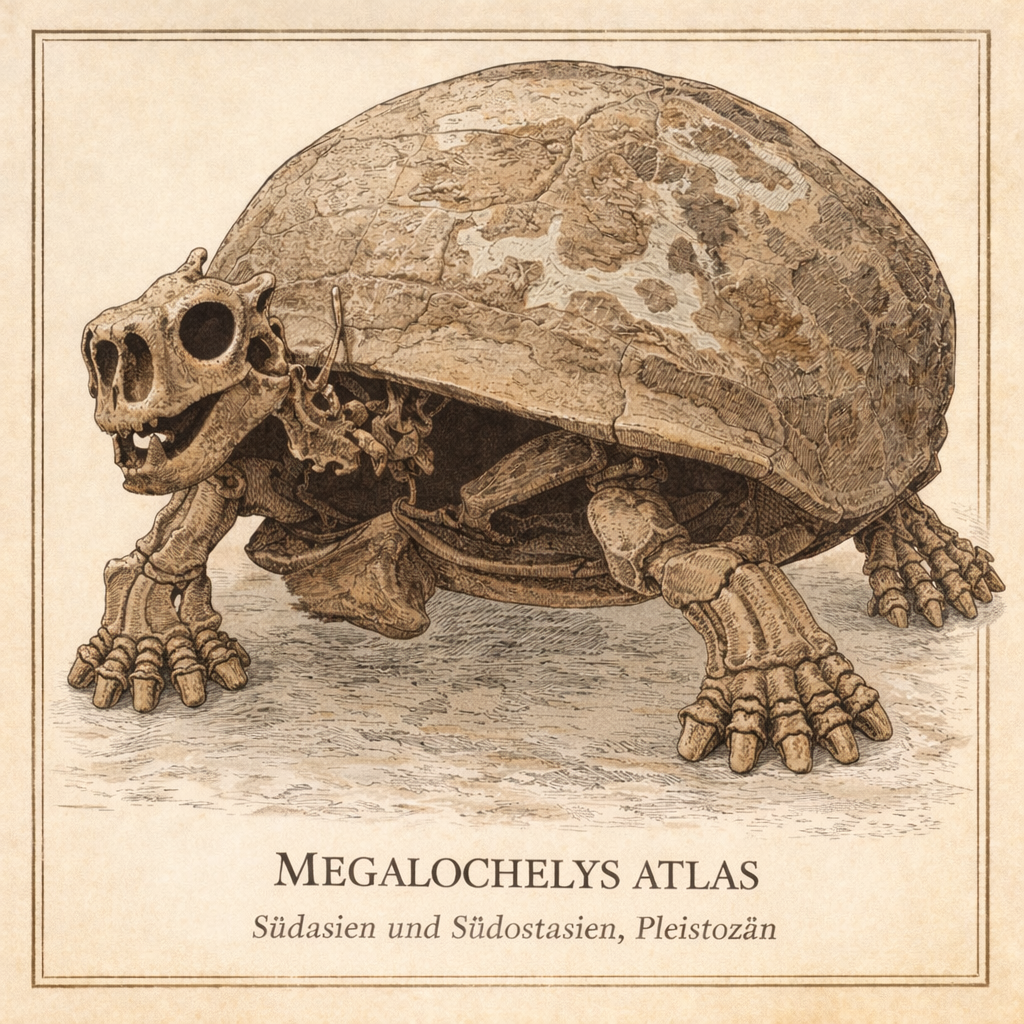
Vielfalt und Lebensräume
Schildkröten sind nahezu weltweit verbreitet und besiedeln alle Kontinente mit Ausnahme der Antarktis. Ihre Lebensräume reichen von tropischen Regenwäldern über mediterrane Landschaften bis hin zu Flüssen, Seen und Meeresküsten.
In Europa ist die Vielfalt deutlich geringer. In Mitteleuropa kommt mit der Emys orbicularis nur eine ursprünglich heimische Art vor.
Die Anpassungsfähigkeit der Schildkröten zeigt sich besonders in ihrer ökologischen Bandbreite – von rein terrestrischen bis hin zu vollständig marinen Lebensweisen.
Größenunterschiede – von Mini bis Gigant
Die Größenunterschiede innerhalb der Schildkröten sind enorm. Viele Arten bleiben mit einer Panzerlänge von 10 bis 50 Zentimetern vergleichsweise klein.
Am anderen Ende des Spektrums stehen beeindruckende Riesenschildkröten wie Chelonoidis nigra, die über einen Meter Panzerlänge erreichen können.
Die größte heute lebende Schildkröte ist die Dermochelys coriacea, die eine Länge von bis zu 2,5 Metern und ein Gewicht von rund 900 Kilogramm erreichen kann.
Den Gegenpol bildet die winzige Homopus signatus, deren Männchen nur etwa 7,5 Zentimeter groß werden.
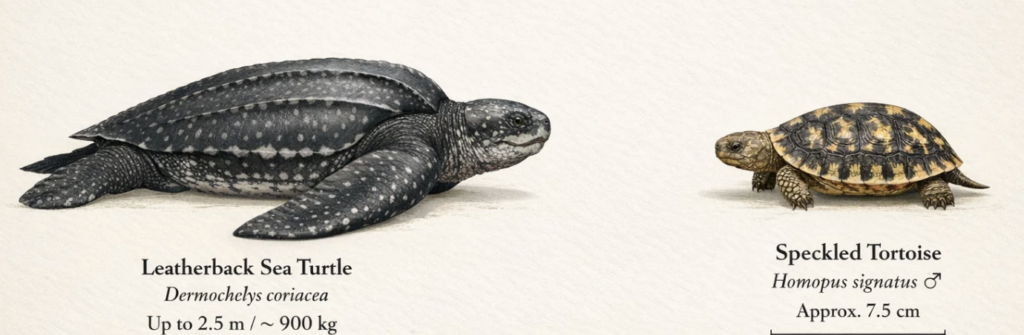
Vergleichende Morphologie der Testudines
Diese Illustration verdeutlicht die enorme biologische Spannweite innerhalb der Ordnung der Schildkröten (Testudines) und zeigt den extremen Dimorphismus in der Körpergröße zwischen den größten marinen und den kleinsten terrestrischen Vertretern.
- Links: Die Lederschildkröte (Dermochelys coriacea) Der größte lebende Vertreter der Schildkröten. Charakteristisch ist der namensgebende, lederartige Panzer ohne Hornschilde, der durch sieben markante Längskiele verstärkt wird. Diese hochspezialisierte Anatomie erlaubt Tauchtiefen von über 1.200 Metern.
- Maximalmaße: Länge bis zu 2,5 m; Gewicht bis zu 900 kg.
- Rechts: Die Gesägte Flachschildkröte (Homopus signatus) Die kleinste Schildkrötenart der Welt, heimisch in den Trockengebieten Südafrikas. Besonders markant ist das komplexe Fleckenmuster auf dem flachen Carapax, das in ihrem felsigen Lebensraum als perfekte Tarnung dient.
- Durchschnittsmaß (Männchen): ca. 7,5 cm.
Anmerkung zum Größenvergleich: Die zentrale Silhouette verdeutlicht nur annähernd das massive Volumenverhältnis. Während die Lederschildkröte ein gewaltiger Meereswanderer ist, passt die Gesägte Flachschildkröte bequem in die Handfläche eines Menschen.
Besondere Merkmale und Anpassungen
Schildkröten zeichnen sich durch eine Reihe einzigartiger Merkmale aus. Ihr Panzer ist fest mit dem Skelett verbunden und stellt eine der außergewöhnlichsten anatomischen Strukturen im Tierreich dar.
Auch ihre Anpassungsfähigkeit ist bemerkenswert. Einige Arten sind hoch spezialisiert, etwa in ihrer Ernährung oder Fortbewegung. Andere zeichnen sich durch extreme Langlebigkeit aus und können ein Alter von über 100 Jahren erreichen.
Diese Kombination aus Stabilität und Anpassungsfähigkeit hat es den Schildkröten ermöglicht, über Millionen von Jahren hinweg nahezu unverändert zu bestehen.
Weiterführende Themen rund um Schildkröten von A-Z
Landschildkröten- Refugien während der „Eiszeit“
„Ursprung der Testudo-Arten„
Anatomie im Artikel „Der Körperbau der Schildkröten“
Gefährdung im Artikel „Taxonomie und Bedrohung“
Ernährung im Artikel „Ernährung und Verhalten“
Artenschutz-Instrumente im Artikel „Die Wächter der Vielfalt„
Bemerkenswertes im Artikel „Besondere Fakten„
Quellen
BEVER, G. S., LYSON, T. R., FIELD, D. J. & BHULLAR, B.-A. S. (2015): Evolutionary origin of the turtle skull. Nature 525: 239–242. DOI: 10.1038/nature14900.
CADENA, E. A., SCHEYER, T. M., CARRILLO-BRICEÑO, J. D., SÁNCHEZ, R., AGUILERA, O. A., VANEGAS, A., PARDO, M., HANSEN, D. M. & SÁNCHEZ-VILLAGRA, M. R. (2020): The anatomy, paleobiology, and evolutionary relationships of the largest extinct side-necked turtle. Science Advances 6(7): eaay4593. DOI: 10.1126/sciadv.aay4593.
CRAWFORD, N. G., FAIRCLOTH, B. C., MCCORMACK, J. E., BRUMFIELD, R. T., WINKER, K. & GLENN, T. C. (2012): More than 1000 ultraconserved elements provide evidence that turtles are the sister group of archosaurs. Biology Letters 8(5): 783–786. DOI: 10.1098/rsbl.2012.0331.
FIELD, D. J., GAUTHIER, J. A., KING, B. L., PISANI, D., LYSON, T. R. & PETERSON, K. J. (2014): Toward consilience in reptile phylogeny: miRNAs support an archosaur, not lepidosaur, affinity for turtles. Evolution & Development 16(4): 189–196. DOI: 10.1111/ede.12081.
FRITZ, U. (2012): Die Schildkröten Europas. Wiebelsheim: Quelle & Meyer.
JOYCE, W. G. (2015): The origin of turtles: a paleontological perspective. Journal of Experimental Zoology Part B: Molecular and Developmental Evolution 324B(3): 181–193. DOI: 10.1002/jez.b.22609.
LI, C., WU, X.-C., RIEPPEL, O., WANG, L.-T. & ZHAO, L.-J. (2008): An ancestral turtle from the Late Triassic of southwestern China. Nature 456: 497–501. DOI: 10.1038/nature07533.
LYSON, T. R., BEVER, G. S., BHULLAR, B.-A. S., JOYCE, W. G. & GAUTHIER, J. A. (2010): Transitional fossils and the origin of turtles. Biology Letters 6(6): 830–833. DOI: 10.1098/rsbl.2010.0371.
LYSON, T. R., BEVER, G. S., SCHEYER, T. M., HSIANG, A. Y. & GAUTHIER, J. A. (2013): Evolutionary origin of the turtle shell. Current Biology 23(12): 1113–1119. DOI: 10.1016/j.cub.2013.05.003.
LYSON, T. R., SCHACHNER, E. R., BOTHA-BRINK, J., SCHEYER, T. M., LAMBERTZ, M., BEVER, G. S., RUBIDGE, B. & DE QUEIROZ, K. (2014): Origin of the unique lung ventilatory apparatus of turtles. Nature Communications 5: 5211. DOI: 10.1038/ncomms6211.
LYSON, T. R., RUBIDGE, B. S., SCHEYER, T. M., DE QUEIROZ, K., SCHACHNER, E. R., SMITH, R. M. H., BOTHA-BRINK, J. & BEVER, G. S. (2016): Fossorial origin of the turtle shell. Current Biology 26(14): 1887–1894. DOI: 10.1016/j.cub.2016.05.020.
LYSON, T. R. & BEVER, G. S. (2020): Evolutionary origin of the turtle body plan. Annual Review of Ecology, Evolution, and Systematics 51: 143–166. DOI: 10.1146/annurev-ecolsys-110218-024746.
NAKSRI, W., TONG, H., LAUPRASERT, K., JINTASAKUL, P., SUTEETHORN, V., VIDTHAYANON, C. & CLAUDE, J. (2019): Plio-Pleistocene giant tortoises from Tha Chang sandpits, Nakhon Ratchasima Province, Thailand. Annales de Paléontologie 105: 257–267.
SCHOCH, R. R. & SUES, H.-D. (2015): A Middle Triassic stem-turtle and the evolution of the turtle body plan. Nature 523: 584–587. DOI: 10.1038/nature14472.
TURTLE TAXONOMY WORKING GROUP [RHODIN, A. G. J., IVERSON, J. B., FRITZ, U., GALLEGO-GARCÍA, N., GEORGES, A., SHAFFER, H. B. & VAN DIJK, P. P.] (2025): Turtles of the World: Annotated Checklist and Atlas of Taxonomy, Synonymy, Distribution, and Conservation Status. 10th ed. Chelonian Research Monographs 10: 1–575. DOI: 10.3854/crm.10.checklist.atlas.v10.2025.
VLACHOS, E. (2019): On the nomenclature of the largest tortoise that ever lived: Megalochelys sivalensis Falconer & Cautley, 1837 vs. Colossochelys atlas Falconer & Cautley, 1844 (Reptilia, Testudinidae). The Bulletin of Zoological Nomenclature 76(1): 162–169. DOI: 10.21805/bzn.v76.a050.
𝐓𝐮𝐫𝐭𝐥𝐞𝐬 – 𝐄𝐯𝐨𝐥𝐮𝐭𝐢𝐨𝐧 𝐚𝐧𝐝 𝐃𝐢𝐯𝐞𝐫𝐬𝐢𝐭𝐲
Tortoises and turtles are among the oldest living vertebrates on Earth, with an evolutionary history spanning more than 220 million years. Owing to their calm and ancient appearance, they are regarded as one of the most fascinating groups of animals in the world. Their unique anatomy, remarkable adaptability, and extraordinary longevity make them true survivors.
Today, the order Testudines comprises 364 species occupying almost every habitat on Earth – from arid deserts and freshwater ecosystems to the open oceans.
Evolution – a success story since the Triassic
The origins of turtles date back to the Late Triassic. Fossil discoveries such as 𝘖𝘥𝘰𝘯𝘵𝘰𝘤𝘩𝘦𝘭𝘺𝘴 𝘴𝘦𝘮𝘪𝘵𝘦𝘴𝘵𝘢𝘤𝘦𝘢 demonstrate that even early representatives of this group had already developed characteristic turtle features.
For a long time, the evolutionary placement of turtles within the reptiles remained uncertain. Today, it is generally accepted that turtles belong to the Diapsida and are more closely related to crocodilians and birds than to lizards and snakes. Important evidence comes from 𝘗𝘢𝘱𝘱𝘰𝘤𝘩𝘦𝘭𝘺𝘴 𝘳𝘰𝘴𝘪𝘯𝘢𝘦, an early relative with a characteristic diapsid skull structure.
Over the course of their evolution, turtles developed their unique shell from ribs and other skeletal elements – a body plan that has remained remarkably unchanged to this day.
Diversity and habitats
Turtles are distributed across almost the entire globe and occur on every continent except Antarctica. Their habitats range from tropical rainforests and Mediterranean landscapes to rivers, lakes, and coastal marine environments.
In Europe, however, diversity is considerably lower. In Central Europe, only one species is considered truly native: 𝘌𝘮𝘺𝘴 𝘰𝘳𝘣𝘪𝘤𝘶𝘭𝘢𝘳𝘪𝘴, the European pond turtle.
The adaptability of turtles is particularly evident in their ecological diversity, ranging from entirely terrestrial to fully marine lifestyles.
Size differences – from miniature to giant
The size variation within turtles is enormous. Many species remain relatively small, with shell lengths ranging from 10 to 50 centimetres.
At the opposite end of the spectrum are impressive giant tortoises such as 𝘊𝘩𝘦𝘭𝘰𝘯𝘰𝘪𝘥𝘪𝘴 𝘯𝘪𝘨𝘳𝘢, which can exceed one metre in shell length.
The largest living turtle today is 𝘋𝘦𝘳𝘮𝘰𝘤𝘩𝘦𝘭𝘺𝘴 𝘤𝘰𝘳𝘪𝘢𝘤𝘦𝘢, reaching lengths of up to 2.5 metres and weights of around 900 kilograms.
At the opposite extreme is the tiny 𝘏𝘰𝘮𝘰𝘱𝘶𝘴 𝘴𝘪𝘨𝘯𝘢𝘵𝘶𝘴, whose males grow to only about 7.5 centimetres.
Comparative morphology of the Testudines
This illustration highlights the extraordinary biological range within the order Testudines and demonstrates the extreme body-size dimorphism between the largest marine and the smallest terrestrial representatives.
Left: The leatherback turtle (𝘋𝘦𝘳𝘮𝘰𝘤𝘩𝘦𝘭𝘺𝘴 𝘤𝘰𝘳𝘪𝘢𝘤𝘦𝘢)
The largest living turtle species. Characteristic is its namesake leathery shell lacking keratinous scutes and reinforced by seven prominent longitudinal ridges. This highly specialised anatomy enables diving depths exceeding 1,200 metres.
Maximum size: Length up to 2.5 m; weight up to 900 kg.
Right: The speckled padloper tortoise (𝘏𝘰𝘮𝘰𝘱𝘶𝘴 𝘴𝘪𝘨𝘯𝘢𝘵𝘶𝘴)
The world’s smallest tortoise species, native to the arid regions of South Africa. Particularly striking is the intricate spotted pattern on the flattened carapace, which provides excellent camouflage among rocky habitats.
Average size (males): approx. 7.5 cm.
Note on the size comparison: The central silhouette only approximates the enormous difference in body volume. While the leatherback turtle is a giant oceanic traveller, the speckled padloper fits comfortably into the palm of a human hand.
Special characteristics and adaptations
Turtles are distinguished by a number of unique features. Their shell is firmly fused to the skeleton and represents one of the most extraordinary anatomical structures in the animal kingdom.
Their adaptability is equally remarkable. Some species are highly specialised, for example in diet or locomotion. Others are noted for their exceptional longevity and may live well beyond 100 years.
This combination of structural stability and evolutionary adaptability has enabled turtles to persist for millions of years with comparatively little fundamental change.
Sources
BEVER, G. S., LYSON, T. R., FIELD, D. J. & BHULLAR, B.-A. S. (2015): Evolutionary origin of the turtle skull. Nature 525: 239–242. DOI: 10.1038/nature14900.
CADENA, E. A., SCHEYER, T. M., CARRILLO-BRICEÑO, J. D., SÁNCHEZ, R., AGUILERA, O. A., VANEGAS, A., PARDO, M., HANSEN, D. M. & SÁNCHEZ-VILLAGRA, M. R. (2020): The anatomy, paleobiology, and evolutionary relationships of the largest extinct side-necked turtle. Science Advances 6(7): eaay4593. DOI: 10.1126/sciadv.aay4593.
CRAWFORD, N. G., FAIRCLOTH, B. C., MCCORMACK, J. E., BRUMFIELD, R. T., WINKER, K. & GLENN, T. C. (2012): More than 1000 ultraconserved elements provide evidence that turtles are the sister group of archosaurs. Biology Letters 8(5): 783–786. DOI: 10.1098/rsbl.2012.0331.
FIELD, D. J., GAUTHIER, J. A., KING, B. L., PISANI, D., LYSON, T. R. & PETERSON, K. J. (2014): Toward consilience in reptile phylogeny: miRNAs support an archosaur, not lepidosaur, affinity for turtles. Evolution & Development 16(4): 189–196. DOI: 10.1111/ede.12081.
FRITZ, U. (2012): Die Schildkröten Europas. Wiebelsheim: Quelle & Meyer.
JOYCE, W. G. (2015): The origin of turtles: a paleontological perspective. Journal of Experimental Zoology Part B: Molecular and Developmental Evolution 324B(3): 181–193. DOI: 10.1002/jez.b.22609.
LI, C., WU, X.-C., RIEPPEL, O., WANG, L.-T. & ZHAO, L.-J. (2008): An ancestral turtle from the Late Triassic of southwestern China. Nature 456: 497–501. DOI: 10.1038/nature07533.
LYSON, T. R., BEVER, G. S., BHULLAR, B.-A. S., JOYCE, W. G. & GAUTHIER, J. A. (2010): Transitional fossils and the origin of turtles. Biology Letters 6(6): 830–833. DOI: 10.1098/rsbl.2010.0371.
LYSON, T. R., BEVER, G. S., SCHEYER, T. M., HSIANG, A. Y. & GAUTHIER, J. A. (2013): Evolutionary origin of the turtle shell. Current Biology 23(12): 1113–1119. DOI: 10.1016/j.cub.2013.05.003.
LYSON, T. R., SCHACHNER, E. R., BOTHA-BRINK, J., SCHEYER, T. M., LAMBERTZ, M., BEVER, G. S., RUBIDGE, B. & DE QUEIROZ, K. (2014): Origin of the unique lung ventilatory apparatus of turtles. Nature Communications 5: 5211. DOI: 10.1038/ncomms6211.
LYSON, T. R., RUBIDGE, B. S., SCHEYER, T. M., DE QUEIROZ, K., SCHACHNER, E. R., SMITH, R. M. H., BOTHA-BRINK, J. & BEVER, G. S. (2016): Fossorial origin of the turtle shell. Current Biology 26(14): 1887–1894. DOI: 10.1016/j.cub.2016.05.020.
LYSON, T. R. & BEVER, G. S. (2020): Evolutionary origin of the turtle body plan. Annual Review of Ecology, Evolution, and Systematics 51: 143–166. DOI: 10.1146/annurev-ecolsys-110218-024746.
NAKSRI, W., TONG, H., LAUPRASERT, K., JINTASAKUL, P., SUTEETHORN, V., VIDTHAYANON, C. & CLAUDE, J. (2019): Plio-Pleistocene giant tortoises from Tha Chang sandpits, Nakhon Ratchasima Province, Thailand. Annales de Paléontologie 105: 257–267.
SCHOCH, R. R. & SUES, H.-D. (2015): A Middle Triassic stem-turtle and the evolution of the turtle body plan. Nature 523: 584–587. DOI: 10.1038/nature14472.
TURTLE TAXONOMY WORKING GROUP [RHODIN, A. G. J., IVERSON, J. B., FRITZ, U., GALLEGO-GARCÍA, N., GEORGES, A., SHAFFER, H. B. & VAN DIJK, P. P.] (2025): Turtles of the World: Annotated Checklist and Atlas of Taxonomy, Synonymy, Distribution, and Conservation Status. 10th ed. Chelonian Research Monographs 10: 1–575. DOI: 10.3854/crm.10.checklist.atlas.v10.2025.
VLACHOS, E. (2019): On the nomenclature of the largest tortoise that ever lived: Megalochelys sivalensis Falconer & Cautley, 1837 vs. Colossochelys atlas Falconer & Cautley, 1844 (Reptilia, Testudinidae). The Bulletin of Zoological Nomenclature 76(1): 162–169. DOI: 10.21805/bzn.v76.a050.