English below
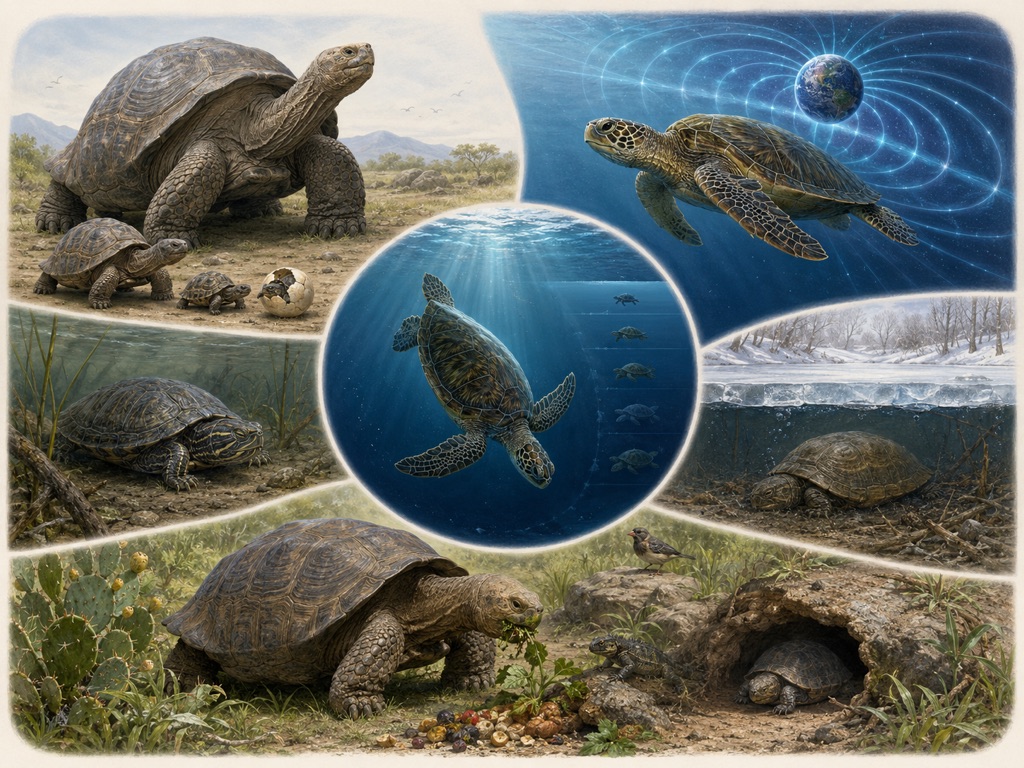
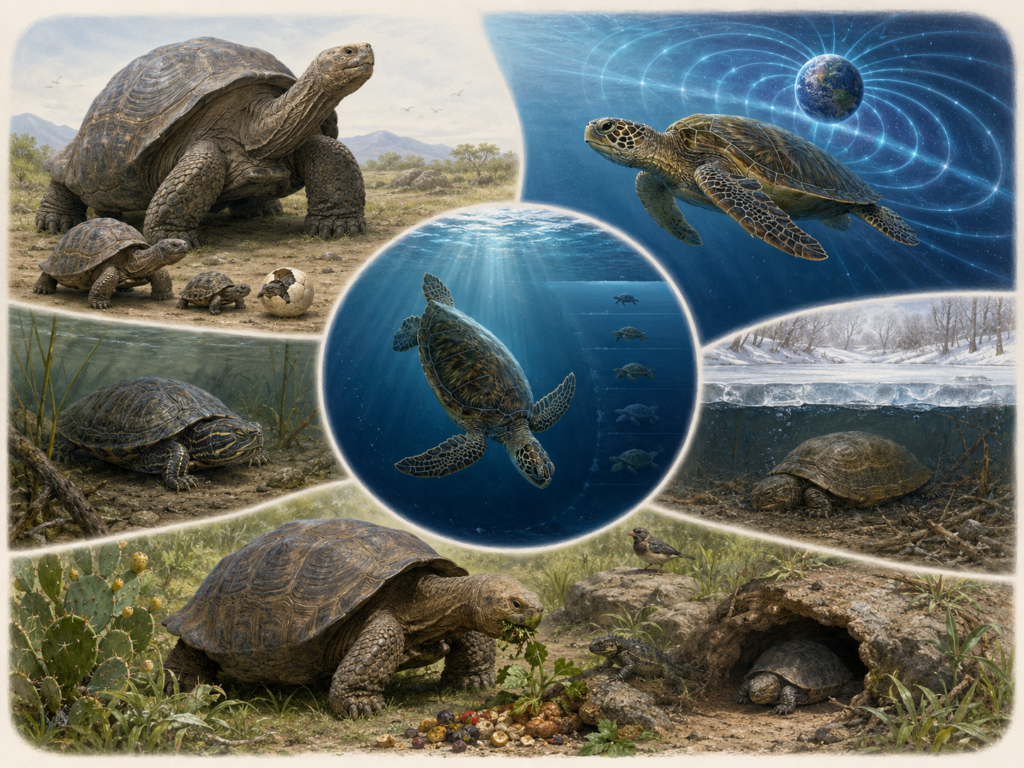
Schildkröten gehören zu den faszinierendsten Wirbeltieren der Erde. Neben ihrer langen Evolutionsgeschichte beeindrucken sie durch außergewöhnliche Fähigkeiten, extreme Anpassungen und bemerkenswerte Rekorde. Sie können sehr alt werden, enorme Strecken zurücklegen, tief tauchen, unter Eis überwintern, sich am Magnetfeld der Erde orientieren und in ihren Lebensräumen eine ökologische Schlüsselrolle einnehmen.
Viele dieser Eigenschaften wirken auf den ersten Blick unspektakulär, weil Schildkröten oft mit Langsamkeit verbunden werden. Tatsächlich stehen hinter ihrer Lebensweise jedoch hochspezialisierte Anpassungen, die sich über Millionen von Jahren entwickelt haben.
Langlebigkeit als Erfolgsmodell
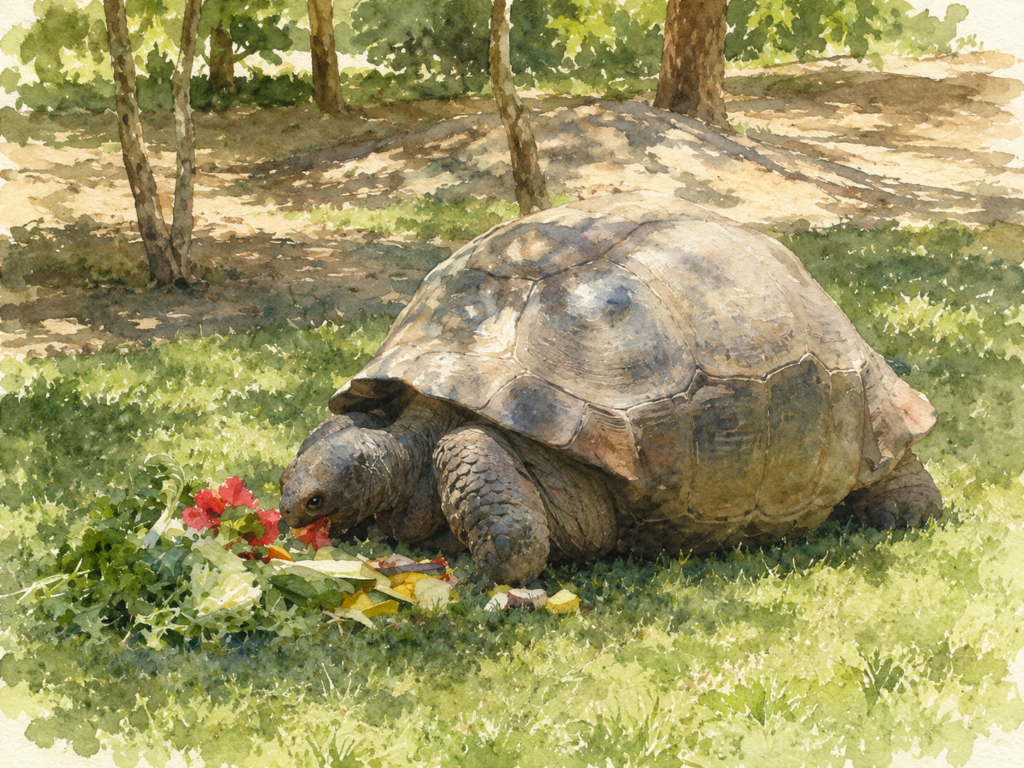
Schildkröten gehören zu den langlebigsten Wirbeltieren der Erde. Viele Arten erreichen problemlos mehrere Jahrzehnte, große Landschildkröten sogar mehr als 100 Jahre. Ursache dafür sind vermutlich mehrere Faktoren, die zusammenwirken: ein langsamer Stoffwechsel, ein vergleichsweise geringes Wachstum im Alter, eine hohe Widerstandsfähigkeit gegenüber oxidativem Stress sowie besondere Mechanismen der Zellreparatur und Stressresistenz.
Besonders Riesenschildkröten der Galápagos- und Seychelleninseln sind für ihre extreme Lebensdauer bekannt. Sie wachsen langsam, erreichen die Geschlechtsreife oft erst nach Jahrzehnten und können selbst im hohen Alter noch fortpflanzungsaktiv sein. Diese Lebensstrategie ist erfolgreich, solange stabile Lebensräume vorhanden sind und erwachsene Tiere eine hohe Überlebenswahrscheinlichkeit haben.
Genau hier liegt jedoch auch ihre Schwäche. Werden adulte Tiere durch Lebensraumverlust, Straßenverkehr, Beifang, invasive Arten, Umweltverschmutzung oder illegale Entnahme dezimiert, können Populationen solche Verluste nur sehr langsam ausgleichen.
Harriet und die widerlegte Darwin-Legende
Ein berühmtes Beispiel für die Langlebigkeit großer Landschildkröten war Harriet, eine Galápagos-Riesenschildkröte aus der Santa-Cruz-Form. Sie wird heute meist als 𝘊𝘩𝘦𝘭𝘰𝘯𝘰𝘪𝘥𝘪𝘴 𝘯𝘪𝘨𝘦𝘳 𝘱𝘰𝘳𝘵𝘦𝘳𝘪 geführt, in älterer Literatur auch als 𝘊𝘩𝘦𝘭𝘰𝘯𝘰𝘪𝘥𝘪𝘴 𝘯𝘪𝘨𝘳𝘢 𝘱𝘰𝘳𝘵𝘦𝘳𝘪. Harriet wurde etwa 1830 auf den Galápagos-Inseln geboren und starb am 23. Juni 2006 im Australia Zoo in Queensland. Mit rund 175 Jahren und etwa 180 Kilogramm Körpergewicht gehörte sie zu den ältesten bekannten Schildkröten der Welt.
Bis 1960 war Harriet unter dem Namen Harry bekannt, da man sie lange für ein Männchen hielt. Erst ein Zoodirektor aus Hawaii soll erkannt haben, dass es sich tatsächlich um ein Weibchen handelte. Besonders bekannt wurde Harriet durch die Erzählung, sie sei 1835 von Charles Darwin während der Reise der HMS Beagle auf den Galápagos-Inseln gesammelt und später nach England gebracht worden. Nach dieser Version soll sie 1841 in die Brisbane City Botanic Gardens gekommen sein und dort bis zur Schließung des botanischen Gartens 1952 gelebt haben. Danach soll sie in ein Naturschutzgebiet an der Sunshine Coast gebracht worden sein, bevor sie schließlich in den Australia Zoo gelangte.
Diese Geschichte wurde seit den 1990er Jahren besonders vom Australia Zoo gepflegt. Sie ist populär, lässt sich wissenschaftlich jedoch nicht halten. Mitochondriale DNA-Analysen ordneten Harriet der Santa-Cruz-Form zu. Diese kommt ausschließlich auf Santa Cruz vor, einer Insel des Galápagos-Archipels, die Darwin nie betreten hat. Die Darwin-Legende ist damit sehr unwahrscheinlich. Bestätigt werden konnte hingegen ihr außergewöhnlich hohes Alter: Harriet muss nachweislich vor 1850 geschlüpft sein. Sie starb 2006 nach kurzer Krankheit an Herzversagen.
Jonathan, die Resident Tortoise auf St. Helena
Noch bekannter ist Jonathan, eine Seychellen-Riesenschildkröte auf der Insel St. Helena. Er wird häufig als 𝘈𝘭𝘥𝘢𝘣𝘳𝘢𝘤𝘩𝘦𝘭𝘺𝘴 𝘨𝘪𝘨𝘢𝘯𝘵𝘦𝘢 𝘩𝘰𝘭𝘰𝘭𝘪𝘴𝘴𝘢 geführt und gilt als das älteste bekannte lebende Landwirbeltier der Welt. Sein Schlupf wird auf etwa 1832 datiert. Damit ist er heute, im Jahr 2026, je nach Berechnung etwa 193 bis 194 Jahre alt.
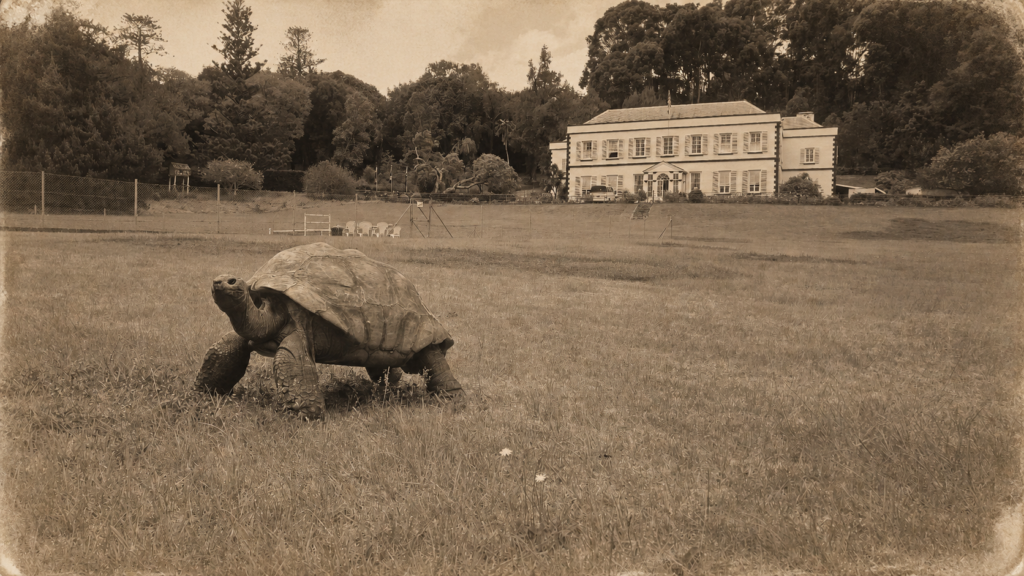
Jonathan kam 1882 von den Seychellen nach St. Helena. Er wurde dem damaligen Gouverneur Sir William Grey-Wilson geschenkt und war zu diesem Zeitpunkt bereits vollständig adult. Da Riesenschildkröten erst nach langer Entwicklungszeit ihre volle Größe erreichen, war Jonathan bei seiner Ankunft mindestens 50 Jahre alt. Sein tatsächliches Alter könnte daher sogar noch höher liegen.
Ein wichtiger Beleg für seine Altersangabe ist eine historische Fotografie aus dem Zeitraum 1882 bis 1886. Sie zeigt Jonathan bereits als ausgewachsenes Tier im Garten von Plantation House, der Residenz des Gouverneurs von St. Helena. Dort lebt er bis heute.
Obwohl Katarakte seine Sicht stark eingeschränkt haben und sein Geruchssinn nachgelassen hat, ist sein Appetit weiterhin gut. Jonathan wird regelmäßig von einem kleinen Team per Hand mit Obst und Gemüse gefüttert. Guinness World Records führt ihn als ältestes bekanntes lebendes Landtier und als ältestes dokumentierte Schildkröte überhaupt. Damit übertraf er den bisherigen Rekordhalter Tu’i Malila, eine madagassische Strahlenschildkröte, die mindestens 188 Jahre alt wurde.
Vernachlässigbare Seneszenz
Interessanterweise zeigen viele Schildkröten im Alter vergleichsweise geringe Alterserscheinungen. Wissenschaftliche Untersuchungen deuten darauf hin, dass zahlreiche Arten eine sogenannte vernachlässigbare Seneszenz besitzen. Damit ist gemeint, dass die altersbedingte Verschlechterung von Körperfunktionen deutlich langsamer verläuft als bei vielen anderen Tiergruppen.
Studien an Riesenschildkröten und anderen langlebigen Schildkrötenarten zeigen außerdem:
- sehr niedrige Stoffwechselraten
- hohe Widerstandsfähigkeit gegen oxidativen Stress
- langsame Zellalterung
- effiziente DNA-Reparaturmechanismen
- lange reproduktive Aktivität bis ins hohe Alter
Trotz ihrer potenziell enormen Lebensdauer erreichen viele Schildkröten in freier Wildbahn dieses Alter heute nicht mehr. Lebensraumverlust, Straßenverkehr, invasive Arten, Umweltverschmutzung und illegale Entnahme gefährden zahlreiche Populationen weltweit.
Giganten der Meere
Die Lederschildkröte 𝘋𝘦𝘳𝘮𝘰𝘤𝘩𝘦𝘭𝘺𝘴 𝘤𝘰𝘳𝘪𝘢𝘤𝘦𝘢 ist die größte heute lebende Schildkrötenart der Erde. Einzelne Tiere können eine Panzerlänge von über zwei Metern erreichen und mehr als 600 Kilogramm wiegen. Historische Messungen besonders großer Exemplare liegen sogar noch darüber.
Im Gegensatz zu anderen Meeresschildkröten besitzt die Lederschildkröte keinen harten Hornpanzer. Stattdessen besteht ihr Rückenpanzer aus einer lederartigen, elastischen Haut mit eingelagerten Knochenplatten. Diese besondere Konstruktion macht den Körper leichter und hydrodynamischer und gilt als wichtige Anpassung an das Leben im offenen Ozean.
Die Art zählt außerdem zu den außergewöhnlichsten Tauchern unter den Reptilien. Lederschildkröten können Tiefen von über 1000 Metern erreichen und dabei lange Zeit unter Wasser bleiben. Möglich wird dies durch hohe Sauerstoffspeicher im Blut und in der Muskulatur sowie durch einen stark reduzierten Stoffwechsel während tiefer Tauchgänge.
Ihre Hauptnahrung besteht aus Quallen und anderen gelatinösen Meerestieren. Gerade diese Spezialisierung macht sie jedoch besonders anfällig für Plastikmüll im Meer, da treibende Plastiktüten leicht mit Quallen verwechselt werden können.
Trotz ihrer Größe gilt 𝘋𝘦𝘳𝘮𝘰𝘤𝘩𝘦𝘭𝘺𝘴 𝘤𝘰𝘳𝘪𝘢𝘤𝘦𝘢 heute weltweit als stark gefährdet. Bedrohungen sind unter anderem:
- Plastikverschmutzung
- Beifang in der Fischerei
- Verlust geeigneter Niststrände
- Klimawandel und steigende Sandtemperaturen
- Kollisionen mit Schiffen
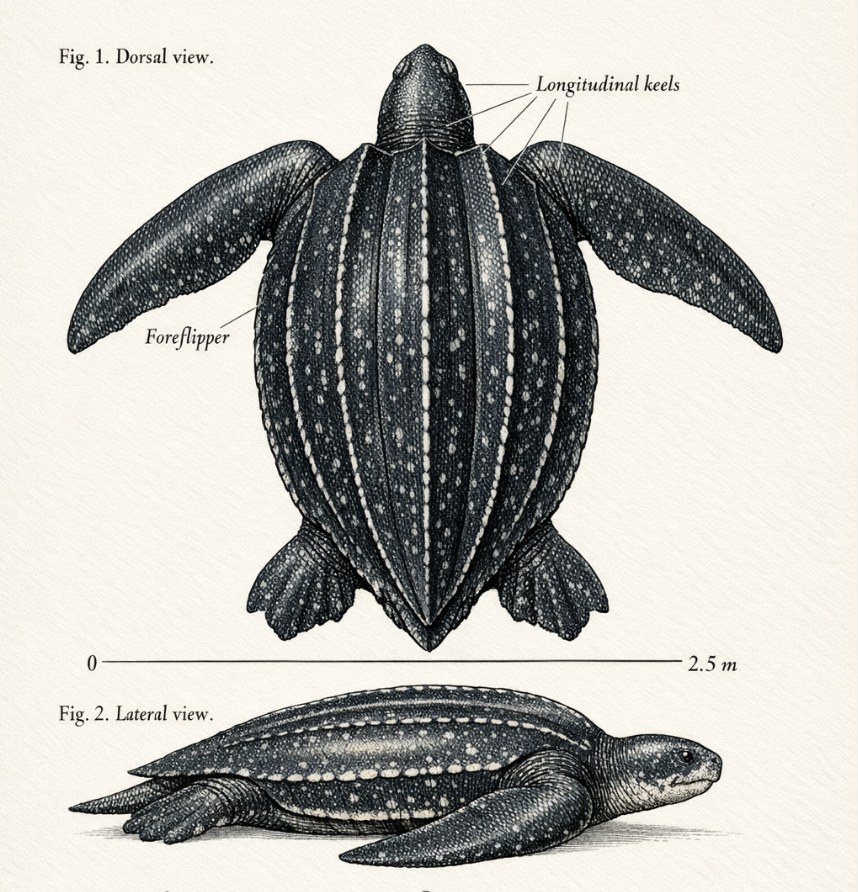
Gigantothermie bei Lederschildkröten
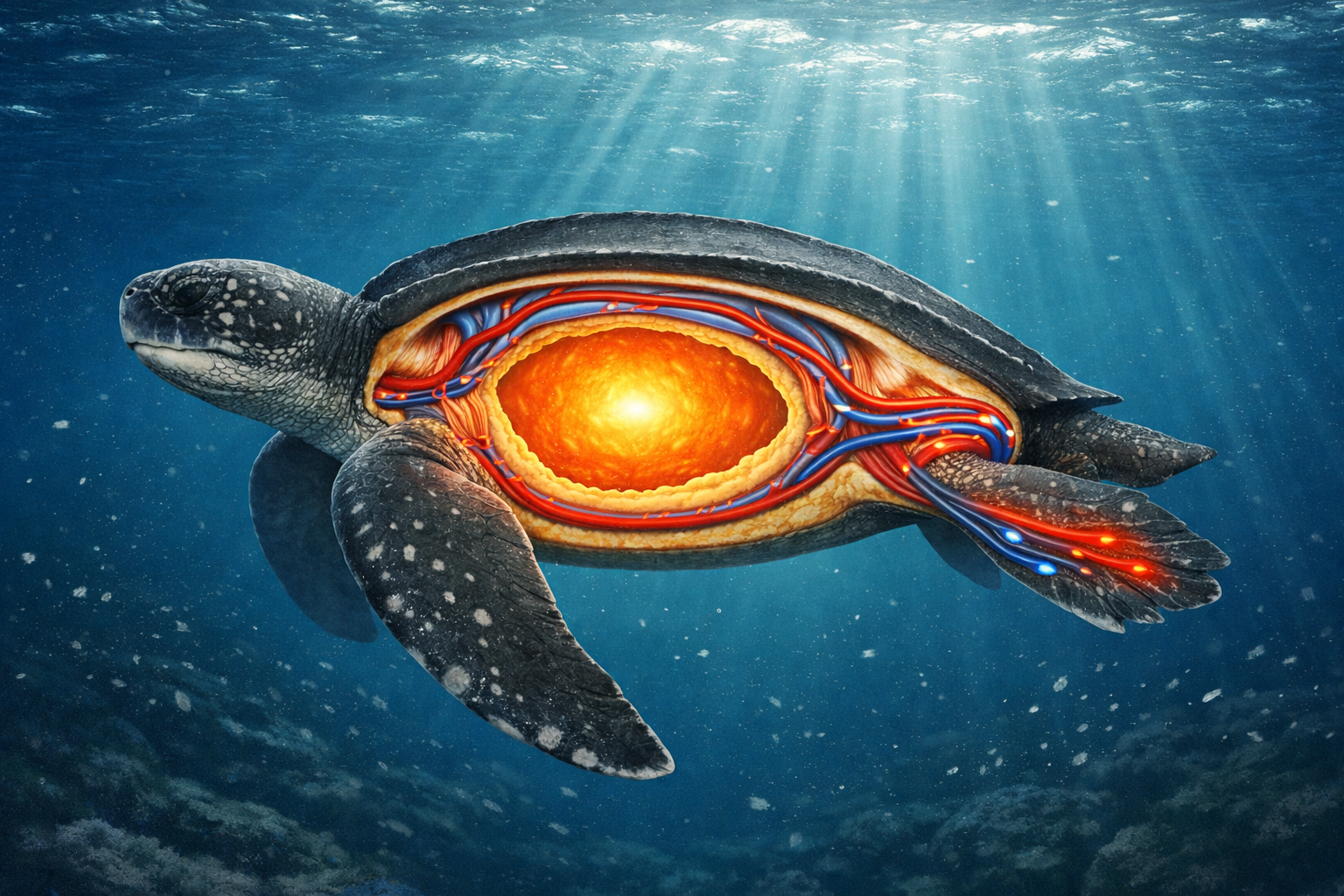
Lederschildkröten (𝘋𝘦𝘳𝘮𝘰𝘤𝘩𝘦𝘭𝘺𝘴 𝘤𝘰𝘳𝘪𝘢𝘤𝘦𝘢) sind trotz ihrer Zugehörigkeit zu den ektothermen Reptilien in der Lage, ihre Körpertemperatur aktiv zu stabilisieren und auch kalte Gewässer zu besiedeln.
Dies gelingt durch Gigantothermie, eine isolierende Fettschicht, gezielte Durchblutungsregulation und Muskelaktivität, wodurch sie ihre Körpertemperatur deutlich über der Umgebung halten können.
Diese besondere Thermoregulation erweitert ihr Verbreitungsgebiet erheblich, macht sie aber gleichzeitig anfällig für anthropogene Gefährdungen wie Beifang und Umweltverschmutzung. Hier kann man mehr über Gigantothermie erfahren.
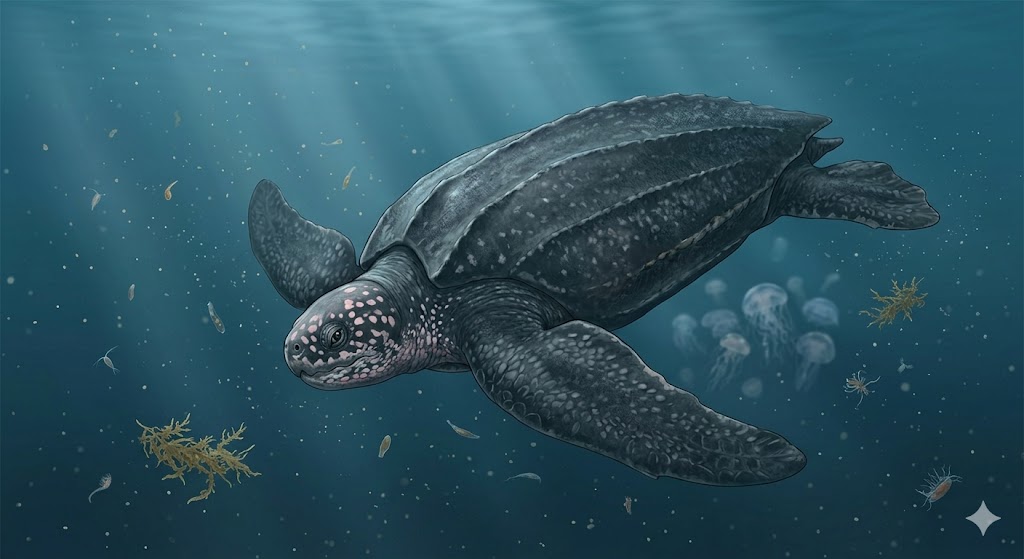
Extreme Anpassungen
Schildkröten zeigen eine bemerkenswerte Vielfalt physiologischer und reproduktiver Anpassungen. Besonders aquatische Arten verfügen über Strategien, die ihnen lange Tauchgänge oder sogar eine Fortpflanzung unter extremen Umweltbedingungen ermöglichen.
Die Grüne Meeresschildkröte 𝘊𝘩𝘦𝘭𝘰𝘯𝘪𝘢 𝘮𝘺𝘥𝘢𝘴 kann während längerer Tauchgänge ihre Herzfrequenz deutlich reduzieren. Diese sogenannte Bradykardie senkt den Sauerstoffverbrauch und erlaubt es den Tieren, über längere Zeit unter Wasser zu bleiben. Studien zeigen, dass Herzfrequenz und Stoffwechsel während des Tauchens stark abgesenkt werden können.
Eine besonders außergewöhnliche Fortpflanzungsstrategie besitzt die australische Schlangenhalsschildkröte 𝘊𝘩𝘦𝘭𝘰𝘥𝘪𝘯𝘢 𝘳𝘶𝘨𝘰𝘴𝘢. Sie legt ihre Eier in überfluteten oder wassergesättigten Böden ab. Die Embryonalentwicklung bleibt dabei zunächst vollständig arretiert. Erst wenn das Wasser während der Trockenzeit zurückgeht und Sauerstoff in das Nest eindringen kann, beginnt die eigentliche Entwicklung der Embryonen. Dieses Phänomen gilt als eine der ungewöhnlichsten bekannten Fortpflanzungsstrategien innerhalb der Reptilien.
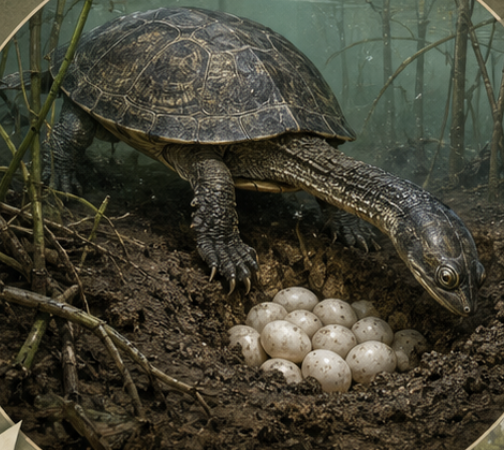
Die Fähigkeit zur Entwicklungsruhe scheint direkt mit Sauerstoffmangel im überfluteten Nest zusammenzuhängen. Untersuchungen zeigten, dass die Eier von 𝘊𝘩𝘦𝘭𝘰𝘥𝘪𝘯𝘢 𝘳𝘶𝘨𝘰𝘴𝘢 bis zu zwölf Wochen unter Wasser überleben können, ohne dass die Embryonen Schaden nehmen. Erst mit steigender Sauerstoffverfügbarkeit setzt die Entwicklung ein.
Erstaunliche Orientierung
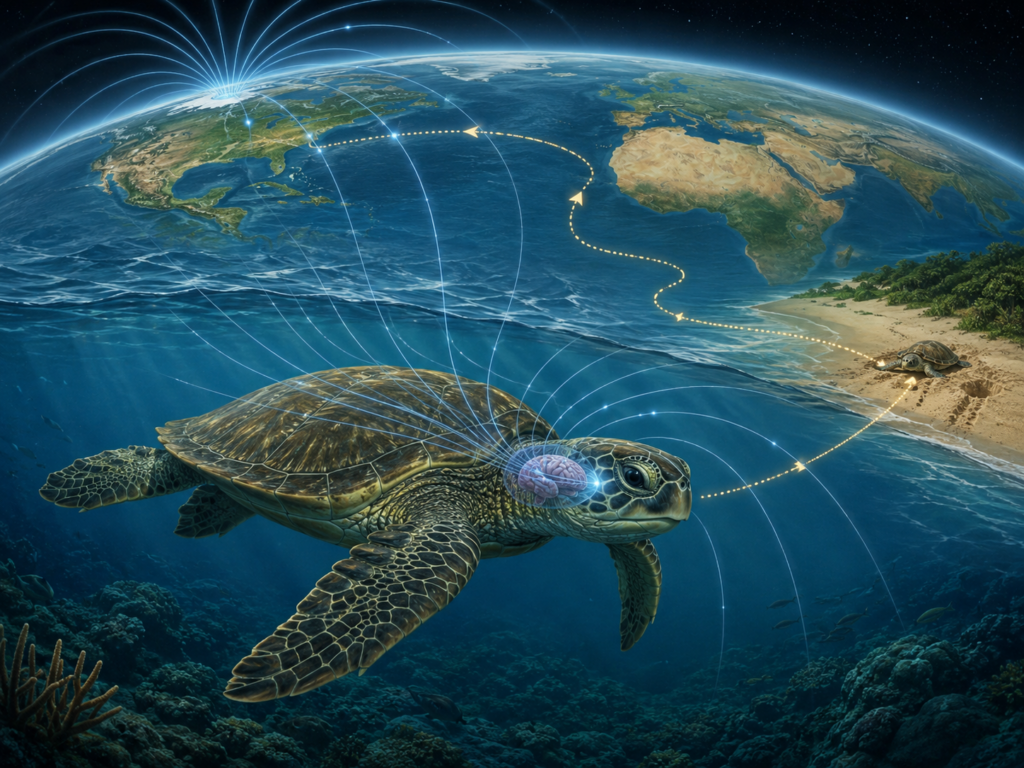
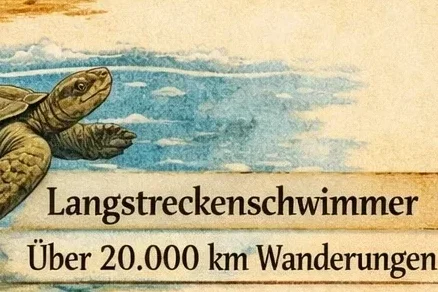
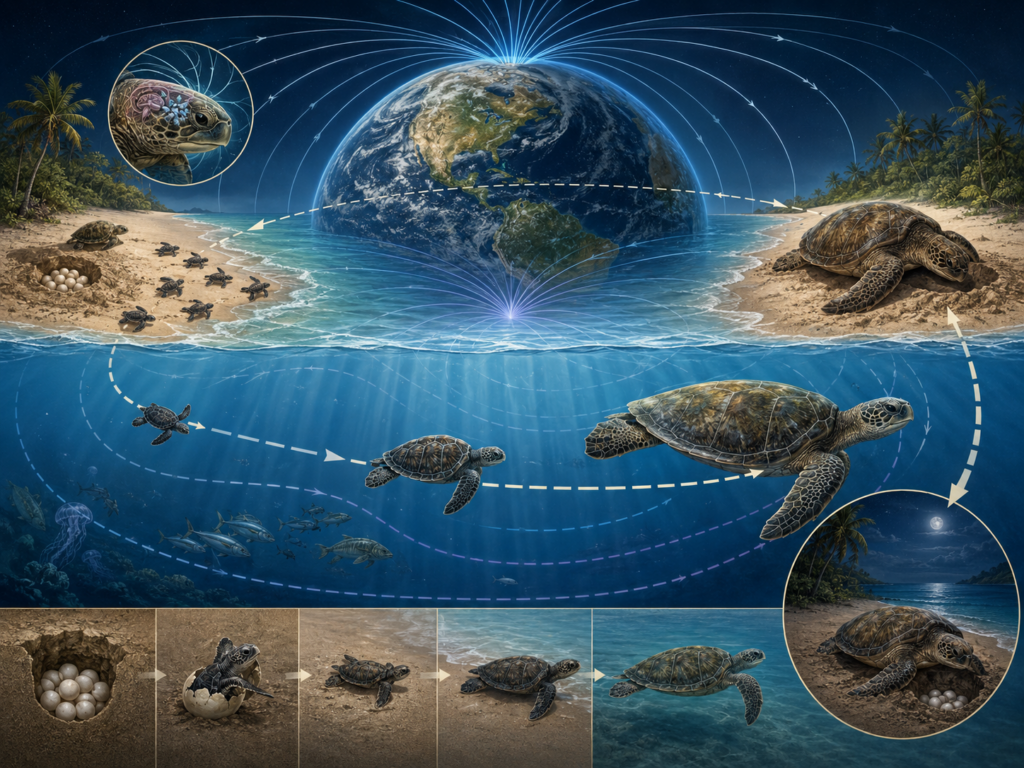
Viele Schildkröten verfügen über ein ausgeprägtes Orientierungsvermögen. Besonders Meeresschildkröten legen enorme Strecken zurück und kehren oft nach Jahren oder Jahrzehnten an den Strand zurück, an dem sie selbst geschlüpft sind. Diese Rückkehr an den Geburtsstrand wird als Natal Homing bezeichnet.
Ein wichtiger Bestandteil dieser Navigation ist das Magnetfeld der Erde. Meeresschildkröten können magnetische Informationen nutzen, um Position und Richtung zu bestimmen. Untersuchungen zeigen, dass sie nicht nur eine Art inneren Kompass besitzen, sondern auch eine Art magnetische Karte verwenden können. Aktuelle Forschung deutet zudem darauf hin, dass unterschiedliche magnetische Mechanismen für Kompass- und Karteninformationen verantwortlich sind.
Diese Fähigkeit gehört zu den beeindruckendsten Leistungen im Tierreich. Sie ermöglicht Wanderungen über Tausende Kilometer und verbindet weit entfernte Futtergebiete mit bestimmten Niststränden.
Langsame Entwicklung, große Wirkung
Einige Schildkrötenarten wachsen sehr langsam und erreichen erst nach Jahrzehnten die Geschlechtsreife. Diese Lebensweise wird häufig mit der sogenannten K-Strategie in Verbindung gebracht. Gemeint ist eine Strategie, bei der Langlebigkeit, wiederholte Fortpflanzung über viele Jahre und eine hohe Überlebenswahrscheinlichkeit erwachsener Tiere eine zentrale Rolle spielen.
Im Vergleich zu kurzlebigen Arten setzen Schildkröten also weniger auf schnelle Generationsfolge, sondern auf Beständigkeit. Diese Strategie ist an stabile Lebensräume angepasst. Sie macht Schildkröten aber besonders anfällig für Umweltveränderungen und menschliche Eingriffe.
Wenn erwachsene Tiere verloren gehen, fehlt häufig genau jener Teil der Population, der über viele Jahre hinweg zur Fortpflanzung beitragen würde. Deshalb haben Eingriffe in adulte Bestände bei vielen Schildkrötenarten besonders gravierende Folgen. Klassische Populationsmodelle für Meeresschildkröten zeigen, dass der Schutz älterer Jungtiere und adulter Tiere für den langfristigen Bestand entscheidend sein kann.
Schildkröten in Kultur und Geschichte
Schildkröten haben seit jeher eine besondere Bedeutung für den Menschen. Sie stehen häufig für Langlebigkeit, Beständigkeit und Weisheit. Nicht zuletzt, weil Schildkröten in vielen Kulturkreisen besondere mythologische Bedeutungen innehaben.
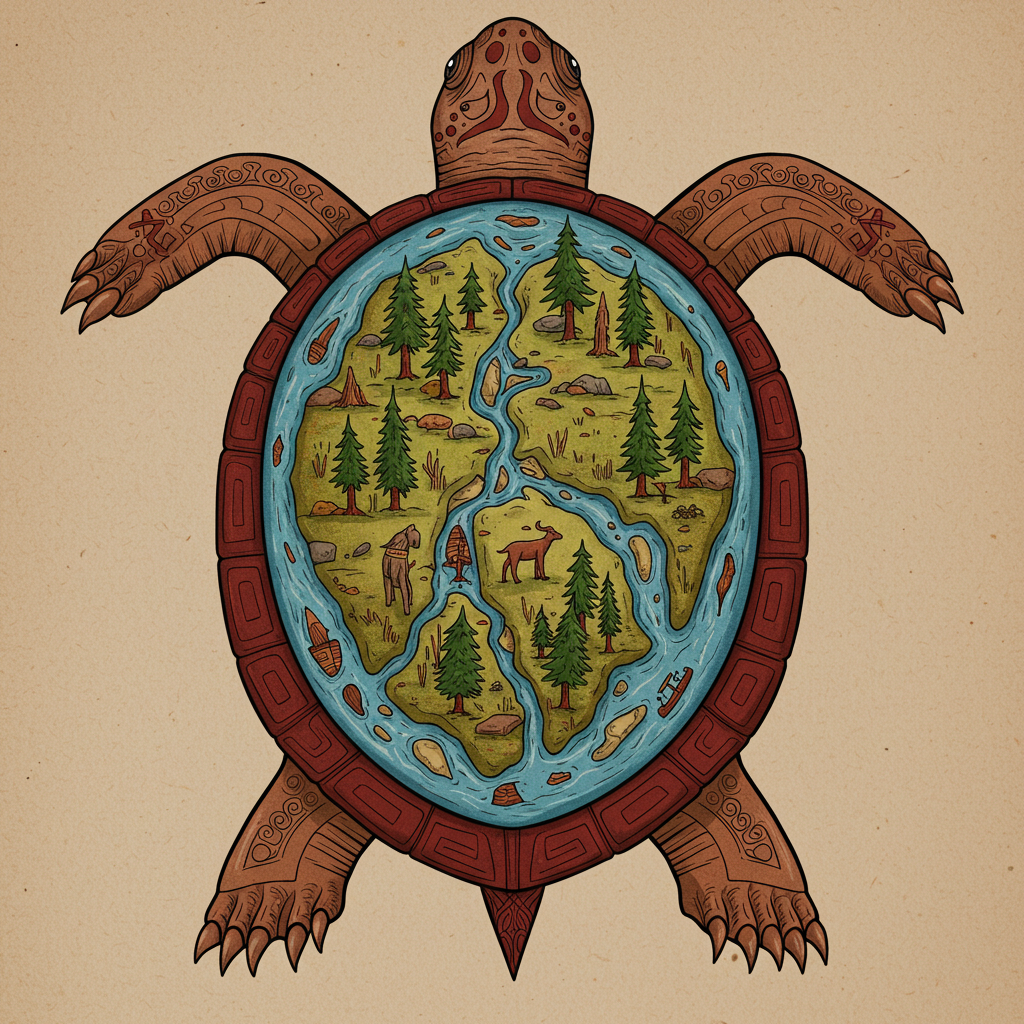
In der Mythologie vieler nordamerikanischer indigener Völker, insbesondere der Haudenosaunee (Irokesen) und Anishinabe (Ojibwe), bezeichnet Turtle Island (Schildkröteninsel) den Kontinent Nordamerika. Die Schildkröte gilt dabei als heiliges Symbol für das Universum, die Erde sowie für Weisheit, Schutz und Langlebigkeit.
Schildkröten Darstellungen begleiten den Menschen seit jeher, wie man in den kulturellen Schildkröten-Exkursionen mit Elke Wallrapp sehen kann.
Einzigartige Überlebenskünstler
Die Kombination aus außergewöhnlicher Lebensdauer, spezialisierten Anpassungen und bemerkenswertem Verhalten macht Schildkröten zu einer der faszinierendsten Tiergruppen überhaupt. Trotz ihrer scheinbaren Langsamkeit haben sie sich über Millionen von Jahren erfolgreich behauptet.
Schildkröten sind jedoch nicht nur passive Überlebenskünstler. Viele Arten beeinflussen ihre Lebensräume aktiv. Sie verbreiten Samen, halten Vegetation offen, schaffen Bauten, strukturieren Landschaften und verändern Nährstoffkreisläufe. In vielen Ökosystemen können Schildkröten deshalb als Schlüsselarten, sogenannte Keystone Species, wirken.
Schildkröten als Keystone Species
Schildkröten sind weit mehr als passive Überlebenskünstler der Evolution; sie fungieren in ihren Habitaten als unverzichtbare Schlüsselarten (Keystone Species). Durch ihr Verhalten und ihre Biologie beeinflussen sie die Stabilität und Biodiversität ihrer Ökosysteme maßgeblich.
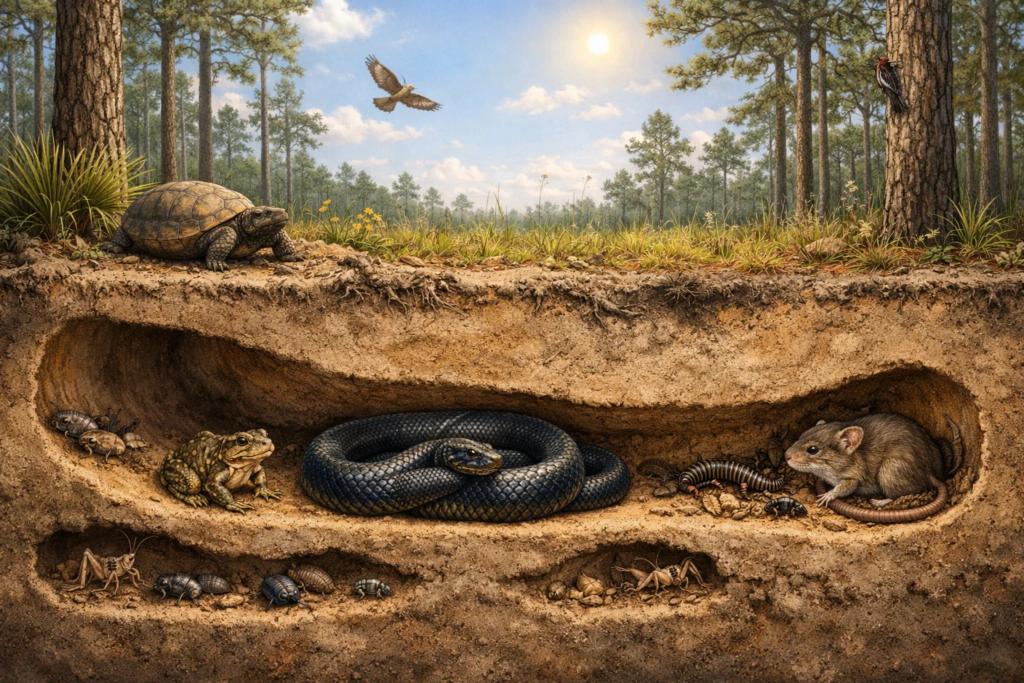
Gopherschildkröten (Gopherus polyphemus) gelten beispielsweise aufgrund ihrer ausgeprägten Grabtätigkeit als Schlüsselart. Ihre Baue bieten hunderten anderer Tierarten, sogenannten Kommensalen, Schutz und Lebensraum.
Kloakenatmung
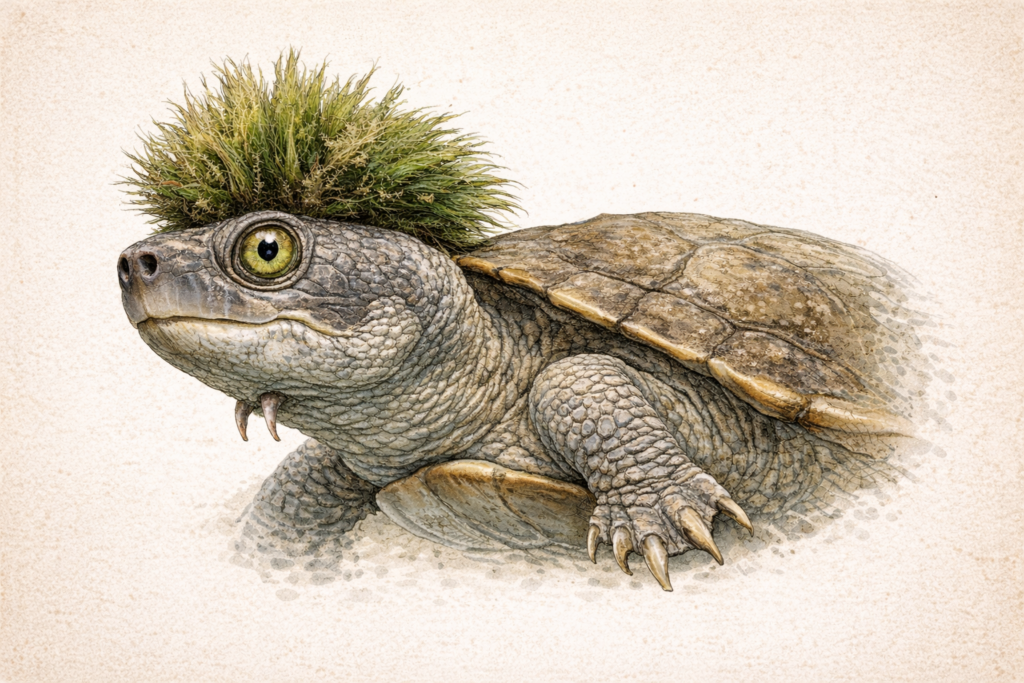
Einige Wasserschildkröten besitzen paarige, sackartige Ausstülpungen in der Kloake – sogenannte Kloakenbursen –, die mit winzigen, stark durchbluteten Papillen ausgekleidet sind. Indem die Tiere rhythmisch Wasser einpumpen und wieder ausstoßen, diffundiert der darin gelöste Sauerstoff direkt ins Blut. Das Prinzip ähnelt dem von Kiemen auf verblüffende Weise – nur eben am anderen Ende des Tieres. Gleichzeitig wird dabei auch Kohlendioxid abgegeben, sodass es sich um echten, bidirektionalen Gasaustausch handelt, nicht bloß um passive Diffusion.
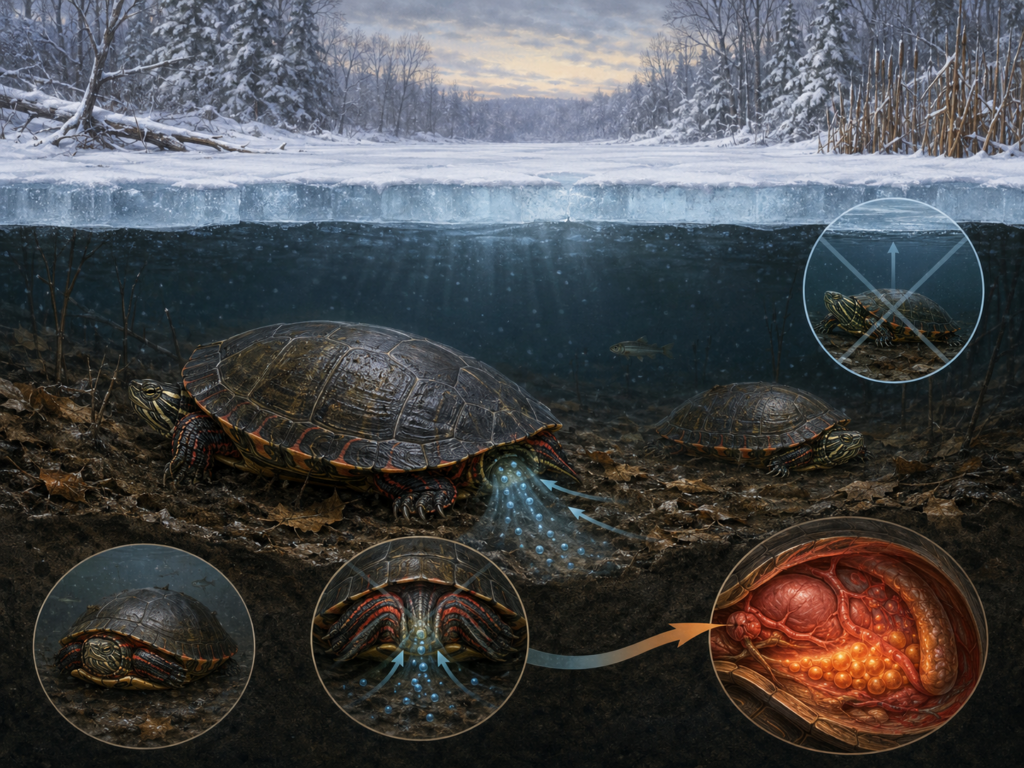
Diese ungewöhnliche Fähigkeit ermöglicht zwei sehr unterschiedliche Überlebensstrategien:
Überwintern unter dem Eis
Nordamerikanische Zierschildkröten (Chrysemys picta) verbringen den Winter reglos auf dem Gewässergrund – manchmal monatelang unter einer geschlossenen Eisdecke, wo kein Auftauchen zum Luftholen möglich wäre. In dieser extremen Kälte drosselt ihr Stoffwechsel so stark, dass der Sauerstoffbedarf auf ein absolutes Minimum sinkt. Die Kloakenatmung allein reicht dann aus, um sie am Leben zu erhalten. Reicht auch das nicht, können sie zusätzlich auf anaeroben Stoffwechsel umschalten – allerdings nur begrenzt, da dabei Milchsäure anfällt.
Dauertauchen im Fließgewässer
Australische Fitzroy-Schildkröten (Rheodytes leukops) verfolgen eine ganz andere Strategie. Sie leben in sauerstoffreichen, schnell fließenden Gewässern und pumpen das Wasser bis zu 60-mal pro Minute aktiv durch die Kloake. Ihre Kloakenbursen sind dafür besonders groß und reich vaskularisiert. So können sie tagelang unter Wasser bleiben, ohne auftauchen zu müssen – die Kloakenatmung ist hier kein Notbehelf, sondern ihre primäre Atemweise. Steigt der Sauerstoffgehalt des Wassers, sinkt die Pumpfrequenz entsprechend; das System reguliert sich also bedarfsgerecht.
Arten
Kloakenatmung ist vor allem bei aquatischen Süßwasserschildkröten verbreitet, jedoch nicht universell. Besonders ausgeprägt ist sie bei 𝘌𝘭𝘶𝘴𝘰𝘳 𝘮𝘢𝘤𝘳𝘶𝘳𝘶𝘴, die einen erheblichen Teil ihres Sauerstoffbedarfs über die Kloake decken kann.
Auch Arten wie 𝘊𝘩𝘦𝘭𝘺𝘥𝘳𝘢 𝘴𝘦𝘳𝘱𝘦𝘯𝘵𝘪𝘯𝘢 sowie Vertreter der 𝘛𝘳𝘪𝘰𝘯𝘺𝘤𝘩𝘪𝘥𝘢𝘦 nutzen Kloaken- und ergänzend Hautatmung.
Bei 𝘌𝘮𝘺𝘴 𝘰𝘳𝘣𝘪𝘤𝘶𝘭𝘢𝘳𝘪𝘴 spielt dieser Mechanismus ebenfalls eine Rolle während der Überwinterung, jedoch in geringerem Ausmaß.
Grundsätzlich gilt:
Je stärker eine Art an ein dauerhaft aquatisches Leben angepasst ist, desto ausgeprägter ist die Kloakenatmung.
Fazit
Schildkröten wirken auf den ersten Blick langsam und unscheinbar. Tatsächlich gehören sie zu den außergewöhnlichsten Wirbeltieren der Erde. Sie können extrem alt werden, tief tauchen, lange ohne Luft auskommen, sich am Magnetfeld orientieren, unter Eis überwintern und ganze Ökosysteme prägen.
Ihre besondere Lebensweise ist jedoch zugleich ihre Schwäche. Arten, die spät geschlechtsreif werden, lange leben und auf stabile Lebensräume angewiesen sind, können Verluste nur schwer ausgleichen. Der Schutz erwachsener Tiere, sicherer Lebensräume und intakter Fortpflanzungsgebiete ist deshalb entscheidend, wenn diese uralte Tiergruppe auch in Zukunft bestehen soll.

Weiterführende Themen rund um alle Schildkrötenarten
Grundlagen im Artikel „Schildkröten – Evolution und Vielfalt“
Anatomie im Artikel „Der Körperbau der Schildkröten“
Gefährdung im Artikel „Taxonomie und Bedrohung“
Ernährung im Artikel „Ernährung und Verhalten“
Artenschutz-Instrumente im Artikel „Die Wächter der Vielfalt„
Schildkröten als „Schlüsselarten“
Lederschildkröten und „Gigantothermie“
Quellen
Australia Zoo: Harriet. Biographische Angaben zu Harriet und ihrem Tod im Australia Zoo.
Bjorndal, K. A. (1980): Nutrient cycling by resident sea turtles in seagrass ecosystems. Bulletin of Marine Science, 30(2), 470–477.
Bjorndal, K. A. et al. (2020): Slowing of productivity in green turtles. Marine Ecology Progress Series, 656, 145–158.
Brothers, J. R. und Lohmann, K. J. (2015): Evidence for geomagnetic imprinting and natal homing in sea turtles. Current Biology, 25(3), 392–396.
Cayot, L. J. (1987): Ecology of Giant Tortoises in the Galápagos Islands.
Crouse, C. R. et al. (1987): A stage-based population model for loggerhead sea turtles and implications for conservation. Ecology, 68(5), 1412–1423.
da Silva, J. et al. (2022): Slow and negligible senescence among testudines. Science, 376(6596), 1466–1470.
Donlan, J. et al. (2013): Rewilding turtles. Megafaunal tortoises as keystone species in ecosystem restoration. Biological Conservation, 165, 203–212.
Eckert, K. L., Bjorndal, K. A., Abreu-Grobois, F. A. und Donnelly, M. (2000): Research and Management Techniques for the Conservation of Sea Turtles.
Gatten, R. E. (2011): Reptilian physiology. Adaptations to the environment. In: Gans, C. und Pough, F. H. (Hrsg.): Biology of the Reptilia, Band 13. Academic Press.
Gerlach, J. (2004): Giant Tortoises of the Indian Ocean.
Gibbs, J. P. et al. (2014): Giant Tortoises of the Galápagos.
Goforth, K. M. et al. (2025): Learned magnetic map cues and two mechanisms of magnetoreception in turtles. Nature, 638(8052), 1015–1022.
Guinness World Records: Oldest land animal living. Jonathan als ältestes lebendes Landtier, Stand 2026.
Guinness World Records: Jonathan the tortoise is not dead. Bestätigung, dass Jonathan 2026 weiterhin lebt.
Guinness World Records: World’s oldest living land animal, Jonathan, turns 191 years old. Angaben zu Geburtsjahr, Ankunft 1882, Seh- und Geruchseinschränkungen, Appetit und Plantation House.
Guinness World Records: 190-year-old Jonathan becomes world’s oldest tortoise ever. Angaben zum Rekord als ältestes Chelonier und zu Tu’i Malila.
Hays, G. C. et al. (2004): Deep diving by leatherback turtles. Nature, 429, 522.
Heppell, S. S. (1998): Application of life-history theory and population model analysis to turtle conservation. Copeia, 1998(2), 367–375.
IUCN Marine Turtle Specialist Group: Red List Assessments. Globaler und regionaler Gefährdungsstatus von 𝘋𝘦𝘳𝘮𝘰𝘤𝘩𝘦𝘭𝘺𝘴 𝘤𝘰𝘳𝘪𝘢𝘤𝘦𝘢.
Joyce, W. G. (2015): The origin of turtles. A paleontological perspective. Journal of Experimental Zoology Part B, 324(3), 181–193.
Kennett, R., Christian, K. und Pritchard, D. (1993): Underwater nesting by the tropical freshwater turtle 𝘊𝘩𝘦𝘭𝘰𝘥𝘪𝘯𝘢 𝘳𝘶𝘨𝘰𝘴𝘢. Australian Journal of Zoology, 41, 47–52. DOI: 10.1071/ZO9930047.
Kennett, R., Georges, A. und Palmer-Allen, M. (1993): Early developmental arrest during immersion of eggs of a tropical freshwater turtle 𝘊𝘩𝘦𝘭𝘰𝘥𝘪𝘯𝘢 𝘳𝘶𝘨𝘰𝘴𝘢. Australian Journal of Zoology, 41, 37–45.
Lohmann, K. J., Lohmann, C. M. F. und Endres, C. S. (2013): The navigation and oceanography of sea turtles. In: Wyneken, J., Lohmann, K. J. und Musick, J. A. (Hrsg.): The Biology of Sea Turtles, Band 3. CRC Press, 251–277.
Myers, A. E. et al. (2007): A novel technique for measuring heart rate in a free-ranging marine turtle.
Okuyama, J. et al. (2020): Heart rate and cardiac response to exercise during voluntary dives in green sea turtles. Proceedings of the Royal Society B.
Powell, J. und Caccone, A. (2006): Giant tortoises. Current Biology, 16(12), R498–R501.
Priest, C. E. und Franklin, C. E. (2002): Quantitative contribution of the cloacal bursae in 𝘙𝘩𝘦𝘰𝘥𝘺𝘵𝘦𝘴 𝘭𝘦𝘶𝘬𝘰𝘱𝘴. Journal of Experimental Biology, 205(24), 3951–3958.
Pritchard, P. C. H. (1979): Encyclopedia of Turtles.
Putman, N. F. et al. (2011): Longitude perception and bicoordinate magnetic maps in sea turtles. Current Biology, 21(6), 463–466.
Schaffer, J. et al. (2011): The importance of the cloacal bursae as the primary site of aquatic respiration in the freshwater turtle 𝘌𝘭𝘴𝘦𝘺𝘢 𝘢𝘭𝘣𝘢𝘨𝘶𝘭𝘢. Marine and Freshwater Research, 62(12), 1373–1378.
Spotila, J. R. (2004): Sea Turtles. A Complete Guide to Their Biology, Behavior, and Conservation.
St Helena Government: Coins and Stamps. Angaben zu Jonathan und den Schildkröten auf dem Gelände von Plantation House.
The Associated Press (2026): World’s oldest known tortoise still very much alive despite rumor to the contrary. Aktuelle Bestätigung zu Jonathan, St. Helena und dem 2026 verbreiteten Todesgerücht.
Wallace, B. P. und Jones, T. T. (2008): What makes marine turtles go. A review of metabolic rates and their consequences. Journal of Experimental Marine Biology and Ecology.
Wüthrich, F. (2006): Die Geschichte der Galápagos-Riesenschildkröte Harriet. Testudo, 15(4).
Wikipedia: Harriet. Zusammenfassung zur Darwin-Legende, DNA-Zuordnung zu Santa Cruz, Alter und Tod.
Remarkable facts about turtles and tortoises
Turtles and tortoises are among the most fascinating vertebrates on Earth. In addition to their long evolutionary history, they are remarkable for their extraordinary abilities, extreme adaptations and impressive records. They can reach a very great age, travel enormous distances, dive to considerable depths, overwinter beneath ice, orient themselves by the Earth’s magnetic field and play a key ecological role in their habitats.
At first glance, many of these traits may seem rather unremarkable, as turtles and tortoises are often associated with slowness. In reality, however, their way of life is based on highly specialised adaptations that have evolved over millions of years.
Longevity as a successful strategy
Turtles and tortoises are among the longest-lived vertebrates on Earth. Many species easily reach several decades of age, while large tortoises can live for more than 100 years. This is probably due to several interacting factors: a slow metabolism, comparatively limited growth in old age, a high resistance to oxidative stress, and specialised mechanisms of cell repair and stress resistance.
Giant tortoises from the Galápagos and Seychelles islands are particularly well known for their extreme longevity. They grow slowly, often do not reach sexual maturity until several decades of age, and may remain reproductively active even in old age. This life-history strategy is successful as long as stable habitats are available and adult animals have a high probability of survival.
Yet this is precisely where their weakness lies. If adult animals are reduced by habitat loss, road traffic, bycatch, invasive species, environmental pollution or illegal collection, populations can only compensate for such losses very slowly.
Harriet and the Disproved Darwin Legend
A famous example of the longevity of large tortoises was Harriet, a Galápagos giant tortoise from the Santa Cruz form. Today she is usually assigned to 𝘊𝘩𝘦𝘭𝘰𝘯𝘰𝘪𝘥𝘪𝘴 𝘱𝘰𝘳𝘵𝘦𝘳𝘪, although older literature also refers to her as 𝘊𝘩𝘦𝘭𝘰𝘯𝘰𝘪𝘥𝘪𝘴 𝘯𝘪𝘨𝘳𝘢 𝘱𝘰𝘳𝘵𝘦𝘳𝘪. Harriet was born on the Galápagos Islands in about 1830 and died on 23 June 2006 at Australia Zoo in Queensland. At around 175 years old and with a body weight of about 180 kilogrammes, she was one of the oldest known tortoises in the world.
Until 1960, Harriet was known as Harry, as she had long been thought to be male. It was reportedly a zoo director from Hawaii who recognised that she was in fact female. Harriet became particularly famous through the story that she had been collected by Charles Darwin on the Galápagos Islands in 1835 during the voyage of HMS Beagle and later taken to England.
According to this version, she was said to have arrived at Brisbane City Botanic Gardens in 1841 and to have lived there until the botanical garden closed in 1952. She was then supposedly taken to a sanctuary on the Sunshine Coast before eventually arriving at Australia Zoo.
This story was promoted particularly by Australia Zoo from the 1990s onwards. It is popular, but it cannot be upheld scientifically. Mitochondrial DNA analyses assigned Harriet to the Santa Cruz form. This occurs only on Santa Cruz, an island in the Galápagos archipelago that Darwin never visited. The Darwin legend is therefore highly unlikely. Her exceptional age, however, could be confirmed: Harriet must demonstrably have hatched before 1850.
She died in 2006 after a short illness from heart failure.
Jonathan, the Resident Tortoise on St Helena
Even better known is Jonathan, a Seychelles giant tortoise on the island of St Helena. He is often listed as 𝘈𝘭𝘥𝘢𝘣𝘳𝘢𝘤𝘩𝘦𝘭𝘺𝘴 𝘨𝘪𝘨𝘢𝘯𝘵𝘦𝘢 𝘩𝘰𝘭𝘰𝘭𝘪𝘴𝘴𝘢 and is regarded as the world’s oldest known living land vertebrate. His hatching is dated to around 1832. This means that today, in 2026, he is around 193 to 194 years old, depending on the calculation.
Jonathan arrived on St Helena from the Seychelles in 1882. He was given to the then Governor, Sir William Grey-Wilson, and was already fully adult at the time. Since giant tortoises only reach their full size after a long period of development, Jonathan must have been at least 50 years old when he arrived. His actual age may therefore be even higher.
An important piece of evidence for his estimated age is a historical photograph dating from between 1882 and 1886. It shows Jonathan already fully grown in the garden of Plantation House, the residence of the Governor of St Helena. He still lives there today.
Although cataracts have severely impaired his vision and his sense of smell has declined, his appetite remains good. Jonathan is regularly hand-fed fruit and vegetables by a small team. Guinness World Records lists him as the oldest known living land animal and as the oldest documented tortoise of all. He thereby surpassed the previous record holder, Tu’i Malila, a Madagascan radiated tortoise that reached at least 188 years of age.
Negligible Senescence
Interestingly, many turtles and tortoises show comparatively few signs of ageing in later life. Scientific studies indicate that numerous species exhibit what is known as negligible senescence. This means that the age-related deterioration of bodily functions occurs much more slowly than in many other groups of animals.
Studies of giant tortoises and other long-lived chelonian species also show:
- very low metabolic rates
- high resistance to oxidative stress
- slow cellular ageing
- efficient DNA repair mechanisms
- prolonged reproductive activity well into old age
Despite their potentially enormous lifespan, many turtles and tortoises in the wild no longer reach such ages today. Habitat loss, road traffic, invasive species, pollution and illegal collection threaten numerous populations worldwide.
Giants of the Seas
The leatherback turtle is the largest living turtle species on Earth. Individual animals can reach a carapace length of more than two metres and weigh over 600 kilogrammes. Historical measurements of particularly large specimens are even higher.
Unlike other sea turtles, the leatherback turtle does not have a hard horn-covered shell. Instead, its dorsal carapace consists of leathery, elastic skin with embedded bony plates. This special construction makes the body lighter and more hydrodynamic and is regarded as an important adaptation to life in the open ocean.
The species is also among the most extraordinary divers among reptiles. Leatherback turtles can reach depths of more than 1,000 metres and remain underwater for long periods. This is made possible by high oxygen stores in the blood and muscles, as well as by a strongly reduced metabolism during deep dives.
Their main diet consists of jellyfish and other gelatinous marine animals. Yet it is precisely this specialisation that makes them particularly vulnerable to plastic waste in the sea, as drifting plastic bags can easily be mistaken for jellyfish.
Despite its size, the species is now considered globally vulnerable. Threats include:
- plastic pollution
- bycatch in fisheries
- loss of suitable nesting beaches
- climate change and rising sand temperatures
- collisions with vessels
Gigantothermy in Leatherback Turtles
Leatherback turtles, 𝘋𝘦𝘳𝘮𝘰𝘤𝘩𝘦𝘭𝘺𝘴 𝘤𝘰𝘳𝘪𝘢𝘤𝘦𝘢, are able to actively stabilise their body temperature and inhabit cold waters despite being ectothermic reptiles.
They achieve this through gigantothermy, an insulating layer of fat, targeted regulation of blood flow and muscular activity, allowing them to maintain their body temperature well above that of the surrounding environment.
This special form of thermoregulation greatly expands their range, but at the same time makes them vulnerable to anthropogenic threats such as bycatch and pollution. More about gigantothermy can be found here.
Extreme Adaptations
Turtles and tortoises show a remarkable variety of physiological and reproductive adaptations. Aquatic species in particular possess strategies that allow them to make long dives or even reproduce under extreme environmental conditions.
The green sea turtle can greatly reduce its heart rate during prolonged dives. This so-called bradycardia lowers oxygen consumption and allows the animals to remain underwater for extended periods. Studies show that heart rate and metabolism can be strongly reduced during diving.
The Australian snake-necked turtle 𝘊𝘩𝘦𝘭𝘰𝘥𝘪𝘯𝘢 𝘳𝘶𝘨𝘰𝘴𝘢 has a particularly extraordinary reproductive strategy. It lays its eggs in flooded or waterlogged soils. Embryonic development initially remains completely arrested. Only when the water recedes during the dry season and oxygen can enter the nest does the actual development of the embryos begin. This phenomenon is considered one of the most unusual known reproductive strategies among reptiles.
The ability to pause development appears to be directly linked to oxygen deficiency in the flooded nest. Studies have shown that the eggs can survive underwater for up to twelve weeks without the embryos being harmed. Development begins only when oxygen availability increases.
Astonishing Orientation
Many turtles possess a highly developed sense of orientation. Sea turtles in particular cover enormous distances and often return after years or decades to the beach where they themselves hatched. This return to the natal beach is known as natal homing.
An important component of this navigation is the Earth’s magnetic field. Sea turtles can use magnetic information to determine both position and direction. Studies show that they possess not only a kind of internal compass, but also a kind of magnetic map. Current research also suggests that different magnetic mechanisms are responsible for compass and map information.
This ability is one of the most impressive achievements in the animal kingdom. It enables migrations over thousands of kilometres and links distant foraging grounds with specific nesting beaches.
Slow Development, Major Impact
Some turtle and tortoise species grow very slowly and do not reach sexual maturity until several decades of age. This way of life is often associated with what is known as a K-selected strategy. This refers to a strategy in which longevity, repeated reproduction over many years and a high probability of adult survival play a central role.
Compared with short-lived species, turtles and tortoises therefore rely less on rapid generation turnover and more on persistence. This strategy is adapted to stable habitats. However, it also makes turtles and tortoises particularly vulnerable to environmental change and human interference.
When adult animals are lost, the population often loses precisely those individuals that would have contributed to reproduction over many years. For this reason, impacts on adult populations have particularly serious consequences for many turtle and tortoise species. Classic population models for sea turtles show that the protection of older juveniles and adult animals can be crucial for long-term population survival.
Turtles and Tortoises in Culture and History
Turtles and tortoises have always held special meaning for humans. They often symbolise longevity, constancy and wisdom. This is due in no small part to the special mythological significance they hold in many cultures.
In the mythology of many North American Indigenous peoples, especially the Haudenosaunee, or Iroquois, and the Anishinaabe, or Ojibwe, Turtle Island refers to the continent of North America. The turtle is regarded as a sacred symbol of the universe, the Earth, wisdom, protection and longevity.
Representations of turtles and tortoises have accompanied humans throughout history, as can be seen in the cultural turtle excursions with Elke Wallrapp.
Unique Survivors
The combination of exceptional longevity, specialised adaptations and remarkable behaviour makes turtles and tortoises one of the most fascinating groups of animals of all. Despite their apparent slowness, they have successfully persisted for millions of years.
However, turtles and tortoises are not merely passive survivors. Many species actively influence their habitats. They disperse seeds, keep vegetation open, create burrows, structure landscapes and alter nutrient cycles. In many ecosystems, turtles and tortoises can therefore act as keystone species.
Turtles and Tortoises as Keystone Species
Turtles and tortoises are far more than passive survivors of evolution; in their habitats they function as indispensable keystone species. Through their behaviour and biology, they have a major influence on the stability and biodiversity of their ecosystems.
Gopher tortoises, 𝘎𝘰𝘱𝘩𝘦𝘳𝘶𝘴 𝘱𝘰𝘭𝘺𝘱𝘩𝘦𝘮𝘶𝘴, are regarded as a keystone species, for example, because of their extensive digging activity. Their burrows provide shelter and habitat for hundreds of other animal species, known as commensals. Read more about turtles as keystone species.
Cloacal Respiration
Some aquatic turtles possess paired, sac-like outgrowths in the cloaca, known as cloacal bursae, which are lined with tiny, highly vascularised papillae. By rhythmically pumping water in and out, the animals allow dissolved oxygen to diffuse directly into the blood. The principle is strikingly similar to that of gills, only at the other end of the animal.
At the same time, carbon dioxide is also released, meaning that this is genuine bidirectional gas exchange, not merely passive diffusion.
This unusual ability allows two very different survival strategies:
Overwintering Beneath the Ice
North American painted turtles, 𝘊𝘩𝘳𝘺𝘴𝘦𝘮𝘺𝘴 𝘱𝘪𝘤𝘵𝘢, spend the winter motionless on the bottom of bodies of water, sometimes for months beneath a closed layer of ice, where surfacing to breathe would be impossible. In this extreme cold, their metabolism slows so much that their oxygen requirement is reduced to an absolute minimum. Cloacal respiration alone is then sufficient to keep them alive.
If even that is not enough, they can additionally switch to anaerobic metabolism, although only to a limited extent, as lactic acid accumulates in the process.
Prolonged Diving in Flowing Water
Australian Fitzroy River turtles, 𝘙𝘩𝘦𝘰𝘥𝘺𝘵𝘦𝘴 𝘭𝘦𝘶𝘬𝘰𝘱𝘴, follow a very different strategy. They live in oxygen-rich, fast-flowing waters and actively pump water through the cloaca up to 60 times per minute. Their cloacal bursae are particularly large and richly vascularised. This allows them to remain underwater for days without needing to surface; in this case, cloacal respiration is not an emergency solution, but their primary mode of respiration.
As the oxygen content of the water increases, the pumping frequency decreases accordingly; the system therefore regulates itself according to demand.
Species
Cloacal respiration is found mainly in aquatic freshwater turtles, although it is not universal. It is particularly pronounced in the Fitzroy River turtle, 𝘙𝘩𝘦𝘰𝘥𝘺𝘵𝘦𝘴 𝘭𝘦𝘶𝘬𝘰𝘱𝘴, and the Mary River turtle, 𝘌𝘭𝘶𝘴𝘰𝘳 𝘮𝘢𝘤𝘳𝘶𝘳𝘶𝘴. Species such as the white-throated snapping turtle, 𝘌𝘭𝘴𝘦𝘺𝘢 𝘢𝘭𝘣𝘢𝘨𝘶𝘭𝘢, and representatives of related Australian freshwater turtle groups also use cloacal and supplementary cutaneous respiration. In the North American painted turtle, 𝘊𝘩𝘳𝘺𝘴𝘦𝘮𝘺𝘴 𝘱𝘪𝘤𝘵𝘢, this mechanism plays a role mainly during overwintering.
In the European pond turtle, 𝘌𝘮𝘺𝘴 𝘰𝘳𝘣𝘪𝘤𝘶𝘭𝘢𝘳𝘪𝘴, this mechanism also plays a role during overwintering, although to a lesser extent.
In principle:
The more strongly a species is adapted to a permanently aquatic life, the more pronounced cloacal respiration tends to be.
Conclusion
At first glance, turtles and tortoises may appear slow and unremarkable. In reality, they are among the most extraordinary vertebrates on Earth. They can live to extreme old age, dive to great depths, survive for long periods without air, orient themselves using the Earth’s magnetic field, overwinter beneath ice and shape entire ecosystems.
Yet their special way of life is also their weakness. Species that mature late, live for a long time and depend on stable habitats can only compensate for losses with great difficulty. The protection of adult animals, safe habitats and intact reproductive opportunitiescare therefore essential if this ancient group of animals is to persist into the future.
Sources
Australia Zoo: Harriet. Biographical information on Harriet and her death at Australia Zoo.
Bjorndal, K. A. (1980): Nutrient cycling by resident sea turtles in seagrass ecosystems. Bulletin of Marine Science, 30(2), 470–477.
Bjorndal, K. A. et al. (2020): Slowing of productivity in green turtles. Marine Ecology Progress Series, 656, 145–158.
Brothers, J. R. and Lohmann, K. J. (2015): Evidence for geomagnetic imprinting and natal homing in sea turtles. Current Biology, 25(3), 392–396.
Cayot, L. J. (1987): Ecology of Giant Tortoises in the Galápagos Islands.
Crouse, C. R. et al. (1987): A stage-based population model for loggerhead sea turtles and implications for conservation. Ecology, 68(5), 1412–1423.
da Silva, J. et al. (2022): Slow and negligible senescence among testudines. Science, 376(6596), 1466–1470.
Donlan, J. et al. (2013): Rewilding turtles. Megafaunal tortoises as keystone species in ecosystem restoration. Biological Conservation, 165, 203–212.
Eckert, K. L., Bjorndal, K. A., Abreu-Grobois, F. A. and Donnelly, M. (2000): Research and Management Techniques for the Conservation of Sea Turtles.
Gatten, R. E. (2011): Reptilian physiology. Adaptations to the environment. In: Gans, C. and Pough, F. H. (eds.): Biology of the Reptilia, Volume 13. Academic Press.
Gerlach, J. (2004): Giant Tortoises of the Indian Ocean.
Gibbs, J. P. et al. (2014): Giant Tortoises of the Galápagos.
Goforth, K. M. et al. (2025): Learned magnetic map cues and two mechanisms of magnetoreception in turtles. Nature, 638(8052), 1015–1022.
Guinness World Records: Oldest turtle/chelonian. Jonathan as the oldest documented chelonian, with age estimate, origin, Plantation House and historical photographic evidence.
Guinness World Records: Oldest land animal living. Jonathan as the oldest living land animal, status 2026.
Guinness World Records: Jonathan the tortoise is not dead. Confirmation that Jonathan was still alive in 2026.
Guinness World Records: World’s oldest living land animal, Jonathan, turns 191 years old. Information on year of birth, arrival in 1882, impaired vision and sense of smell, appetite and Plantation House.
Guinness World Records: 190-year-old Jonathan becomes world’s oldest tortoise ever. Information on the record as the oldest chelonian and on Tu’i Malila.
Hays, G. C. et al. (2004): Deep diving by leatherback turtles. Nature, 429, 522.
Heppell, S. S. (1998): Application of life-history theory and population model analysis to turtle conservation. Copeia, 1998(2), 367–375.
IUCN Marine Turtle Specialist Group: Red List Assessments. Global and regional threat status of 𝘋𝘦𝘳𝘮𝘰𝘤𝘩𝘦𝘭𝘺𝘴 𝘤𝘰𝘳𝘪𝘢𝘤𝘦𝘢.
Joyce, W. G. (2015): The origin of turtles. A paleontological perspective. Journal of Experimental Zoology Part B, 324(3), 181–193.
Kennett, R., Christian, K. and Pritchard, D. (1993): Underwater nesting by the tropical freshwater turtle 𝘊𝘩𝘦𝘭𝘰𝘥𝘪𝘯𝘢 𝘳𝘶𝘨𝘰𝘴𝘢. Australian Journal of Zoology, 41, 47–52. DOI: 10.1071/ZO9930047.
Kennett, R., Georges, A. and Palmer-Allen, M. (1993): Early developmental arrest during immersion of eggs of a tropical freshwater turtle 𝘊𝘩𝘦𝘭𝘰𝘥𝘪𝘯𝘢 𝘳𝘶𝘨𝘰𝘴𝘢. Australian Journal of Zoology, 41, 37–45.
Lohmann, K. J., Lohmann, C. M. F. and Endres, C. S. (2013): The navigation and oceanography of sea turtles. In: Wyneken, J., Lohmann, K. J. and Musick, J. A. (eds.): The Biology of Sea Turtles, Volume 3. CRC Press, 251–277.
Myers, A. E. et al. (2007): A novel technique for measuring heart rate in a free-ranging marine turtle.
Okuyama, J. et al. (2020): Heart rate and cardiac response to exercise during voluntary dives in green sea turtles. Proceedings of the Royal Society B.
Powell, J. and Caccone, A. (2006): Giant tortoises. Current Biology, 16(12), R498–R501.
Priest, C. E. and Franklin, C. E. (2002): Quantitative contribution of the cloacal bursae in 𝘙𝘩𝘦𝘰𝘥𝘺𝘵𝘦𝘴 𝘭𝘦𝘶𝘬𝘰𝘱𝘴. Journal of Experimental Biology, 205(24), 3951–3958.
Pritchard, P. C. H. (1979): Encyclopedia of Turtles.
Putman, N. F. et al. (2011): Longitude perception and bicoordinate magnetic maps in sea turtles. Current Biology, 21(6), 463–466.
Schaffer, J. et al. (2011): The importance of the cloacal bursae as the primary site of aquatic respiration in the freshwater turtle 𝘌𝘭𝘴𝘦𝘺𝘢 𝘢𝘭𝘣𝘢𝘨𝘶𝘭𝘢. Marine and Freshwater Research, 62(12), 1373–1378.
Spotila, J. R. (2004): Sea Turtles. A Complete Guide to Their Biology, Behavior, and Conservation.
St Helena Government: Coins and Stamps. Information on Jonathan and the tortoises on the grounds of Plantation House.
The Associated Press (2026): World’s oldest known tortoise still very much alive despite rumour to the contrary. Current confirmation regarding Jonathan, St Helena and the death rumour circulated in 2026.
Wallace, B. P. and Jones, T. T. (2008): What makes marine turtles go. A review of metabolic rates and their consequences. Journal of Experimental Marine Biology and Ecology.
Wüthrich, F. (2006): Die Geschichte der Galápagos-Riesenschildkröte Harriet. Testudo, 15(4).
Wikipedia: Harriet. Summary of the Darwin legend, DNA assignment to Santa Cruz, age and death.