Mallows are easy-care, popular food plants
Mallows (genus Malva) belong to the mallow family (Malvaceae) and are widespread across Eurasia and North Africa. With their soft leaves, striking flowers, and great adaptability, they are among the classic, tried-and-tested food plants in natural tortoise husbandry. Various mallow species also grow in the native ranges of European tortoises.
This mainly refers to species of the genus Malva, such as common mallow (Malva sylvestris), dwarf mallow (Malva neglecta), or musk mallow (Malva moschata). There are also other well-suited food plants in the mallow family, such as hollyhocks, marsh mallow, or hibiscus. Some garden forms, such as Mauritanian mallow or the variety ‘Zebrina’, can also be interesting food plants, provided they are unsprayed and reliably identified.
Mallows and related members of the mallow family combine several advantages: they provide suitable food, bring structure to the enclosure, flower for a long time, and are also valuable for wild bees, bumblebees, and other insects.
Why are mallows such good food plants?
Mallows provide textured, leafy, natural food. They fit very well into the varied diet recommended for European tortoises, with a wide range of wild plants, leaves, flowers, high-fibre plant parts, and food that is as lean as possible.
- well suited (when reliably identified)
- high in crude fibre
- contain mucilage
- easily digestible
- both fresh and dried (e.g. in herb hay)
Among their secondary plant compounds (in German), mallow leaves and flowers contain plant mucilage. This mucilage is known from herbal medicine and is traditionally valued for its soothing properties. For tortoises, however, this does not mean that mallows should be seen as a “medicinal plant” or a substitute for veterinary treatment. Rather, they are a well-suited, mild, and varied food plant as part of a natural diet.
What is particularly nice is that mallows not only serve as food but also bring structure to the enclosure. They grow upright, flower for a long time, and can provide cover and shade at times.
Which parts of the plant are eaten?
Leaves
Many tortoises readily eat the soft, rounded to palmately lobed leaves. Young leaves in particular are tender and easy to eat. Older leaves can be somewhat tougher, but provide more texture.
Flowers
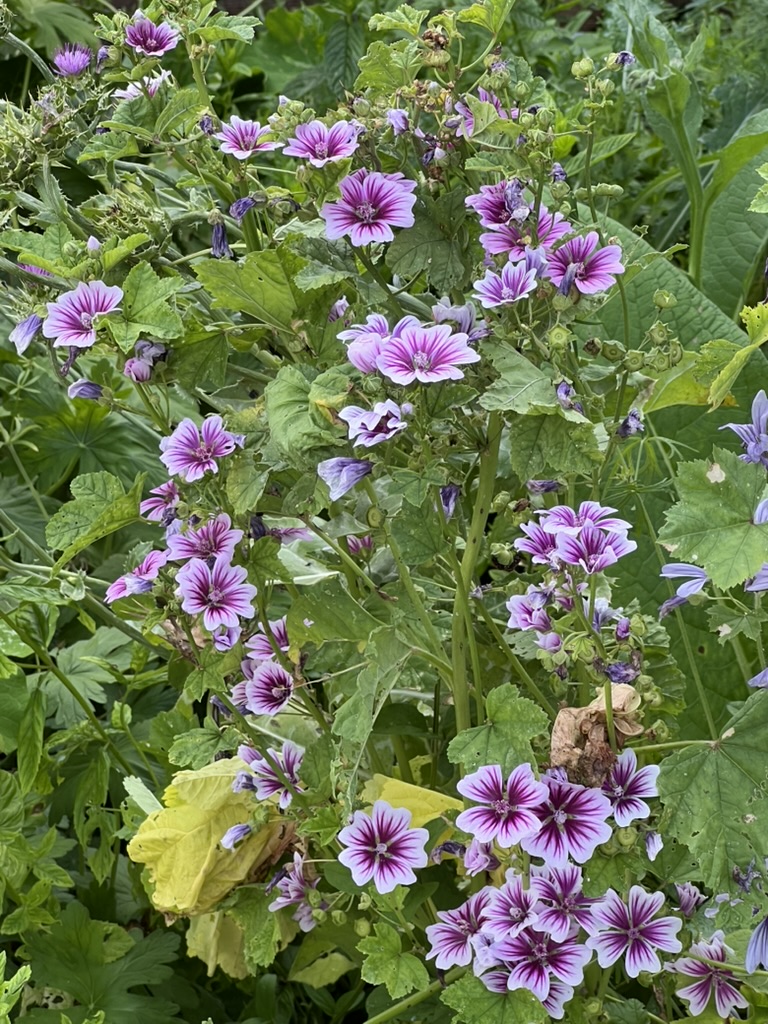
The pink, purple, whitish, or darkly veined flowers are a natural extra on the menu. Like all flowers, they should be offered as a supplement rather than as staple food, and only fed once they have finished flowering.
Young stems and shoots
Tender shoots and young stems are sometimes eaten too. Very tough, old, or heavily woody parts of the plant are of less interest.
Seed heads
Mallows form the typical small, round “cheese” fruits. The seed heads should not be fed deliberately.
How do you recognise mallows?
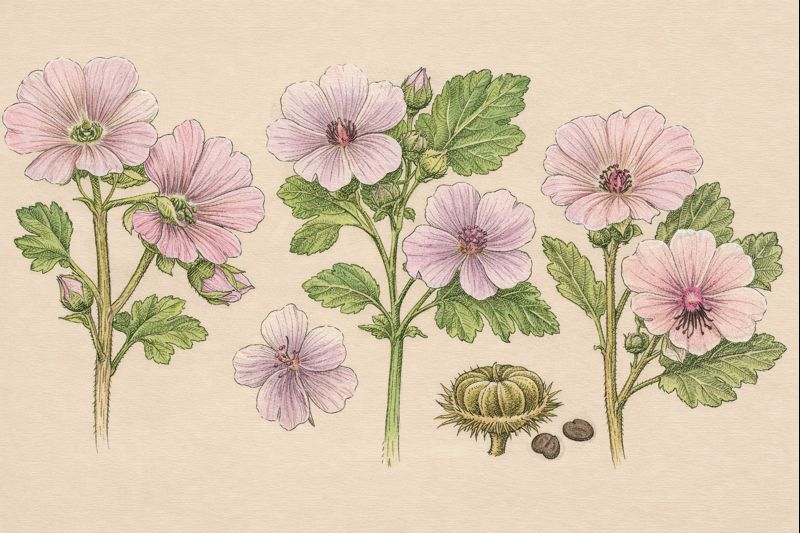
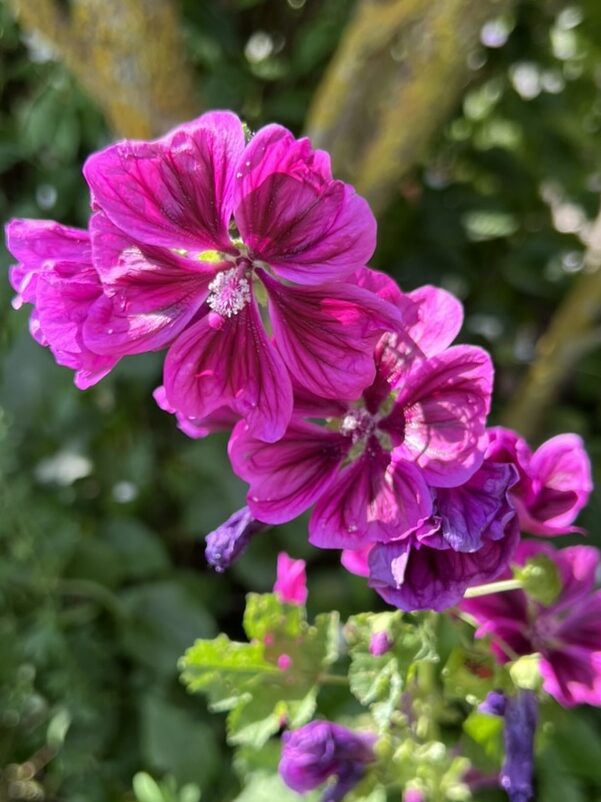
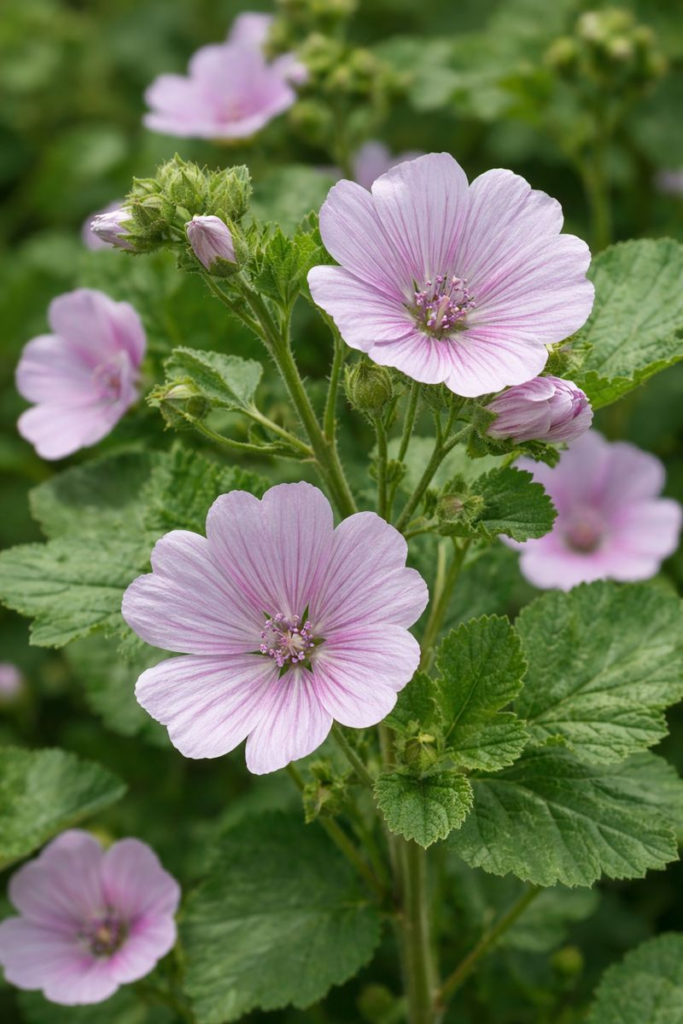
Mallows usually have rounded to palmately lobed leaves, often with soft hairs. The flowers have five petals and, depending on the species, are pink, purple, whitish, or a strong purple. Darker veins on the petals are typical of many species.
After flowering, the characteristic disc-shaped fruits form, which look like little wheels of cheese. These “cheeses” are a good identifying feature of many mallow species.
Nevertheless, the rule is: only feed plants that have been reliably identified. If in doubt, do not put the plant in the enclosure and do not feed it.
Suitable mallow species and related food plants
Various species and garden forms from the mallow family are particularly interesting for tortoise keepers. These include, for example:
- Common mallow (Malva sylvestris)
- Dwarf mallow (Malva neglecta)
- Musk mallow (Malva moschata)
- Mauritanian mallow (Malva sylvestris var. mauritiana)
- ‘Zebrina’ as a common garden form
- Hollyhock (Alcea rosea)
- Marsh mallow (Althaea officinalis)
- Hibiscus, for example rose of Sharon (Hibiscus syriacus) or Chinese hibiscus (Hibiscus rosa-sinensis)
- Tree mallows (Lavatera)
All these plants belong to the mallow family and, if reliably identified and from an uncontaminated source, can be valuable food plants. The leaves and flowers are of particular interest. They should be part of a varied wild-plant diet and not serve as the sole staple food plant.
With garden plants in particular, exact identification is important. Trade names can be confusing, and not every plant commonly called a “mallow” belongs to the same genus. In practice, however, this is not a problem as long as the plant in question has been reliably identified, is known to be suitable, and is free from fertiliser and pesticide residues.
Hollyhocks, marsh mallow, and hibiscus are therefore related food plants from the mallow family that are also well suited. This article focuses on the classic Malva species, but the related members of the mallow family can usefully complement them in the enclosure or food garden.
Safety: what to look out for
Only gather mallows from uncontaminated sites or use them from your own pesticide-free cultivation. Plants from roadsides, dog-walking areas, heavily fertilised land, field margins, or unknown sources are not suitable.
Mallows, hollyhocks, marsh mallow, or hibiscus plants bought from shops must not be fed immediately or planted straight into the tortoise enclosure. They should go into quarantine first. Many ornamental and pot plants from nurseries, garden centres, or DIY stores may be contaminated with fertiliser, pesticides, slug pellets, growth regulators, or other residues. Bought plants should therefore first be taken out of their pots, freed of as much old soil as possible, and replanted in unfertilised, uncontaminated soil. They are then grown on for several months outside the enclosure. Only new growth that is free of contamination can later be used as food.
The site where they are grown also matters, as plants on very nitrogen-rich soils can accumulate more nitrate. For tortoises, lean, natural, unfertilised food plants are generally the better choice.
Only feed mallows and members of the mallow family that are reliably identified, unsprayed, and uncontaminated. Always quarantine plants bought from shops first – never plant them straight into the enclosure or feed them immediately.
Site, sowing, and cultivation
Mallows are uncomplicated plants and are very well suited to natural tortoise enclosures laid out with limestone gravel (in German), food beds, raised beds, and flower strips. They prefer sunny to partially shaded sites with loose, free-draining soil. They are annual to perennial, some short-lived perennials, and often self-seed.
For tortoise keeping, the soil should not be fertilised or excessively rich in nutrients. Poor to moderately nutrient-rich, uncontaminated soils without fertiliser or pesticide residues are better suited. This keeps the plants natural and better suited to the high-fibre diet we are aiming for.
Mallows can be started indoors or in a sheltered cold frame from March. From late April to May, they can also be sown directly outdoors once no hard night frosts are expected. Sowing later, in autumn, is also possible; many mallows will later self-seed if a few plants are allowed to set seed.
The seeds are placed on loose, fine, crumbly soil, pressed in lightly, and only very thinly covered with sieved soil, sand, or fine substrate. They should not be buried deep, as they are light germinators (in German). The soil must be kept evenly moist during germination.
At about 15 to 20 °C, mallows usually germinate within one to three weeks. Depending on the species, the age of the seed, and conditions, germination may take a little longer – so a little patience pays off.
Mini greenhouses with unfertilised seed compost are suitable for raising plants (in German). After the last frosts, usually from mid-May, the young plants can be planted out in the bed or in their final position. Leave enough space between the plants – about 40 to 50 cm, depending on the species. This lets the plants develop well, keeps them airier, and makes them less prone to fungal diseases.
A practical tip: to help germination, mallow seeds can be soaked overnight in lukewarm water before sowing and then sown straight away. After that, even moisture without waterlogging is important.
Mallows can grow directly in the tortoise enclosure if they are reliably identified, uncontaminated, and well established. Plants bought from shops, however, do not belong straight in the enclosure but must first be grown on in quarantine outside it.
Alternatively, mallows can be grown permanently outside the enclosure, with leaves and flowers offered regularly. This is particularly practical if the tortoises would otherwise eat young plants too quickly.
Hollyhocks, marsh mallow, and hibiscus can also be integrated well into a natural food garden. Hollyhocks add height and structure, marsh mallow suits somewhat moister sites, and hibiscus can be an interesting flowering shrub outside or at the edge of the enclosure. Here too, the rule is: only use uncontaminated, reliably identified plants.
If you let a few plants set seed, you can later collect your own seed and establish mallows permanently in the food garden.
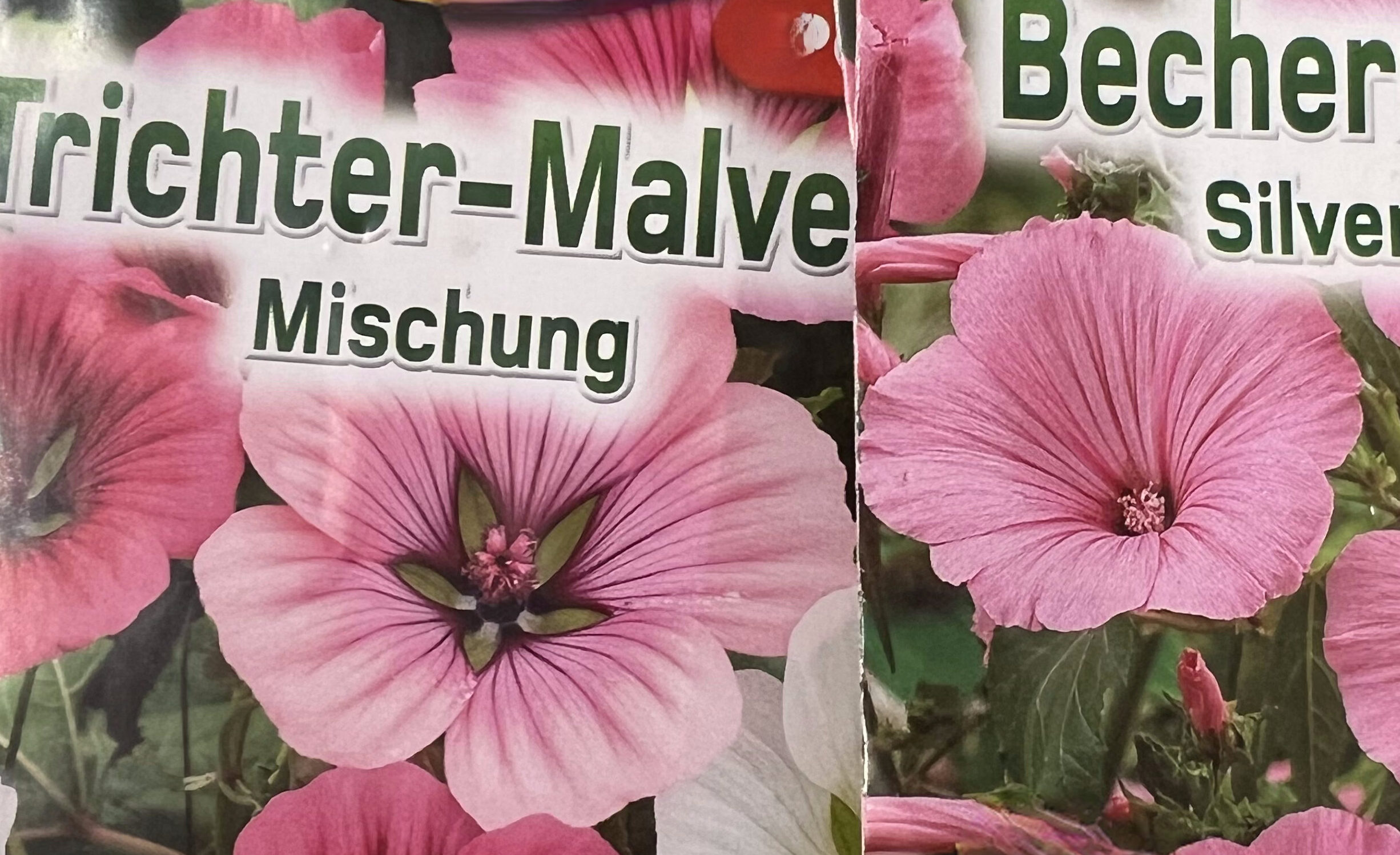
Harvesting mallow seeds
Mallows are easy to propagate from seed. After flowering, they form the typical small, round fruits that look like tiny wheels of cheese. As soon as these are dry, brownish, and easily crumble, the seeds can be harvested.
It is best to harvest on a dry day. The seed heads are cut off or carefully plucked and then left to finish drying in an airy, dry place for about a week. This is important so that no moisture is trapped and no mould forms during storage.
Only once the seed heads are really dry can the individual seeds be removed from the fruits and stored in paper bags, small jars, or seed packets. Paper bags are particularly practical because they still allow some exchange of air.
Clear labelling with plant species, site, and year of harvest is important. The seeds should be stored in a cool, dry, dark place. That way you will have your own uncontaminated seed next spring for food beds, raised beds, or natural areas of the enclosure.
With garden forms and hybrids, such as ‘Zebrina’ or some tree mallows, the offspring may look different from the parent plant. Bear this in mind if you want to preserve particular characteristics. For tortoise keeping, this is usually not a problem as long as the plants are reliably identified and uncontaminated.
Some of the seed heads can happily stay on the plant. This lets mallows self-seed while also providing food and natural structure for insects, birds, and other small animals in the garden. In the tortoise enclosure, however, make sure the tortoises do not deliberately eat too many ripe seed heads. For feeding, the leaves and occasionally the flowers come first.
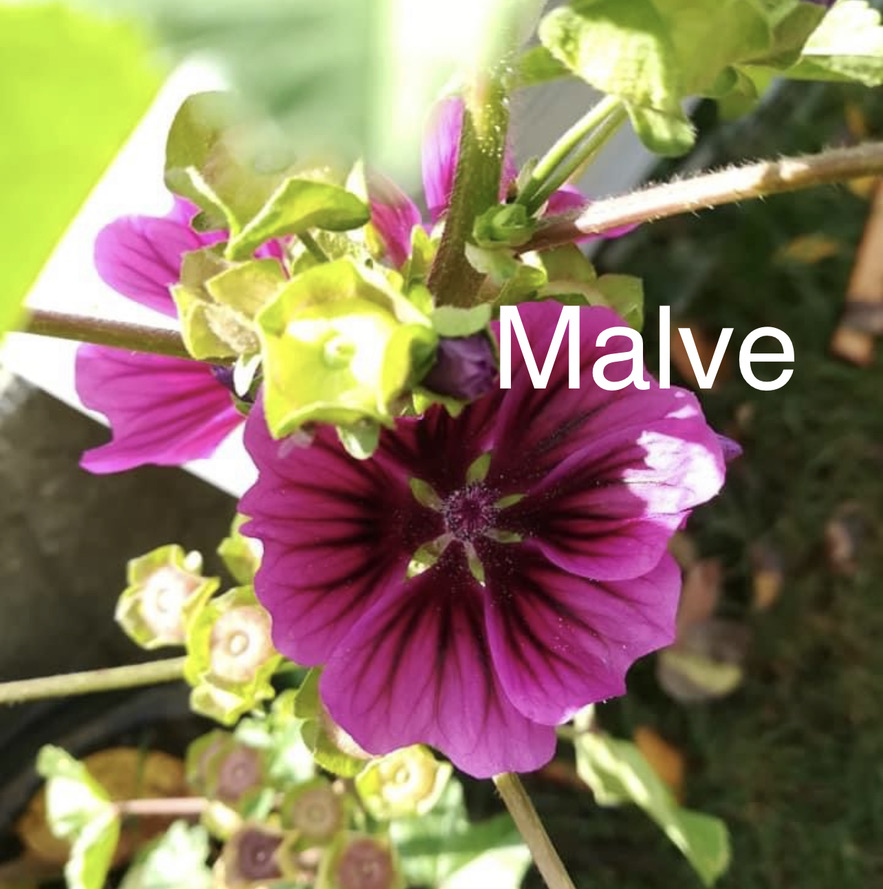
Mallows in the tortoise enclosure
Mallows are well suited as part of varied enclosure planting. They provide height, flowers, cover, and food all in one. In naturalistic outdoor enclosures in particular, they can grow together with plantain, dandelion, stinging nettle (in German), field scabious (in German), chicory, pot marigold, sow thistle, and other suitable food plants.
Hollyhocks, marsh mallow, and hibiscus can also usefully complement the enclosure or food garden. Hollyhocks are particularly suitable as tall flowering plants, hibiscus as a shrub can provide leaves and flowers, and marsh mallow fits well into a varied selection of plants. It often makes sense to grow such plants at the edge of or outside the enclosure and offer the leaves or flowers deliberately, so that young plants are not eaten down completely straight away.
As with all food plants, variety is crucial. Mallows and related members of the mallow family are a very good addition, but should not be the only or dominant food plants. The more varied the range of plants, the closer the diet comes to the natural grazing behaviour of European tortoises.
Ecological added value
Mallows are not only interesting for tortoises. Their flowers are visited by wild bees, bumblebees, hoverflies, and other insects, so they contribute to biodiversity around the tortoise enclosure.
In natural gardens in particular, mallows are valuable flowering plants. They provide food for insects over a long period and can be used as a food plant for tortoises at the same time. This makes them ideal for anyone who wants to combine tortoise keeping with wildlife-friendly gardening.
Hollyhocks, marsh mallow, and hibiscus are also attractive flowering plants that can enrich the food garden visually and ecologically. It is particularly nice not to feed all the flowers straight away: some plants can be left for the insects and allowed to set seed. This creates a small cycle of food plant, insect forage, and seed formation.
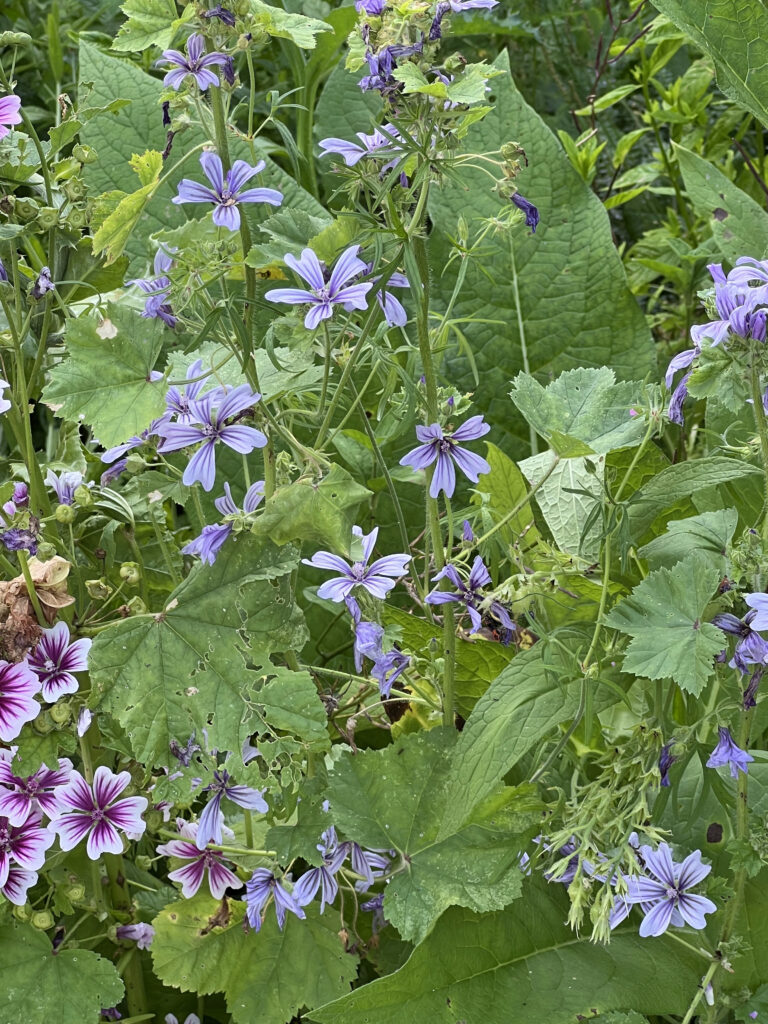
Conclusion
Mallows are valuable, uncomplicated, and versatile food plants for European tortoises. The leaves and flowers are eaten with relish, the plants are easy to grow, and they enrich natural enclosures visually and ecologically. This makes mallows ideal for low-maintenance enclosures in which varied, natural vegetation is meant to develop.
Related members of the mallow family, such as hollyhocks, marsh mallow, and hibiscus, can also be integrated well into the food garden if they are reliably identified and from an uncontaminated source. They provide leaves and flowers, add structure, and promote biodiversity at the same time.
What matters is reliable identification, an uncontaminated source, and moderate use as part of a varied wild-plant diet. Mallows and other members of the mallow family bought from shops should always be grown on in quarantine first before being fed or planted in the enclosure.
Used in this way, mallows, hollyhocks, marsh mallow, and hibiscus are a lovely addition to tortoise enclosures, food beds, and natural gardens with a focus on biodiversity.