
Guiding European tortoises safely through brumation, step by step
Testudo hermanni · Testudo graeca ibera · Testudo marginata
Controlled brumation in a refrigerator is safe – provided that preparation, equipment, and checks are right. The new Refrigerator Brumation Checklist sums up every step in a compact format, ready to tick off: from the decision in late summer, through running in the refrigerator and reducing the temperature, to emergence in March. This article walks through the eight sections of the checklist and links to the pages on which we cover each topic in detail. Readers who would like to start with the basics will find them under What exactly is brumation? and in our overview Controlled refrigerator brumation of European tortoises.

1. Health check
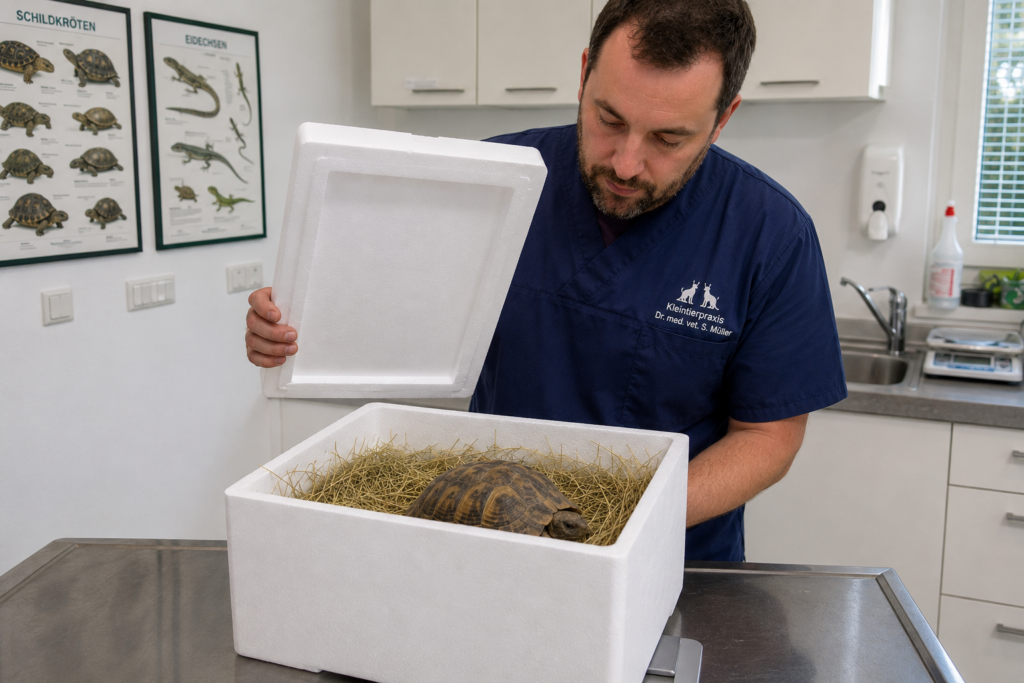
Preparation begins in summer. By August, we assess whether each animal has built up sufficient condition for brumation – more on this under Deciding on brumation (in German). The pre-brumation check-up with a reptile vet (in German) is due in August or September at the latest. In Germany, reptile-experienced practices are listed in the AGARK vet list.
Two faecal examinations for intestinal parasites per year are part of this. Two weeks after the last dose of a worming treatment (in German), we have a follow-up faecal sample examined. After that, the animals stay at summer temperatures for several more weeks – 25–30 °C ambient, 35 °C at the basking spot. We record the weight before brumation as the baseline value.
Gravid females, acutely ill or recently operated animals, and animals in poor general condition do not brumate. We always agree the course of action with the reptile vet; these animals overwinter actively in a large, open-topped emergency enclosure with heat, a UV basking spot, and a night-time temperature drop. Animals from different collections never brumate together in one refrigerator.
2. Refrigerator and equipment
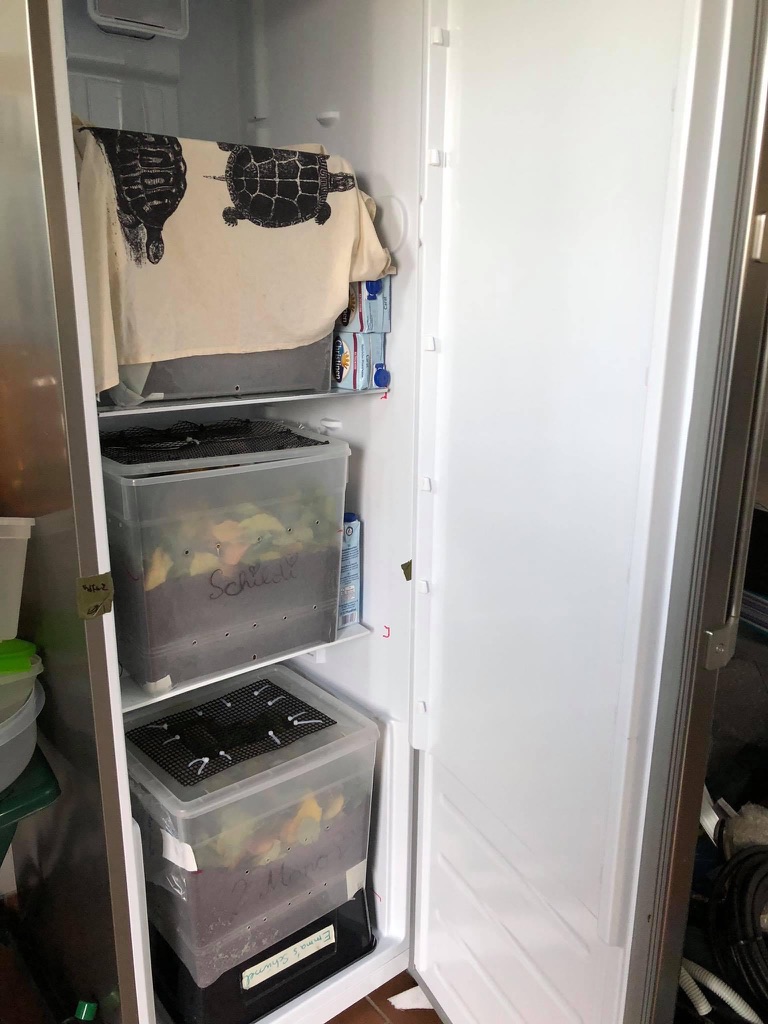
We use a dedicated refrigerator without a freezer or ice compartment, with automatic defrost. It stands in a heated room at no less than 16 °C – never in unheated places such as a garage, loft, or shed. Camping cool boxes, mini fridges, and incubators are ruled out because they are unreliable.
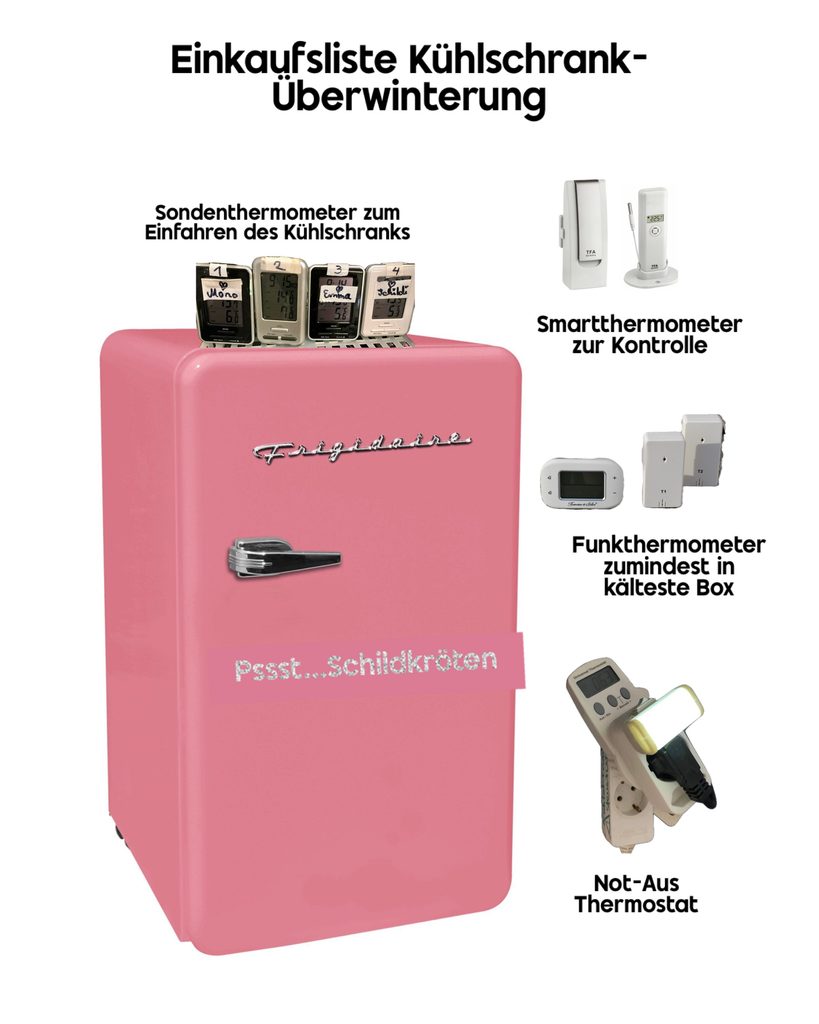
Each box contains a probe thermometer with min/max memory and an alarm, together with a smart thermometer that sends alerts to a mobile phone. A battery-powered wireless thermometer with an audible alarm covers power and internet failures. An external emergency cut-off thermostat completes the set-up. Important: the refrigerator itself holds 4.5–7 °C on every shelf – the emergency cut-off only covers the emergency. Everything needed in detail is listed in our shopping list (in German) and on our page on technology.
3. Brumation boxes
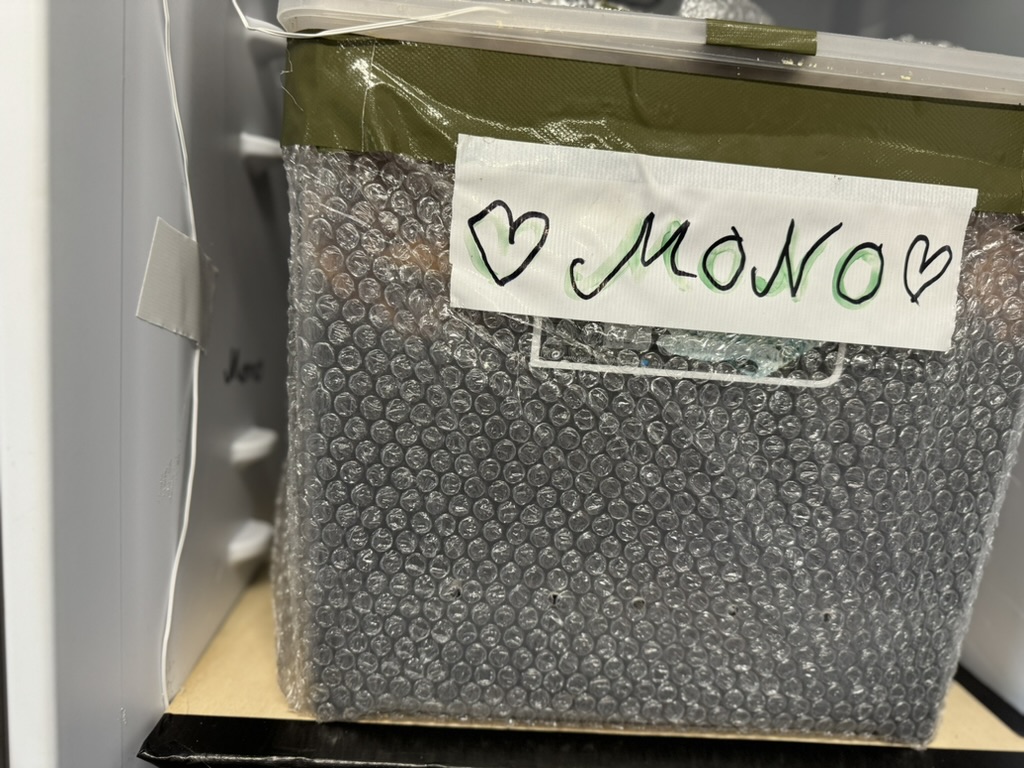
Every adult or subadult animal has its own sturdy plastic box. We fill in substrate to at least three times the height of the shell – tortoise soil or sieved topsoil, slightly moist, never wet. On top goes fresh beech or hornbeam leaf litter up to the rim; leaves that turn mouldy quickly are unsuitable. A mesh lid secured with a bungee cord, drainage holes, and a gap to the refrigerator walls make the box safe. Details are given under All about the refrigerator and brumation boxes (in German).
Even with refrigerator brumation, a pit beneath the cold frame that is protected against frost and predators remains important: the animals brumate there for one to two weeks before moving into the refrigerator, and predators are active all year round. The pit simply does not need to be as deep as for pit brumation – around 30 cm of soil substrate is sufficient.
4. Running in the refrigerator
As soon as the temperature reduction in the cold frame begins, we start running in the refrigerator (in German) – without animals. The refrigerator initially runs on its warmest setting, with the fully filled boxes already inside. All sensors lie at the back of the box beneath the leaves, with the tip just inside the substrate. Every day we record the min/max readings of each box and reset them. We adjust step by step until all boxes sit stably at 4.5–7 °C; 5–6 °C is ideal. Temperatures below 4 °C and above 8 °C are dangerous.
Only after about a week of stable readings do we connect the emergency cut-off thermostat; its sensor lies in the coldest box. It switches off 0.2 °C below the measured minimum, never below 4.3 °C, and switches back on 0.2 °C below the measured maximum, never above 5.8 °C.
5. Temperature reduction
From the end of October, we lower the ambient temperature in the cold frame step by step over four weeks – by no more than about 1 °C per day. Week 1: 19 °C by day, 14 °C at night, eight hours of basking spot. Week 2: 15 and 10 °C, seven hours. Week 3: 11 and 5 °C, six hours. Week 4: 5 °C and five hours, until all animals are inactive. The individual weeks are described in our temperature reduction prior to brumation.
The UV basking spot continues to provide 35 °C at shell height. Food and water remain available to the very end – no enforced fasting, no forced bathing. The temperature in the cold frame does not fall below 5 °C. We only switch off the UV lamp once all animals have been completely inactive for several days.
6. Moving tortoises into the refrigerator
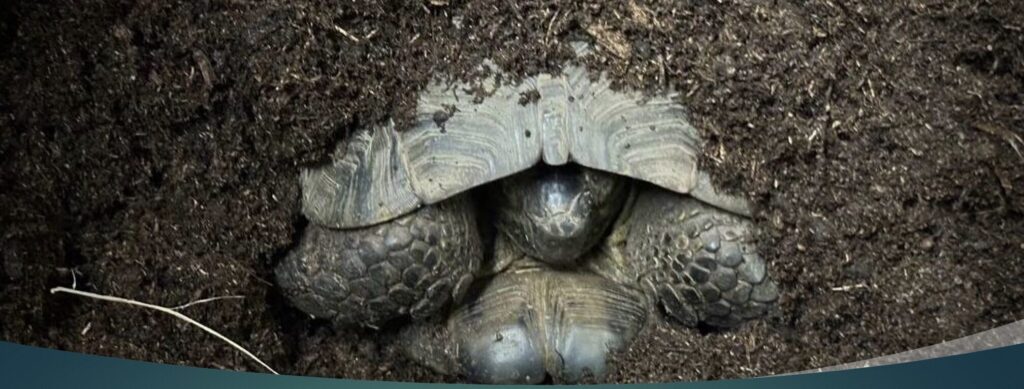
Animals are only moved once they have been in deep brumation for one to two weeks – usually in early December. By then they are completely inactive, their eyes are closed, and they respond only sluggishly to touch. Each animal is weighed and checked all over, and its starting weight recorded. We place it rear end first into a shallow hollow and cover the shell lightly with substrate – the head area stays free. We fill the box loosely with leaves and secure the mesh lid. The refrigerator then stays closed for two to three days if possible, but for at least 24 hours. Animals that are still active go back into the cold frame. In detail: Moving tortoises into the refrigerator and the checklist for the move (both in German).
7. During brumation
Every two days we air the refrigerator for about ten seconds – daily if the refrigerator is small or fully occupied. Every day we check the thermometers and that the refrigerator and emergency cut-off thermostat are working. A full check is due at least once a month, every two weeks in the final third, and always on a weekday: weigh the animal, check the plastron with a torch for reddening, and look at the nose, mouth, and eyes. If weight loss clearly exceeds 1 % per month or 5 % in total, we contact the reptile vet. How the check works is shown in Checks during refrigerator brumation (in German).
We moisten substrate that has become too dry with two or three sprays of cold water; wet or mouldy material is replaced. Changes to the door seal or the refrigerator itself are dangerous. When we are away, we brief a stand-in and leave emergency contacts.
Emergency: reddening or spots on the shell, swellings, bubbles at the nose or mouth, breathing noises, an open mouth, or persistent scrabbling. The box then goes into a cool room at about 12 °C, and we contact the reptile vet to agree on the next steps.
8. Emergence in spring
Brumation lasts about twelve weeks, including the time in the cold frame; emergence takes place in early to mid-March. Two weeks beforehand, we check the equipment and the back-up equipment, clean the cold frame, keep it at no less than 8 °C, and sow food plants – see Preparing for emergence from the refrigerator (in German).
The animals are moved on a weekday evening. We do not switch off the refrigerator – the tortoises wake free of stress in the cold frame. After weighing and checking, we place them in a hollow and cover them with substrate and leaves from their box; the head stays free. The first night stays at 8 °C; the following day brings 12 °C and five hours of basking spot. After that, we increase by 1 °C and one hour each day until 20 °C and twelve hours are reached. At night the temperature does not fall below 12 °C, and the basking spot provides 35 °C at shell height from the very first day. Fresh wild plants and water are available from the start. The procedure is described in Emergence from the refrigerator (in German).
Warning signs: no drinking after 48 hours, no feeding after seven to ten days, no faeces or urine over several days, lethargy, weight loss, or a white coating on the tongue. In that case, the animal goes to the reptile vet promptly. More on this under Warning signs after brumation.
Further reading
The complete guide from temperature reduction through brumation to emergence – with photographs, graphics, and references – is the Refrigerator Brumation Handbook, now available in English as a paperback, hardcover, and Kindle eBook. All proceeds go to Schildkroetensuche.org.
The printed checklist
The printed Refrigerator Brumation Checklist – a four-page A4 folded leaflet with tick boxes, a weight table for three animals, graphics, and QR codes – is currently available in German only. For questions, a message via the contact form is all that is needed.
Important: this checklist does not replace individual advice from a reptile vet.