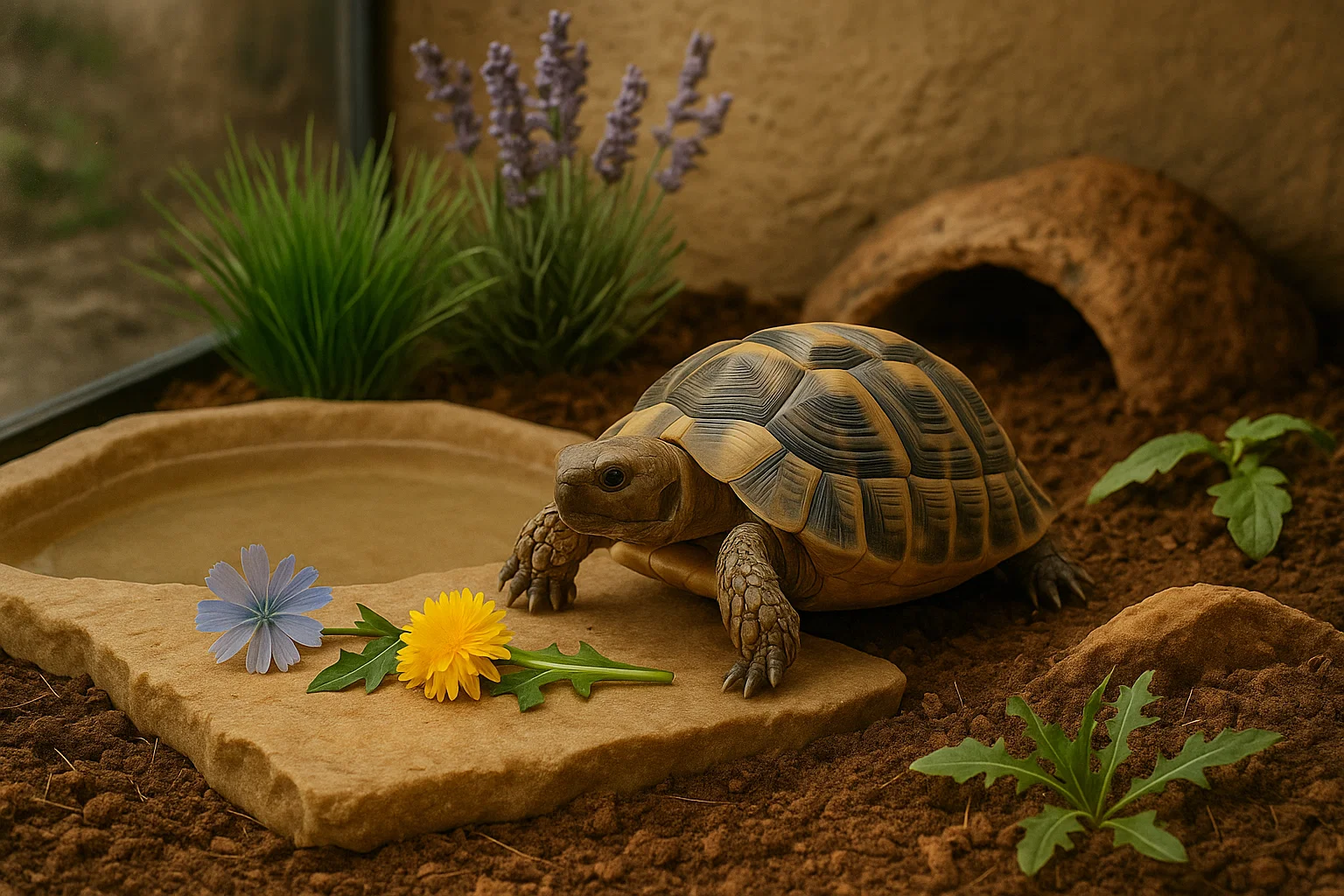
Can tortoises kept in a vivarium brumate?
Permanent vivarium housing is unsuitable for European tortoises – yet sadly, many tortoises are still kept in vivaria or indoors on tortoise tables.
European tortoises do not belong in a vivarium: for healthy development, they need an outdoor enclosure with natural environmental influences such as sun, wind, rain, and changing temperatures. They also need a heated cold frame with a UV lamp and heating.
In a vivarium, key metabolic processes, digestion, and natural brumation cannot function properly. Overheating, as well as unnatural growth and disease, are also common.
This raises the question: may these tortoises at least brumate?
The answer is: only under certain conditions – and always after clearance from a reptile vet.
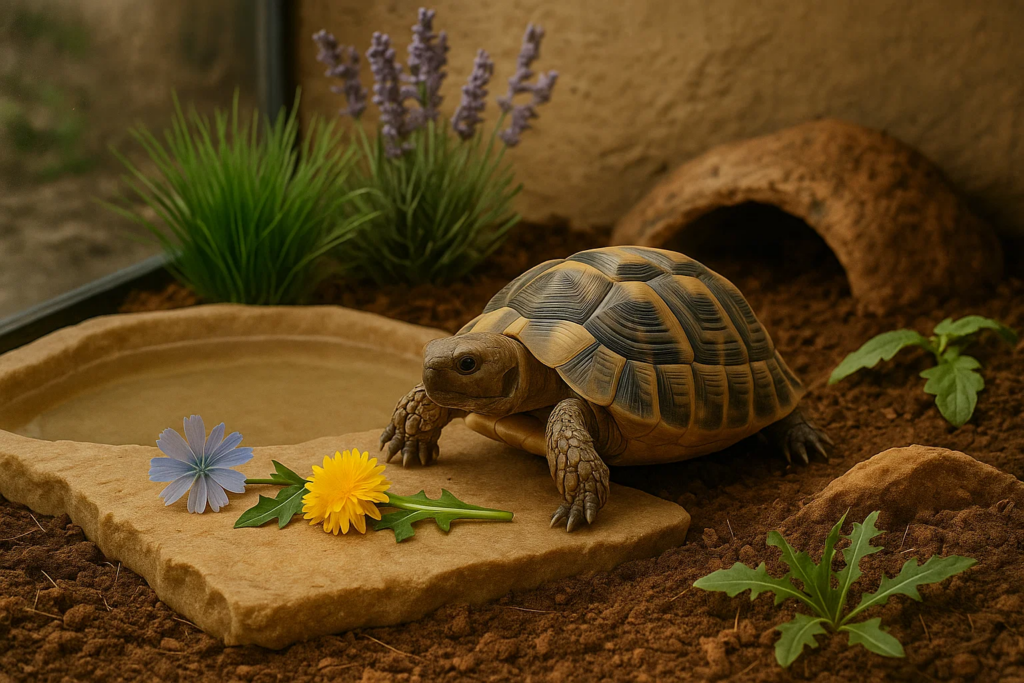
1. Veterinary examination before brumation
Before European tortoises kept in a vivarium may brumate, a thorough examination by an experienced reptile vet is essential.
Key points of the examination
- Blood test: tortoises kept in vivaria often have markedly abnormal blood values. In that case, they must not brumate at first, but must be stabilised with medication.
- X-ray: condition of the shell, skeleton, and organs.
- Faecal examination: because of the confined living space, tortoises kept in vivaria often carry a heavy parasite burden.
- Hydration: many tortoises kept in vivaria are dehydrated and often receive fluids at the vet’s. On the reptile vet’s advice, regular baths in a shallow water dish can help to solve the problem.
2. Improving vivarium housing
– if a move to a heated cold frame is not possible in the short term
If a switch to a heated cold frame with an outdoor enclosure cannot be made soon, the vivarium must be improved to give the tortoises at least a reasonably suitable preparation for brumation.
Essential improvements
- UV lighting: ideally high-quality metal halide (HID) lamps (in German) controlled by timers, together with good background lighting from special reptile LEDs (in German).
- Suitable substrate: tortoise soil or sieved topsoil, with limestone gravel for firm footing on walkways; replace weekly.
- High humidity: spray several times a day.
- Natural diet: wild plants only.
- Prevent heat build-up:
- remove the lid
- take out the glass panes and replace them with mesh
- Humid hides: plenty of low-growing plants and humid retreats, plus a “wet box” with sphagnum moss.
- Provide calcium: cuttlefish bone and calcified seaweed available at all times.
- At night: always lower the temperature considerably and raise the humidity.
3. When the vet gives the go-ahead for brumation
Once the animal is medically ready for brumation, the biggest problem remains:
how can suitable temperatures be reached?
Lowering the temperature
- A room is needed in which the window can stay open permanently.
- Target: consistently below 8 °C.
- Alternatively: use a balcony from about mid-October for controlled cooling in the vivarium.
- Then: controlled brumation in a separate brumation refrigerator.
Lingering at temperatures that are too warm, above 8 °C, is life-threatening – the metabolism keeps running while the animals neither eat nor drink enough: dehydration and starvation are the result.
4. Responsibility after brumation
The winter should be used to plan natural housing for the time after brumation – or to rehome the tortoise with someone who can provide it.
Because one thing is clear:
permanent vivarium housing is not suitable for European tortoises if their health is to be maintained.
What do veterinary medicine and science say?
The German Veterinary Association for Animal Welfare (Tierärztliche Vereinigung für Tierschutz, TVT) explicitly classes keeping tortoises indoors, with or without a vivarium, as not appropriate to their needs. According to the TVT, vivarium housing leads to growth disorders (TVT 2017). Instead, the TVT recommends an outdoor enclosure with a cold frame or greenhouse measuring about 25 × 10 times the shell length. For a 20 cm tortoise, that is around 10 m². The German Animal Welfare Federation (Deutscher Tierschutzbund) likewise describes keeping tortoises solely in a vivarium as not appropriate to their needs and calls for at least 10 m² per tortoise (DTSchB n.d.).
A survey of 1,075 keepers by LMU Munich confirms this. Tortoises kept in a vivarium were considerably more likely to develop pyramiding (Bauer, Reese & Kölle 2019; Bauer 2018). The authors regard pyramiding as an indicator of husbandry quality.
Captive tortoises have also been shown to grow faster than wild ones (Ritz et al. 2012). On top of this comes brumation, which the German Federal Chamber of Veterinarians (Bundestierärztekammer, BTK) stresses as necessary (BTK 2013). The natural preparation for it cannot take place properly in a vivarium.
How to set up an outdoor enclosure with a heated cold frame is explained in Outdoor enclosure, cold frame and brumation pit. The complete guide to safe refrigerator brumation is the Refrigerator Brumation Handbook.
Sources
- Bauer, T. (2018): Analyse der Ernährung und der Haltungsbedingungen von in Deutschland gehaltenen paläarktischen Landschildkröten (Testudo spp.) (in German). Doctoral thesis, LMU Munich. DOI: 10.5282/edoc.22734
- Bauer, T., Reese, S. & Kölle, P. (2019): Nutrition and husbandry conditions of Palearctic tortoises (Testudo spp.) in captivity. Journal of Applied Animal Welfare Science. DOI: 10.1080/10888705.2018.1453814
- Bundestierärztekammer (2013): Schildkröten richtig überwintern (in German). Press release no. 20/2013, 18 September 2013
- Deutscher Tierschutzbund (n.d.): Profile: Greek tortoise (Testudo hermanni)
- Ritz, J., Clauss, M., Streich, W. J. & Hatt, J.-M. (2012): Variation in growth and potentially associated health status in Hermann’s and spur-thighed tortoise (Testudo hermanni and Testudo graeca). Zoo Biology 31: 705–717
- Tierärztliche Vereinigung für Tierschutz (2017): Merkblatt Griechische Landschildkröte (in German), as of January 2017