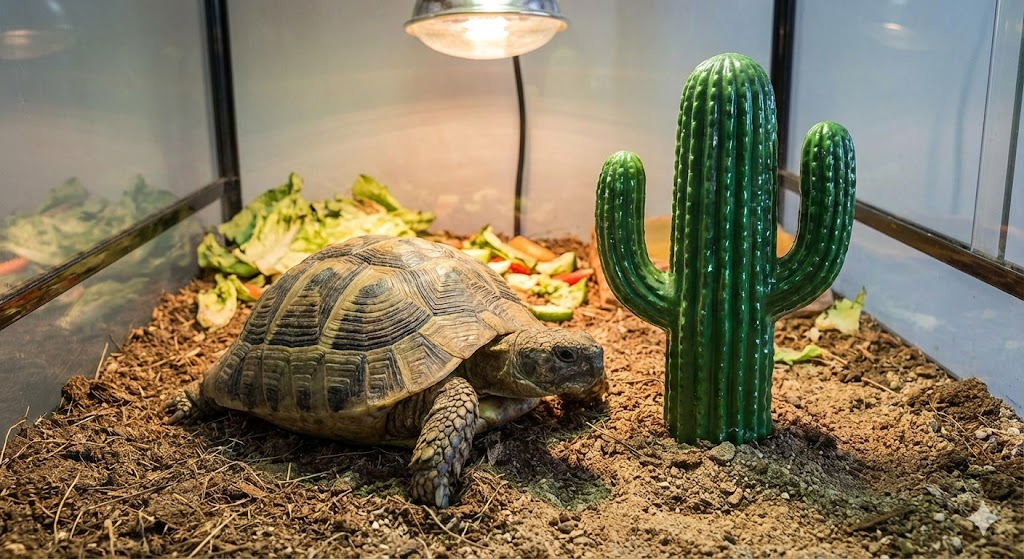
European tortoises do not belong in a vivarium
European tortoises can only be kept in a truly natural way in a naturalistic outdoor enclosure with a heated cold frame fitted with a UV lamp and heating.
European tortoises do not belong in a vivarium, because healthy development depends on natural environmental influences such as UV light, sun, wind, rain, and changing day and night temperatures.
In a vivarium, key metabolic processes, digestion, natural brumation, and the preparation for it cannot function properly. Overheating, as well as unnatural growth and disease, are also common. For females, an egg-laying site that is not deep enough often leads to egg binding.
Alternating between an outdoor enclosure and a vivarium is not an option either: tortoises are extremely sensitive to stress, and the constant changes in temperature and surroundings can make them ill. Tortoises should therefore live permanently in the same enclosure and cold frame.
A vivarium is not suitable for permanent housing – at most temporarily, for example during illness, quarantine, or treatment. Even then, a large emergency enclosure that is completely open at the top is far preferable.
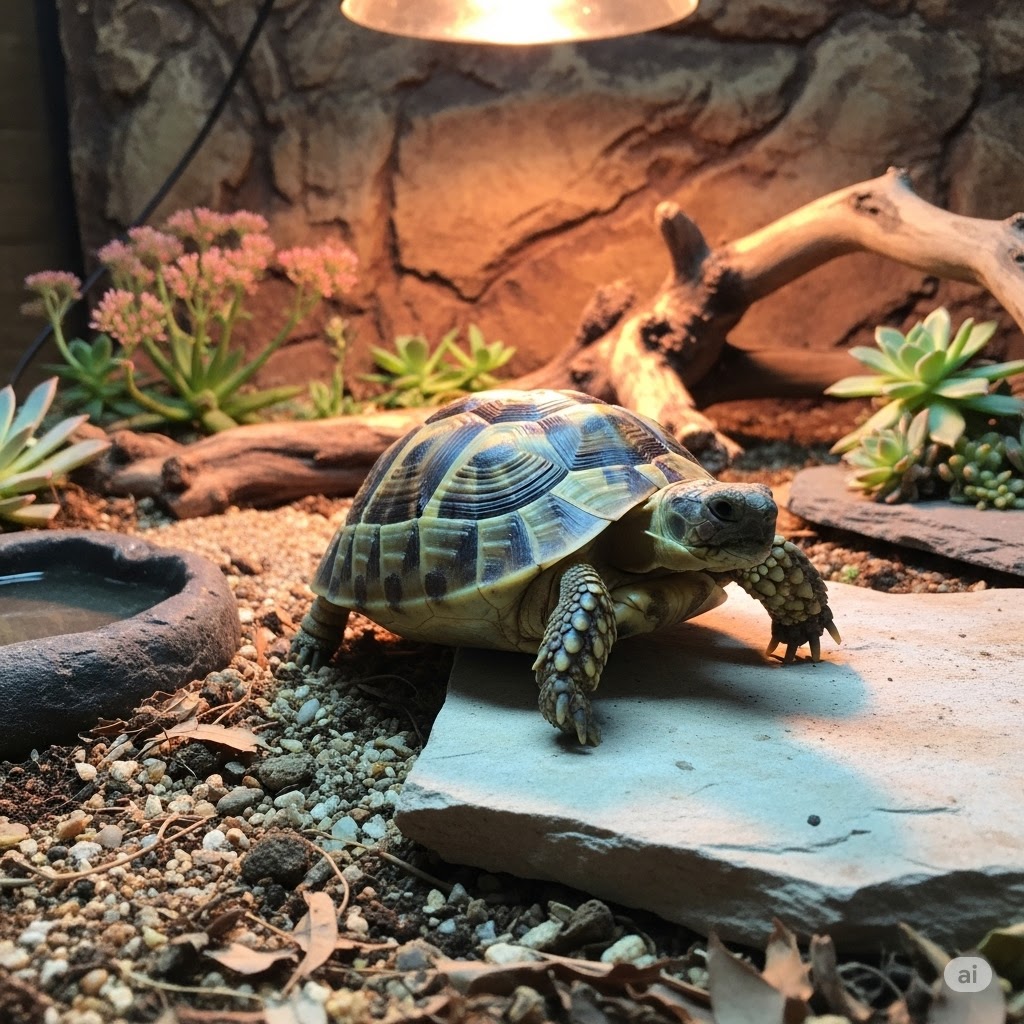
Why a vivarium is unsuitable for European tortoises
Anyone who tries to keep European tortoises indoors soon reaches the limits.
The space needed alone is enormous: two adult Hermann’s tortoises (Testudo hermanni) would need at least 20 m² – roughly the size of an average living room.
Yet even if that much space were available, the natural environment can hardly be recreated indoors.
Producing enough light and warmth would take a number of high-quality LED lamps, supplemented by powerful UV lamps. This equipment causes extremely high electricity costs and is still only an incomplete substitute for real sunlight.
There would also have to be a layer of soil at least 30 cm deep, so that the tortoises can dig in and females can lay their eggs. On top of that come the demands of planting, watering, ventilation, cleaning, and regular soil replacement.
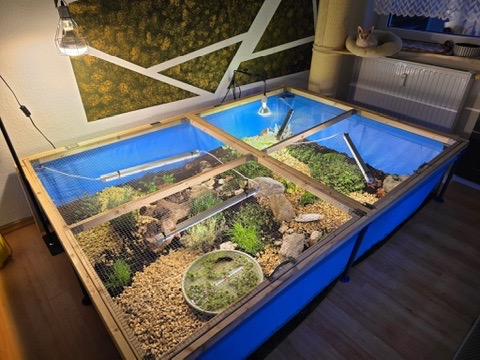
Why there is no such thing as “good vivarium housing” for European tortoises
In my view, “good vivarium housing” for European tortoises cannot exist, if only because there is not enough space.
Everything else might perhaps be partly compensated for technically, at very great effort – with high-quality UV lamps, sprinkler systems, foggers, and heating and cooling equipment (the latter for the necessary night-time drop in background temperature).
But the space in a vivarium is and remains too limited to meet the needs of European tortoises. And sadly, there is no UV lamp that perfectly simulates the sun with all its benefits.
But: outdoor housing is not automatically natural
At the same time, there is no point in fooling ourselves: outdoor housing is not automatically good and natural either.
Poor outdoor housing is quickly created – a draughty mini enclosure in shade all day, with a bit of lawn for an adult male, for example.
If Mediterranean limestone gravel, a cold frame with equipment, hiding places, and an opaque enclosure wall are also missing, the result is a bleak, stressful outdoor prison.
Some exotic tortoise species do need a vivarium
Many tortoise species from warmer or more humid habitats also have a similarly strong urge to move and show roaming and territorial behaviour that can hardly be lived out in a cramped vivarium.
Taken to its logical conclusion, this would really call for a fundamental discussion about keeping tortoises – regardless of where they come from.
Both European and exotic species have complex needs that are difficult to meet fully in human care.
The only difference: with the necessary cold frame and equipment, European species can live outdoors all year round if we simulate the Mediterranean climate for them.
Exotic species, on the other hand, need constantly warmer or more humid conditions – which inevitably forces keepers into vivarium housing, at least some of the time. But here too, the larger, more structured, and more varied the enclosure, the better the tortoises’ quality of life.
Every now and then, we should all question our whole understanding of animal husbandry, space requirements, and the technical recreation of habitats, and improve it in line with the latest findings.
Conclusion: outdoor housing with a heated cold frame is the only natural way to keep European tortoises
Natural husbandry of European tortoises in a vivarium is not achievable – neither technically nor ethically.
But outdoor housing also needs to be well thought out and carefully planned.
Only in a well-structured, sunny, naturalistic outdoor enclosure can European tortoises truly live as their species requires – with sun, a high-quality cold frame, the necessary equipment, soil, limestone gravel, plants, hides, and plenty of room to move.