Check routine for maximum safety
Controlled refrigerator brumation of European tortoises means that the animals are not left unattended during brumation, but are safely accompanied through regular, brief checks.
On the one hand, this includes regularly checking the relevant parameters, such as the temperature at the animal and the moisture of the substrate, as well as ensuring a sufficient supply of oxygen by ventilating. On the other hand, it involves brief, regular checks and weighing the animals.
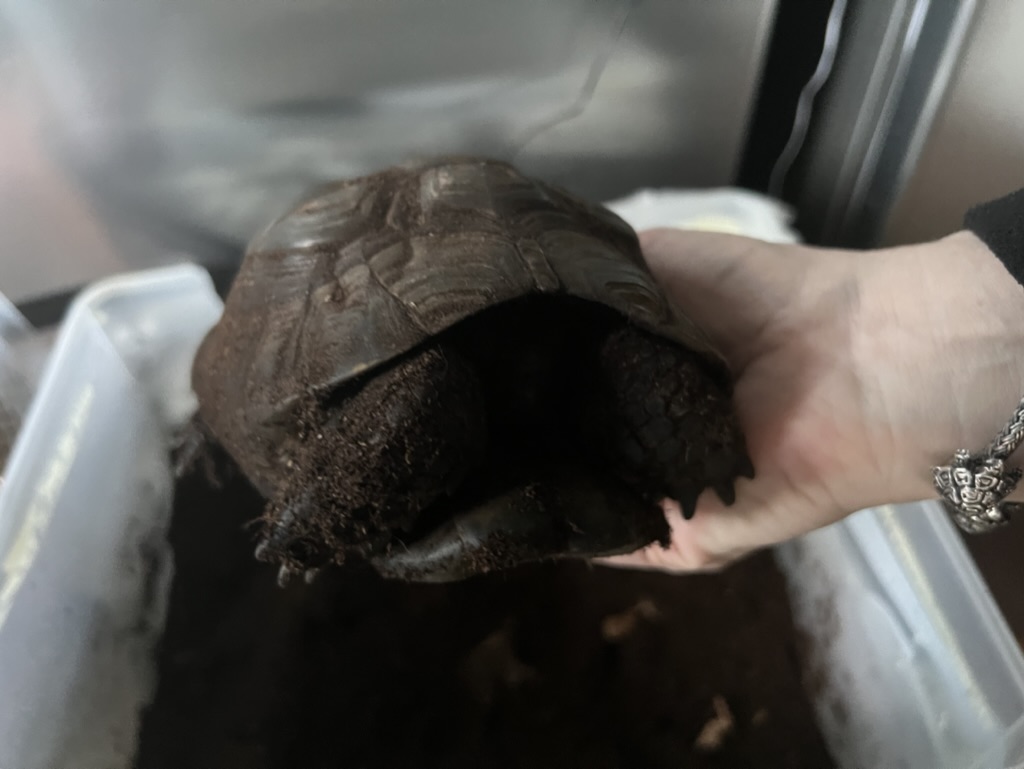
Important: regular checks are neither stressful nor a burden for animals in deep brumation and are nothing to be afraid of. On the contrary: they considerably increase the level of safety during brumation, because developing problems can be detected early.
As a rule, we check and weigh the animals every four weeks. In the last third of brumation, we recommend more frequent checks every two weeks, as this phase is considered particularly sensitive. Some reptile vets recommend shorter intervals between checks.
Preparation
Before brumation begins, or before moving the tortoises into the refrigerator, all batteries in scales, thermometers, data loggers, and other measuring devices should be replaced as a precaution. Weak batteries can lead to measurement errors, data loss, or failures during brumation – and thus compromise its safety. If they have not yet been replaced, this should be done now, at the first check.
Practical tips for checks during refrigerator brumation
1) Ideally, carry out checks on weekdays, so that a reptile vet can be reached in an emergency. It is best to work in pairs – this is quicker, and the animal is soon back in its brumation box in the refrigerator.
2) Air the room containing the refrigerator well, about 30 minutes before the check.
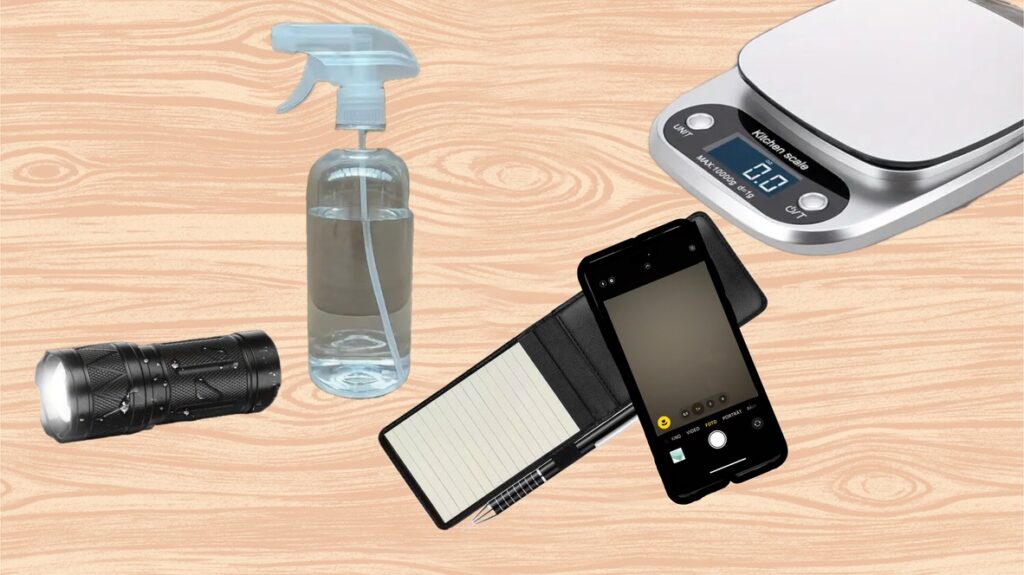
3) No bright “floodlighting”: dim the light. Keep a torch to hand so that the plastron can be checked properly from below.
4) Have the scales, notepad/weighing table, and pen ready, and switch your mobile phone to camera mode. Place the scales on a smooth, firm, level surface.
Note: many “extreme” fluctuations in weight are due to weighing errors (a sloping surface, different scales, failure to tare). Always following the same procedure is therefore essential.
Avoiding typical weighing errors
– always use the same scales
– place the scales on a firm, level surface
– tare before every measurement
– weigh the animal without any soil or leaves attached
Only then can weight trends be interpreted reliably.
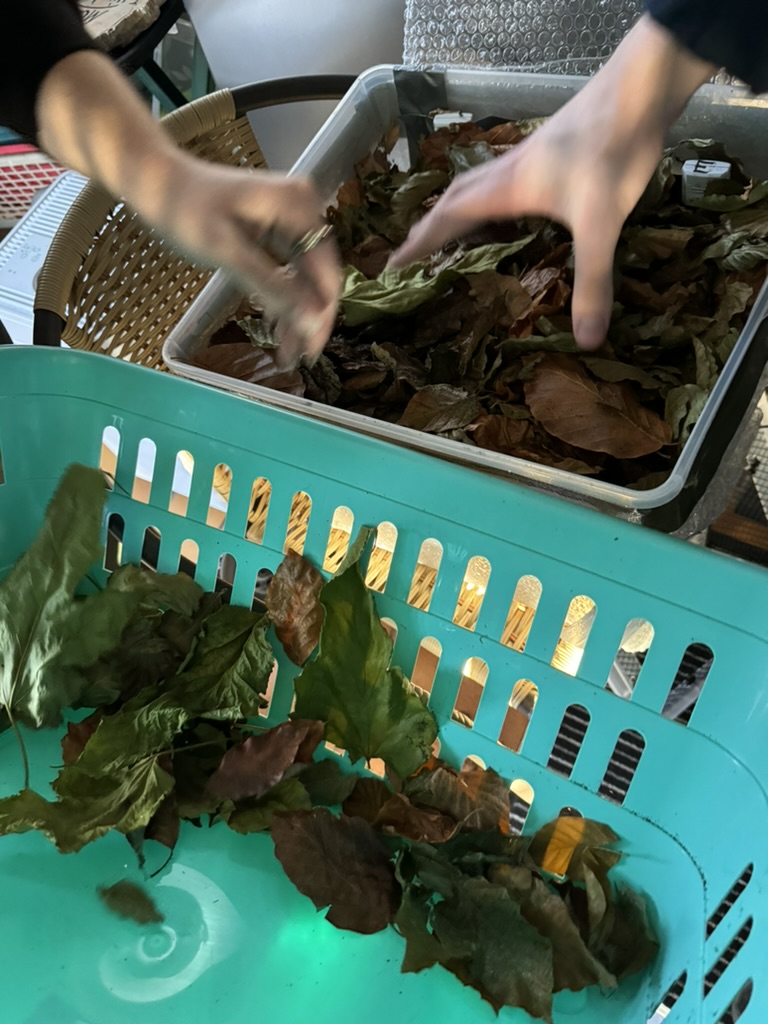
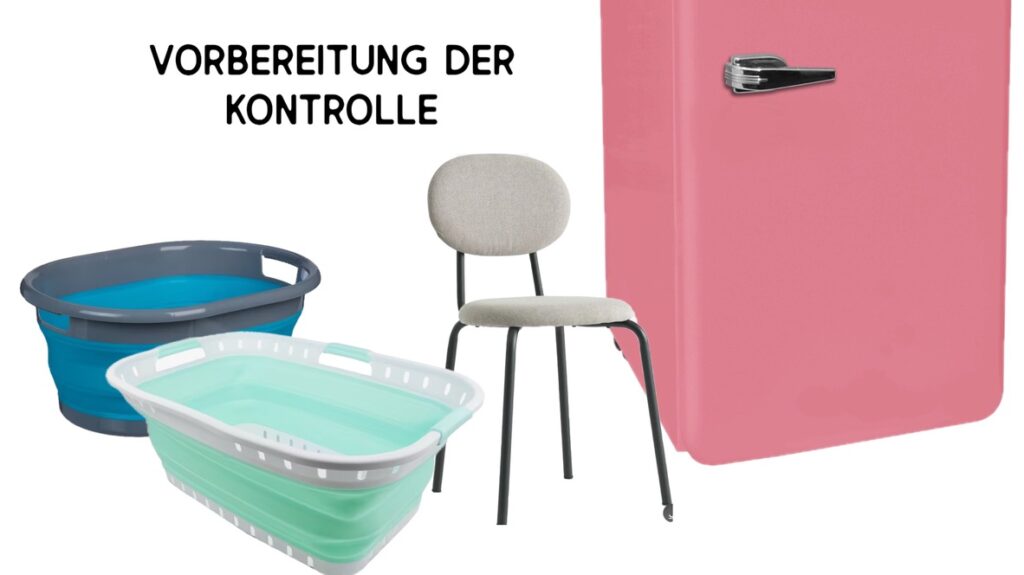
5) Have two containers ready for the leaves and substrate, and a spray bottle filled with water at refrigerator temperature.
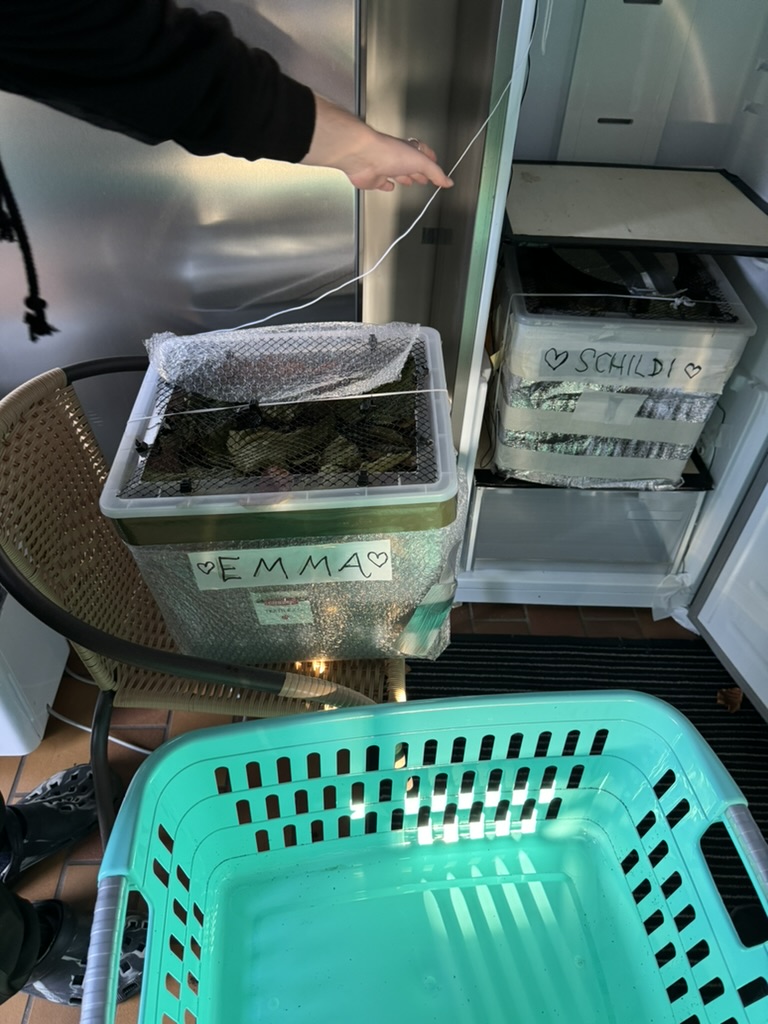
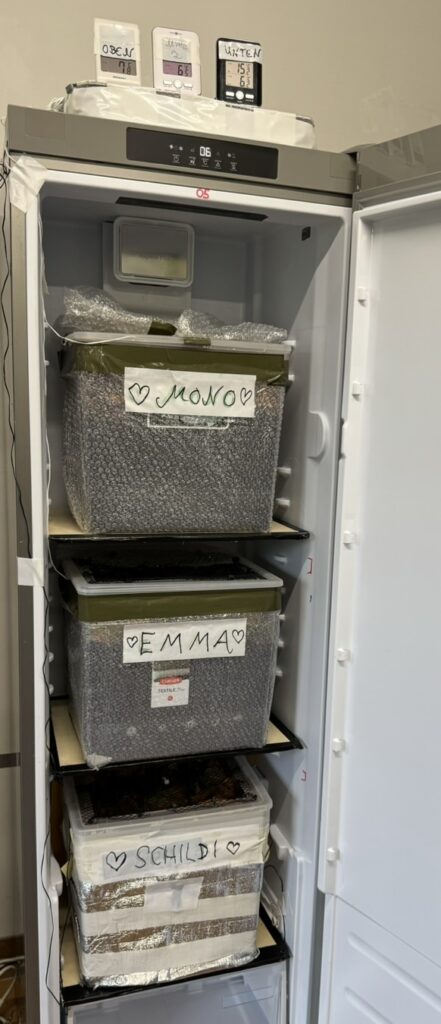
6) For brumation boxes on higher shelves, a chair or small table can be placed next to the refrigerator so that the boxes can be taken out without unplugging any sensor cables. Each box is taken out individually, and the refrigerator is closed again immediately afterwards so that the other animals stay at temperature.
7) Take out the brumation box and put the leaves into a laundry basket. Carefully dig out the tortoise. Collect the substrate in a separate container.
8) Handle the tortoise calmly and slowly throughout the check: no hasty movements, and do not turn it onto its back.
9) This is followed by a quick all-round check:
– shell/skin free of reddening or spots?
– nose/mouth free of mucus, no breathing noises, beak not open?
– limbs free of swelling?
– eyes closed and free of discharge or crusts?
– a slight “slow-motion” reaction?
– animal sitting motionless, no restlessness?
– smell normal?
Occasionally, the tortoise may pass faeces (in German) – this is usually harmless and no cause for concern, as long as everything looks normal. If in doubt, a faecal sample (in German) can be submitted for examination.
Passing urates (in German) is sometimes viewed more critically because of a possible link with dehydration; if in doubt, this should be discussed with the reptile vet (especially if the weight trend gives cause for concern).
If worms are visible in the faeces or urates, animals kept together are usually brought out of brumation straight away. Once the temperature has been raised gradually and the animals have started feeding, they can then usually be wormed. Worms are only visible to the naked eye in cases of heavy infestation.
Caution: do not wipe a brumating tortoise with anything damp.
10) Weighing: weigh the tortoise and record the weight and date in the weighing table.
Weight trend:
As a rule, the weight of a healthy animal in deep brumation within the correct temperature range of 4.5–7 °C should remain largely constant. Some animals even gain a few grams during brumation. Weight loss can always also be a sign that brumation conditions are too dry or too warm. Both parameters should be checked critically if weight is lost.
If an animal has lost more than 5 % of its body weight since being moved into the refrigerator, a reptile vet should assess whether brumation may continue. Highfield of the Tortoise Trust also gives a guideline of a weight loss of no more than 1 % per month of brumation, which, in our experience, is the more accurate guide.
11) Mixing and checking the substrate:
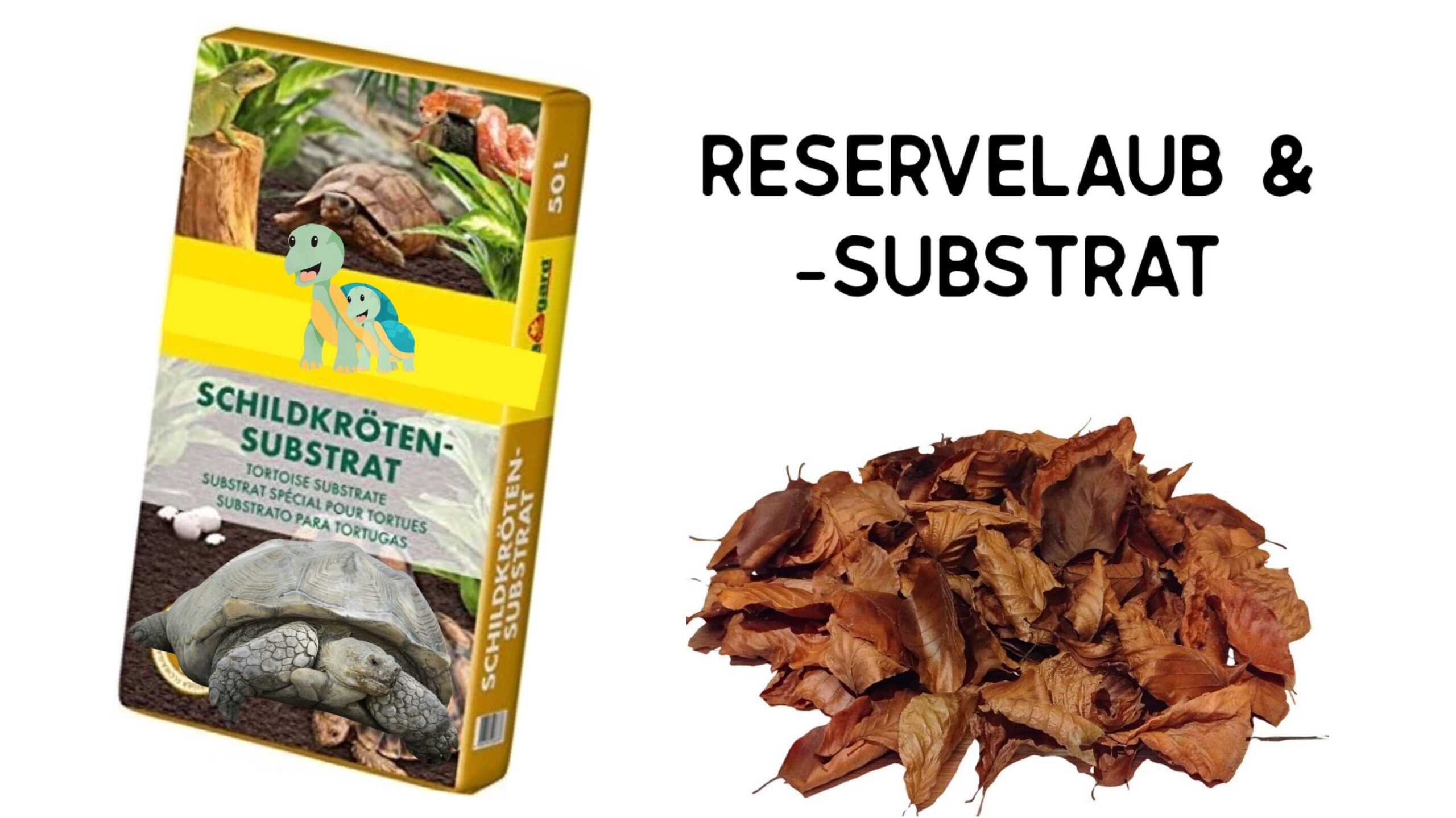
Put the substrate back into the box and mix it thoroughly down to the bottom; at the first check, this is often enough. If it still feels too dry, moisten it lightly from the side with chilled water (one or two sprays) and mix again. The substrate must never be wet; it should only feel slightly moist. If it is too moist or mouldy, replace it with spare substrate pre-cooled to refrigerator temperature. If water drips out of the bottom of the box, it is far too moist → in this case, replacing the substrate with pre-cooled spare substrate is essential, as brumation in overly moist conditions can lead to health problems.
12) Putting the tortoise back:
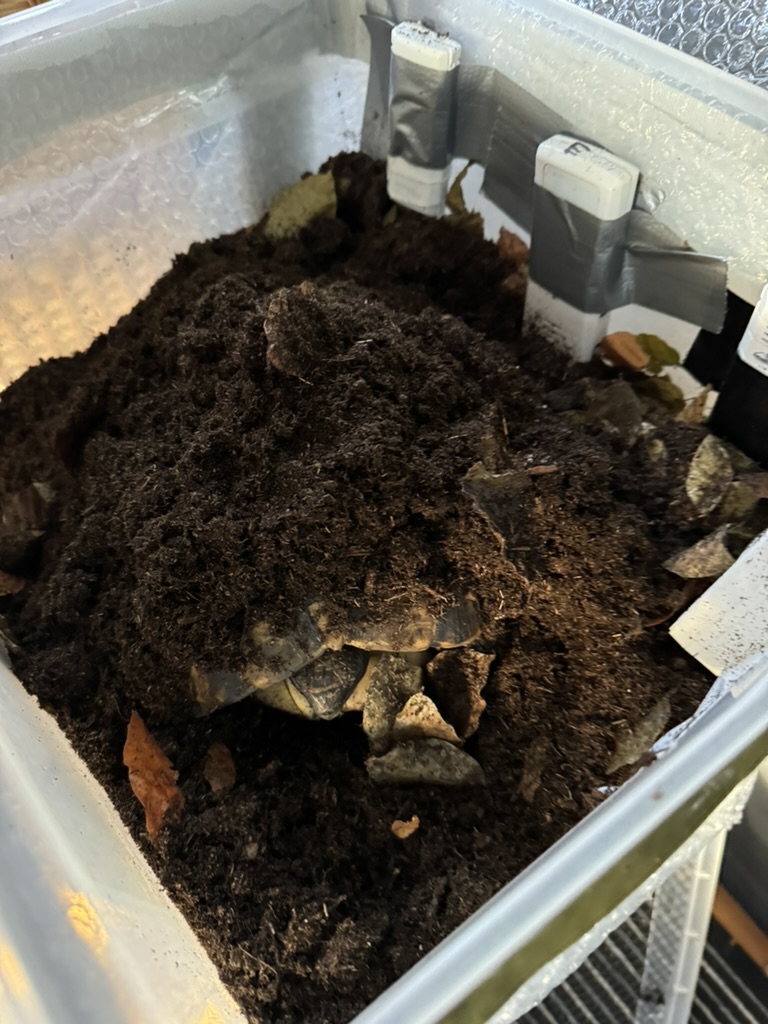
Form a hollow and put the tortoise back, as far as possible in its original position and facing the same direction. Loosely cover the hind legs and back with soil, leaving a generous area around the raised head free. Then top up the leaves, check the position of the sensors, secure the lid, and slide the box back into place.
Check that the brumation box does not touch anything and that the cable of the emergency cut-off (in German) is properly in place.
13) Leaves:
If the beech leaves are very dry, they can be lightly sprayed once or twice in the laundry basket with water at refrigerator temperature and mixed vigorously. The leaves can then be put back. Mouldy leaves should be replaced with chilled spare leaves, as mould can lead to health problems.
⚠️ Caution: evaporative cooling
If leaves or substrate are moistened too much, evaporative cooling can cause a dangerous drop in temperature in the refrigerator. Therefore, moisten only sparingly and when necessary, and monitor the minimum temperatures in the refrigerator particularly closely after moistening and after the door has been open for a longer time. If the temperature does drop sharply, moisten much more sparingly at the next check.
14) After the check, do not ventilate the refrigerator again for two to three days; otherwise, leave the animals completely undisturbed.
Brief ventilation of about 10 seconds then resumes every two days; small and fully occupied refrigerators are ventilated daily.
What to do if you notice anything unusual during brumation
15) If you notice minor abnormalities during a check:
– take photos (without flash)
– put the tortoise back into the refrigerator in its brumation box for the time being
– contact the reptile vet promptly, send them the photos, and discuss the problem
– only then decide whether to continue or end brumation
16) Emergencies:
Is there reddening, soft areas, or spots on the shell, or are there breathing noises? Is the animal sitting with its beak open, is there discharge or oedema, are animals frozen in the substrate, or are animals awake in the refrigerator despite correctly verified brumation temperatures (in this case, always cross-check with another thermometer)? Is there no reaction whatsoever from the animal?
In these cases, place the animal straight away in its brumation box with the mesh lid in a cool room (slightly warmer than the refrigerator) and contact a reptile vet.
Clarify carefully to what temperature the animal should be warmed up before the consultation. Some reptile vets prefer to warm such animals up themselves under controlled conditions at the practice, while others would like the animal to arrive already slightly warmed up.
In any case, slow, gradual warming of our ectothermic animals by moving the box into progressively warmer rooms is important. For the tortoise’s wellbeing, it is important to avoid any drastic measures. Heat lamps are not used at first, as they could lead to circulatory collapse.
Remember: animals that do not (or cannot) move by themselves must never be placed under or on a heat source.
If you are unsure whether the animal is still alive, consult the reptile vet as well. You can find out more in the article “Has My Tortoise Died?”.
In many cases, the animal is simply in particularly deep brumation, especially at borderline low brumation temperatures approaching 4 °C. Here, the brumation temperature should be set slightly warmer in future, at 5–6 °C. Live animals that show no reaction at all during the check should gradually begin to show slight reactions and movement from about 12 °C upwards.
Should an animal actually have died, a post-mortem examination (necropsy) can be considered for the sake of any animals kept with it, in order to determine the cause of death. For this, the body must be kept chilled, but not frozen, until it is sent off. More on this topic can be found, for example, from the German laboratory Exomed (in German).
Equipment checklist before each check
✔ Scales (smooth, level surface)
✔ Notepad & pen / weighing table
✔ Mobile phone (camera mode)
✔ Torch (to check the plastron from below)
✔ Two containers for leaves and substrate
✔ Spray bottle with water at refrigerator temperature
✔ Pre-cooled spare substrate and spare leaves
✔ Fresh batteries in all measuring devices?
The Refrigerator Brumation Handbook explains every step of refrigerator brumation from A to Z in detail, including lowering the temperatures, moving the tortoises into the refrigerator, the routine during brumation, and bringing the tortoises out of brumation into species-appropriate husbandry.