Tortoises are among the longest-lived pets, and European tortoises can even live to over 100 years of age. But they, too, will die one day. Keepers are then faced with the important question of how to tell reliably whether a tortoise has died. The distinction is particularly difficult during phases of rest or during brumation, as tortoises show hardly any breathing, heartbeat, or movement at these times anyway.
“Determining death in reptiles is a difficult puzzle with many pieces.” (Zierschildkroete.de, translated)
First of all, touch your tortoise and, for example, gently pull on one of its legs. As a rule, it should then show a slight reaction.
Signs that a tortoise has died may include absent breathing, no reaction when the eyelids are gently touched, retracted limbs, a stiff posture (rigor mortis), and a heartbeat that can no longer be felt. As tortoises can appear very sluggish when asleep or in brumation, the body temperature should also be checked. Live animals usually still react to stimuli – albeit very slowly. If in doubt, it is essential to have the tortoise examined by a reptile vet as quickly as possible (for Germany, see the vet list of the AG ARK).
If the tortoise is at brumation temperature, and the temperature is borderline low (around 4 °C), it can take quite a while before it reacts. To avoid temperature shock and circulatory collapse, the tortoise is first moved to a cool room that is slightly warmer than its brumation environment, and later exposed step by step to somewhat warmer ambient temperatures. The temperatures are thus raised gradually and carefully over several hours. A reaction should then gradually become noticeable. Animals coming out of brumation must never be placed directly under a heat source, not even partially.
Resuscitating tortoises?
If you suspect that the tortoise might be revived, you could try the following on the way to the vet:
Tortoises can sometimes be revived by gently pulling out the front legs, which pulls the internal organs apart, and then gently pushing them back into the shell, which compresses the organs. The pumping movement of the legs transfers the massage to the heart and lungs. In such cases, a reptile vet must of course be consulted as quickly as possible. There have also been cases in which giving oxygen has helped, for example with victims of fires.
Signs of death in tortoises
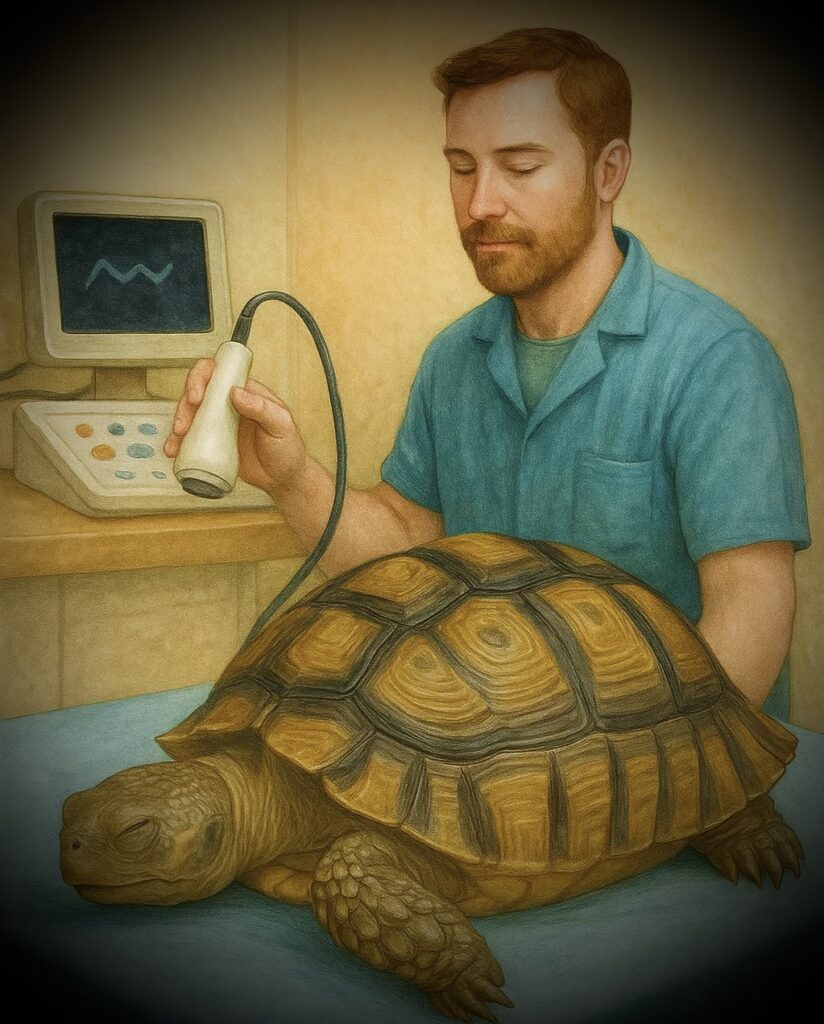
- No heartbeat. If it is unclear whether a tortoise has died, a reptile vet can check the heartbeat with special equipment, for example by ultrasound. Note that a reptile’s heart can continue to beat for several hours after brain death. Detecting a heartbeat alone is therefore not a reliable sign of life.
- No breathing: the animal shows no breathing movements.
- No eyelid reflex: there is no blinking when the eyelids are touched lightly.
- Sunken eyes: the eyes look sunken and dried out and are no longer plump.
- Grey mucous membranes: the mucous membranes in the mouth appear discoloured and grey.
- Rigor mortis: after some time, the body becomes stiff.
- Signs of decomposition: after several hours or days – depending on the temperature – odour and external changes may appear, and as decomposition progresses, body fluids leak out.
What to do if you suspect death?
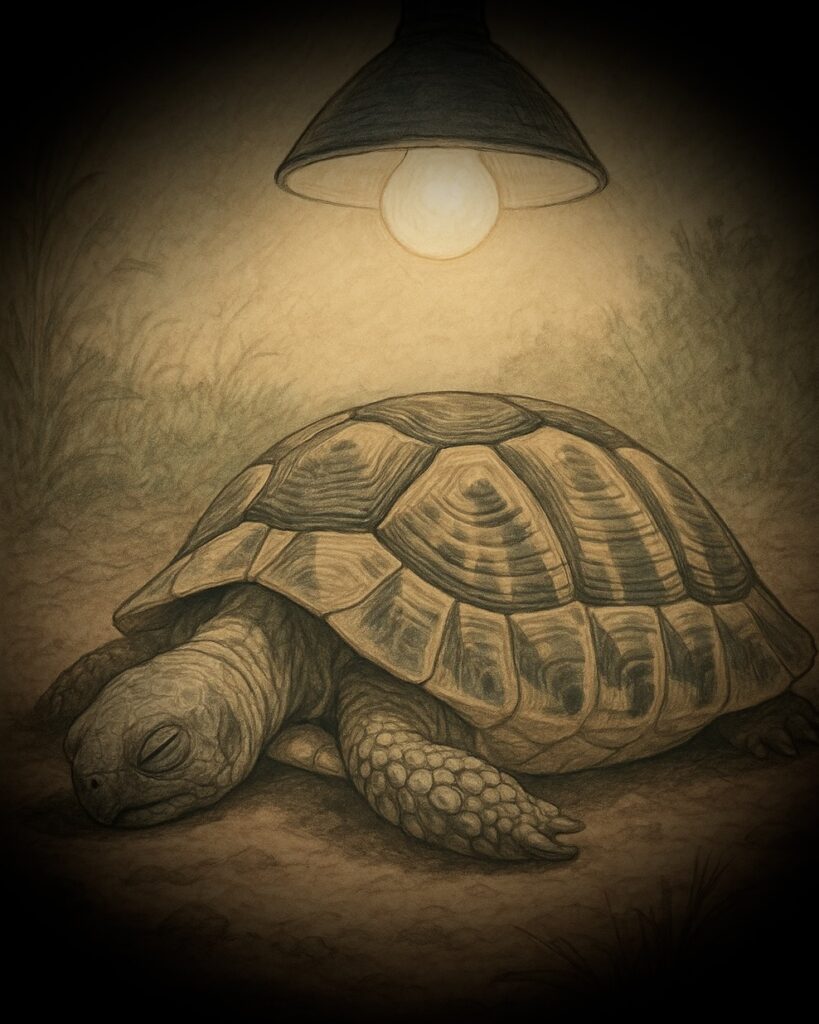
- Heat lamp test: carefully place the tortoise with only one leg under the outer edge of a heat lamp’s radiation. A lifeless animal is never placed directly under a heat lamp. If it does not react, this may be a sign of death.
- Consult a reptile vet: if in doubt, always see a reptile vet to obtain a clear diagnosis.
Rigor mortis in tortoises
In reptiles, rigor mortis is the only reliable sign of death. Immediately after death, the muscles relax completely. Biochemical processes in the muscle fibres then cause them to stiffen progressively. In mammals, full rigor mortis sets in after about 6–8 hours and resolves after 2–4 days, when the muscles break down through decomposition.
In tortoises, the onset of rigor mortis depends on body size and ambient temperature. The timescales are, however, said to be roughly similar to those in mammals.
If in doubt, you should therefore wait until rigor mortis has demonstrably developed in order to confirm a tortoise’s death with certainty.
Conclusion
Laypeople should always consult a reptile vet to clarify whether the tortoise may still be alive, and possibly suffering, or to establish death beyond doubt.
Official requirements after the death of a tortoise (Germany)
In Germany, after a tortoise has died, the keeper must submit a notification to the responsible wildlife protection authority within one month, recording the animal’s death. The authority then usually withdraws the animal’s papers. As a precaution, it is a good idea to make copies of all papers and either hand them in personally and ask for a receipt, or send them by registered post. In the UK and other countries, check the requirements that apply where you live.
Taxidermy
If you would like a taxidermist to preserve your animal, for example to keep the shell, you should obtain papers for this from the wildlife protection authority as quickly as possible, as all parts of deceased animals of protected species must be accompanied by papers.
Checklist: notification requirements for tortoises (Germany)
✅ Notification required for:
- Buying or taking on a tortoise
- Passing it on to another person
- Captive breeding (your own hatchlings)
- Death, escape, or loss
- Moving house (change of address)
✅ Deadlines:
- Additions/disposals/losses: immediately, within one month at the latest
- Your own captive-bred young: within three months at the latest
✅ Details in the notification:
- Number of animals
- Species (common and scientific name)
- Sex and age
- Identification (e.g. photo documentation, microchip, if required)
- Location where the animals are kept (address)
- Origin or new keeper (name and full address)
- Reason for the notification (e.g. acquisition, transfer, death)
✅ Good to know:
- The notification requirement applies to the keeper personally (for minors, to their parents or guardians).
- The responsible authority depends on where the animals are kept (e.g. nature conservation authority, environmental agency, or regional council).
- Always keep copies of all notifications for your own records.
Burial options for tortoises
🏡 Burial in your own garden
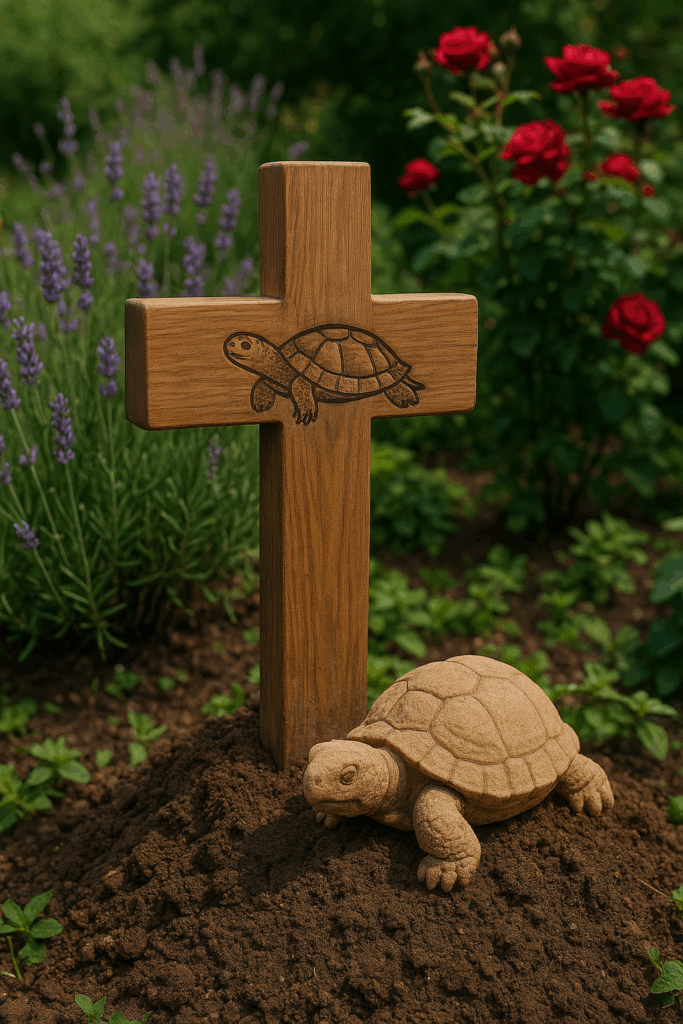
In Germany, burying small pets in your own garden is generally permitted if the property is not in a water protection area, a sufficient distance is kept from public paths and neighbouring properties, and the grave is of a minimum depth. Rules differ elsewhere, so check your local regulations.
Advantages:
- personal and familiar
- close to the animal
- no additional costs
Disadvantages:
- not permitted everywhere; regulations differ by federal state and municipality
- prior consultation with the official veterinarian may be necessary
- not possible on rented property without the owner’s consent
- Caution: improper burial can attract predators! Never bury tortoises near the enclosure.
🐾 Leaving the body with the vet
Advantages:
- a simple and safe solution
- hygienic disposal via a collection point is guaranteed
- the vet can put you in touch with a crematorium on request
Disadvantages:
- no personal place to say goodbye
- usually low, but nonetheless some, costs
🔥 Pet crematorium
Another option is cremation at a small-animal crematorium, after which the ashes may be buried on your own property or kept in an urn.
Individual or communal cremation
With individual cremation, you receive your animal’s ashes back, whereas with communal cremation the ashes are mixed with those of other animals and usually buried in a pet cemetery.
What happens to the ashes
After cremation, you can keep the ashes in an urn, scatter them, or have them made into a piece of jewellery.
Advantages:
- a dignified way to say goodbye
- the option of taking the ashes home in an urn
Disadvantages:
- a longer journey, or arrangements via the vet, may be necessary
- higher costs than the other options
Post-mortem examination
If the animal has died for no obvious reason, an examination at a specialist institute or by an experienced reptile vet can help to determine the cause and avoid future problems in the remaining animals. For this, the animal should be kept cool (but not frozen) and sent off, securely packed and chilled, as quickly as possible. If the cause of death is to be established, the necropsy provides important information about diseases, parasites, or other factors that may be relevant to husbandry.
Note: after a necropsy at a specialist laboratory, the animal is not usually returned; if the necropsy is carried out by your trusted reptile vet, it may be possible to bury the tortoise’s remains afterwards.
Further information on necropsies is available from the specialist laboratory Exomed (in German).