The life insurance policy for tortoises brumating in the refrigerator
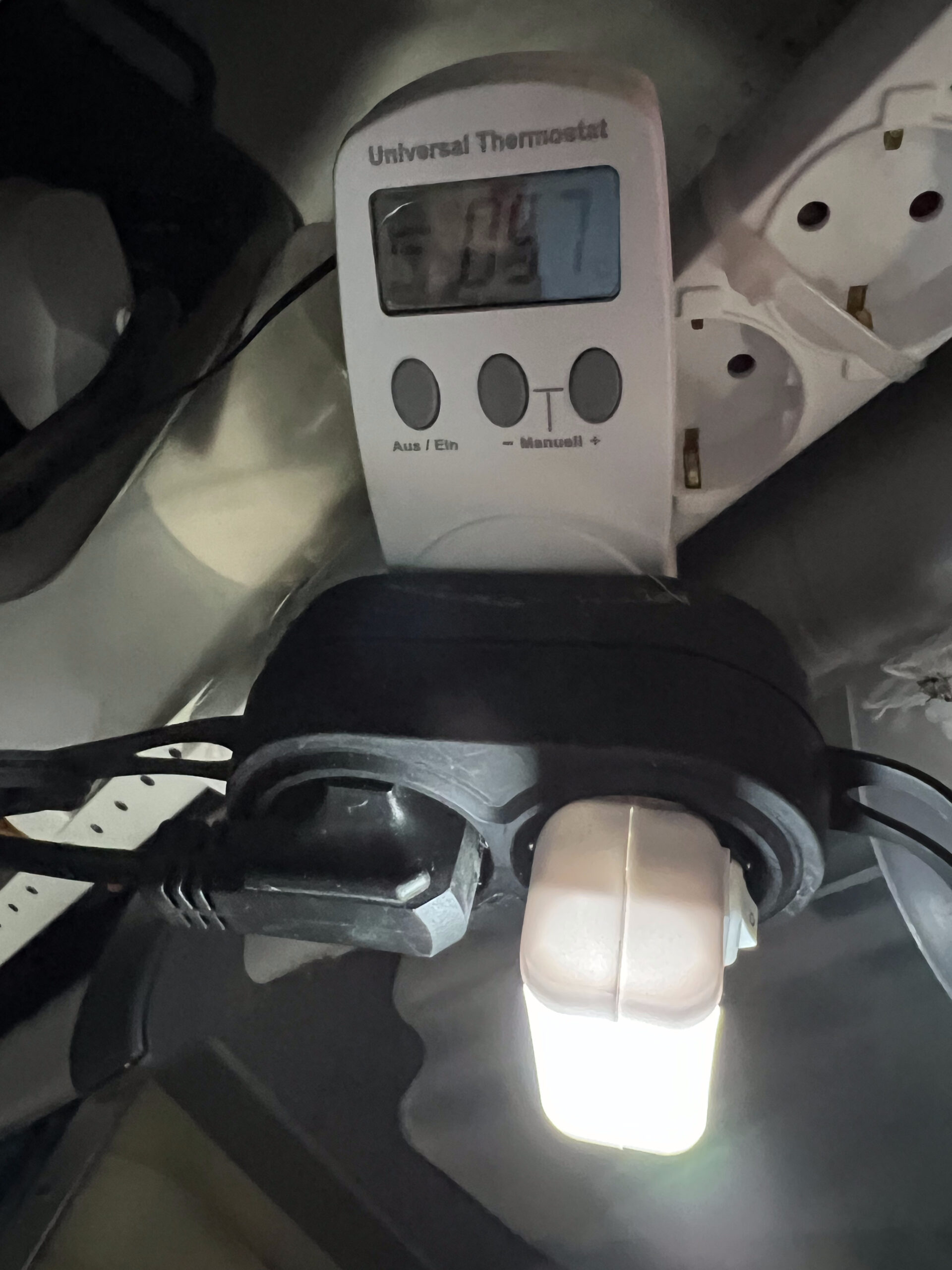
To safeguard the tortoise refrigerator against faults during controlled refrigerator brumation, keepers traditionally use an Equiva UT300 universal thermostat, thanks to its temperature range, adjustable in tenths of a degree (see hysteresis), and its thin sensor cable. Unfortunately, the UT300 has had only limited availability since early 2026, so our shopping list now includes an alternative with the same specifications, though it still needs to prove itself in long-term use.
It should only be programmed once the refrigerator has been stabilised without animals, with probe-thermometer temperature readings completed for every shelf. Only then will you have identified the coldest shelf in the refrigerator, and can set the emergency cut-off accordingly. It serves only as an „emergency cut-off“; the thermostat is not meant to take over control of the refrigerator itself. It is also sensible to keep a spare thermostat on hand together with your other reserve equipment.
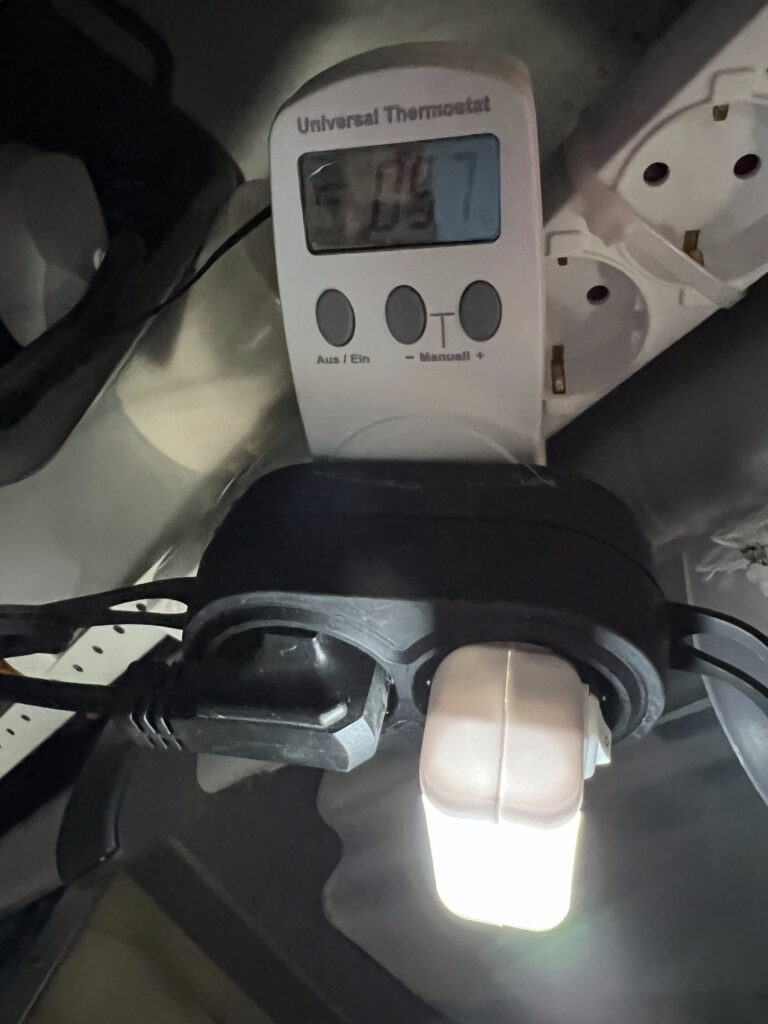
The emergency cut-off is plugged in between the socket and the refrigerator’s plug. The sensor cable is passed through the refrigerator door and protected from crushing and cable breakage with duct tape.
The sensor then goes to the back of the box, at the coldest point in the refrigerator, previously identified with the probe thermometers. The sensor is again tucked slightly into the substrate under the leaves. The temperatures are then set on the emergency cut-off thermostat, and „cooling“ is displayed. Ideally, the refrigerator is set up well enough that the emergency cut-off never needs to switch it off. This is also good for the refrigerator’s service life.
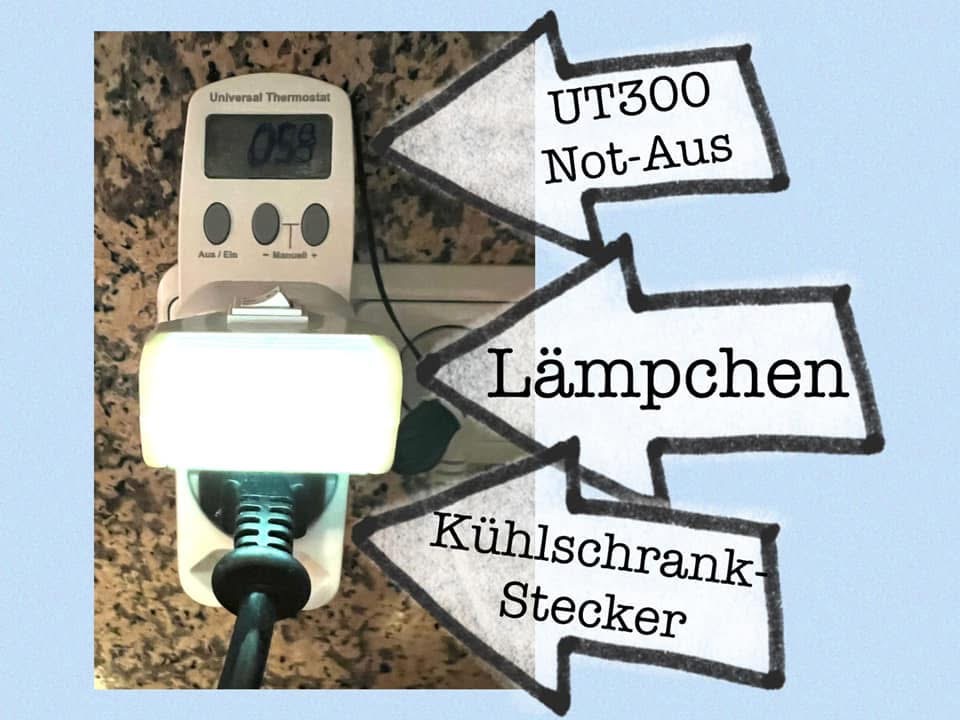
A small indicator lamp, plugged in via a multi-socket adaptor, shows whether the refrigerator is on or off. This is very helpful for setting the emergency cut-off correctly.
If, for example, the minimum temperature in the coldest box is 4.8 °C, the emergency cut-off sensor goes to the back of that box. The UT300’s „OFF“ temperature should be 0.2 °C below the measured minimum, acting purely as an „emergency cut-off“. So, in this example: minimum temperature 4.8, emergency cut-off OFF at 4.6.
Set OFF no lower than 4.3 °C, and ON no higher than 5.8 °C.
If the maximum temperature is, for example, 6.8 °C, set 5.8 °C.
Maximum temperature 5.9 °C = ON at 5.7 °C (-0.2 °C).
Never set OFF below 4.3 °C, and never set ON above 5.8 °C. Test in 0.1 °C steps to find what suits the refrigerator best. The coldest box should never fall below 4 °C. Keep checking the minimum and maximum temperatures daily.
Note: some refrigerators continue cooling by up to 1 °C after switching off.
If a refrigerator is hard to regulate and still gets too cold even on its warmest setting, it must be controlled entirely via the emergency cut-off. Bear in mind that, should the emergency cut-off itself fail, this poses a danger to the animals‘ lives. This approach should therefore only be used as a stop-gap, with a new refrigerator obtained as quickly as possible. One setting that has proved useful in such emergencies: OFF at 5.3 °C, ON at 5.8 °C. Monitor the refrigerator very closely and replace it with another one as soon as possible.