Note: Weeks 1–4 are the usual gradual temperature-reduction period; Weeks 5–6 cover resting and established brumation in the cold frame. Spur-thighed tortoises (Testudo graeca ibera) from warmer southern habitats may start the reduction about one week later.
Rest begins
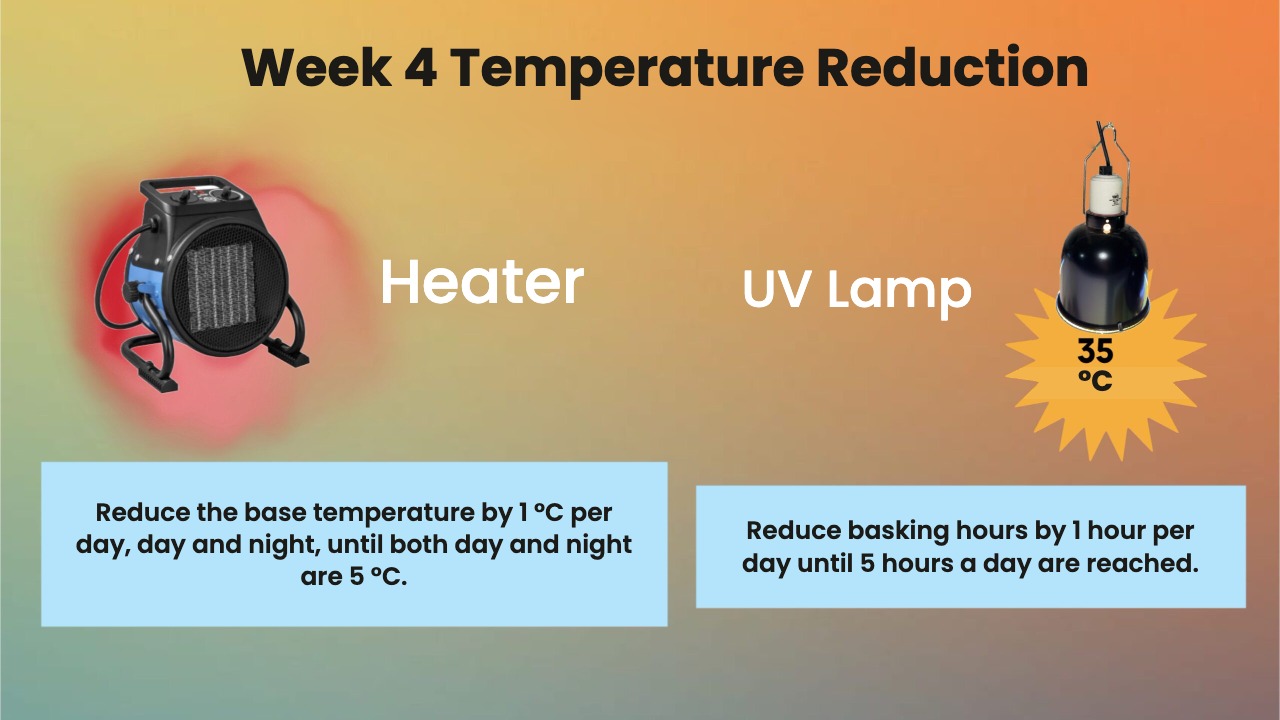
For Hermann’s and marginated tortoises, Week 4 usually completes the gradual reduction of ambient temperatures. Target approximately 5–6 °C both day and night, reducing temperatures by no more than 1 °C per day. This is the end of the standard four-week reduction phase.
Basking while tortoises remain active
Continue the UV basking spotlight for five hours daily, giving about 35 °C locally at shell height. As long as any animal occasionally eats, basks or bathes, this warmth remains important. Animals may still emerge even after several inactive days. Once all have remained hidden and inactive for several days, preferably a full week, the basking lamp can be switched off. Usually it remains available until the end of Week 4, or longer if required.

Stable temperatures and close monitoring
Maintain approximately 5–6 °C with a thermostat and, ideally, an independent temperature alarm. Temperatures must never fall below 4 °C: 3.7 °C proved fatal for Hermann’s tortoises of the subspecies Testudo hermanni hermanni (Bonin et al. 2007).

- Measure in the substrate with a probe thermometer.
- Measure at the side of the carapace with an infrared thermometer when the animal is above ground.
- Monitor the ambient temperature at tortoise height.
Continue providing fresh food and water freely while the animals are active. Do not force-bathe tortoises kept in suitable cold-frame accommodation.

Spur-thighed tortoises from warm habitats
For Testudo graeca ibera from southern Turkey and similar warm regions, the reduction may take longer. At the corresponding stage, the basking lamp may still be offered for six hours at 35 °C at shell height, while ambient temperatures move gradually towards about 5 °C at night and 11 °C by day. Never reduce by more than 1 °C daily. These animals are the stated exception to the usual four-week schedule.
Do not rush refrigerator transfer
Animals that are merely resting should not be transferred. Wait until the temperature at each tortoise has remained below 8 °C day and night for around one to two weeks and the animals are firmly in brumation. Premature movement may cause stress and disruption. This waiting period is separate from the four weeks of routine temperature reduction.
The dedicated refrigerator should be fully test-run without animals at 4.5–7 °C on every occupied level. Place thermometers at the back of the boxes beneath the leaves, slightly in the substrate. Avoid any contact between boxes and the rear refrigerator wall. Insulation can be used where necessary to stabilise temperatures.

Emergency cut-off thermostat
Once the refrigerator has remained stable for about a week, the independent emergency cut-off thermostat is connected. It protects against excessive cooling and does not replace the refrigerator’s own thermostat. Settings: OFF 0.2 °C below the lowest temperature measured in the coldest box, never below 4.3 °C; ON 0.2 °C below the highest temperature measured, never above 5.8 °C. Examples: 4.8–6.4 °C → OFF 4.6 °C / ON 5.8 °C; 4.5–5.9 °C → OFF 4.3 °C / ON 5.7 °C.
Always adjust and test the system without animals, in 0.1 °C steps as appropriate, and observe it for several days. Refrigerators may continue cooling after switch-off.
Refrigerator Brumation Handbook
Refrigerator Brumation Checklist