Staying Parasite-Free Through the Tortoise Year
Regular stool testing for intestinal parasites at the reptile vet or a specialist laboratory (e.g. Exomed) is very important for our animals‘ health. Several times a year, we therefore have stool samples from our tortoises tested for intestinal parasites.

Typical Intestinal Parasites in European Tortoises
Typical intestinal parasites in European tortoises (e.g. Hermann’s tortoise Testudo hermanni, Greek/spur-thighed tortoise Testudo graeca) are mainly the following:
1. Oxyurids (pinworms)
- The most common parasite infestation in tortoises.
- Live in the hindgut.
- A heavy burden can cause digestive problems and weight loss.
- Transmitted via contaminated stool.
2. Strongylids (hookworms/roundworms)
- E.g. Strongyloides or other nematode species.
- Can damage the intestinal lining.
- Symptoms: weight loss, diarrhoea, lethargy.
3. Ascarids (roundworms)
- Less common in tortoises than in other reptiles.
- Large worm species, visible in the stool with heavy infestations.
- Can cause bowel obstruction.
4. Protozoa (single-celled organisms)
- Flagellates (e.g. Hexamita, Trichomonas)
- Some species are harmless, others pathogenic.
- Amoebae
- Pathogenic amoebae cause bloody diarrhoea and are dangerous.
- Coccidia (e.g. Isospora)
- Especially problematic in juveniles.
- Lead to weight loss and diarrhoea.

Stool Testing
Ideally, collect stool over 3 days. The sample should be as free as possible of small stones, soil, or food residue. Individual stool samples are the most informative, but if housed together, all tortoises in the group are dewormed when one is infested. Current practice is generally to treat from even a light (+) infestation onward. Parasites have different life cycles, so they are not always detectable. However, deworming should never be carried out without a prior stool test.
The stool is kept with a drop of water in sample tubes in the fridge. The fresh sample should then be submitted to the vet for testing as soon as possible.
If using a postal collection kit, it’s best to collect over the weekend and post the sample on Monday.
If no stool can be found, the tortoises can occasionally be placed twice a day in their bathing dishes with hand-warm water in the cold frame. This encourages them to pass stool and is not particularly stressful, since they can leave the dish again at any time.
Diagnosis
- Stool testing (flotation, sedimentation, direct smear, possibly PCR) by a reptile vet (in German) or a specialist laboratory. General practice vets without reptile specialisation are often not equipped to correctly interpret tortoise test results. See below for how to submit a sample.
Treatment
- Treatment depends on the parasite: e.g. fenbendazole for pinworms, metronidazole for flagellates, sulfonamides for coccidia. These medications are prescription-only and not available over the counter. If the diagnosis comes from an external laboratory, some reptile vets want to run their own follow-up test on the stool. It’s therefore worth clarifying the procedure in advance, to avoid paying for the test twice.

Deworming
If an infestation is found, the reptile vet will prescribe a deworming medication. For the usual pinworm cases, either Panacur or Welpan is typically recommended.
These medications come in various forms and strengths, and every reptile vet prefers a slightly different dosing schedule. This often raises questions in keeping advice, but all schedules share the same principle: dosing at set intervals over a period of roughly two weeks.
For adult tortoises there are tablets that can simply be given hidden in a treat. For juveniles there is a suspension that has to be given with a pipette. The current weight of the animal is taken for the prescription, so the vet can calculate the correct dose.
If you’re new to keeping and don’t feel confident giving the medication yourself, take the tortoise to the reptile vet at each scheduled dose instead. That way you can be sure the full dose actually reaches the animal.
During the period after deworming, stool must be removed thoroughly and promptly. Water dishes should be kept scrupulously clean. Finally, the substrate along favourite paths and hiding spots can be removed and replaced with fresh topsoil or tortoise substrate. Good hygiene is very important for the success of the treatment.
Follow-Up Testing
Roughly two to three weeks after the last dose, a stool sample should be submitted again for testing, to make sure the tortoise’s stool is genuinely parasite-free. If parasites are still present, the tortoise is dewormed again. The first stool test of the year should be carried out after temperatures are brought back up following brumation. A second test should then be done as a precaution in late summer, as part of the pre-brumation check at the reptile vet. Beginners are well advised to put these dates straight into the calendar and book vet appointments well ahead of time.
With a very heavy worm burden, a tortoise can have trouble passing the resulting clumps of parasites, so keep a close eye on stool output.
If the tortoise is clearly struggling to pass stool, or you see unsuccessful straining, contact the reptile vet directly. In extreme cases, constipation and even life-threatening bowel obstruction can occur. Reassuringly, this is not normally something to worry about — it only happens in rare individual cases with particularly heavily infested tortoises, such as confiscated animals from the illegal wildlife trade, wild-caught specimens, or severely neglected animals. Keepers should simply be aware that if a deworming course doesn’t go smoothly, the reptile vet should be consulted.
Parasite-Free into Brumation
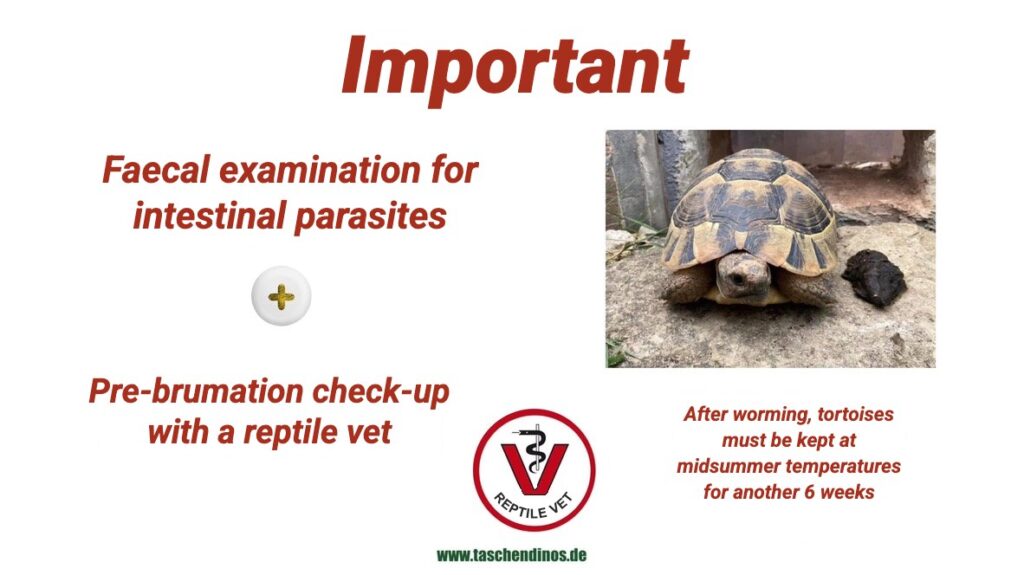
A negative stool test for intestinal parasites is one of the basic requirements for safely brumating a tortoise. It is therefore usually part of a pre-brumation checkup at the reptile vet. No tortoise should begin the temperature reduction without a negative stool test. In his talk at the Gießen Tortoise Workshop (in German) in 2023, Dr Malek Hallinger of the Exomed laboratory explained that many of the tortoises he had necropsied after dying during brumation were heavily infested with parasites. He has also written an interesting article on parasites in Schildkröten im Fokus 3/2020 (in German) from Kleintierverlag. See also our write-up of Dr Hallinger’s 2026 talk on gastrointestinal parasites, which includes the slides and keeper handout from that session.
Keeping Them Warm
It is very important that, after deworming, the tortoise is kept at high-summer temperatures (in German) for a good six weeks, so that the parasites are passed while the metabolism is running well and the medication can be fully metabolised. Keeping the tortoise warm naturally also means providing a bright, warm UV basking lamp (see our Technology Handbook), under which the tortoise can reach its preferred temperature of 35–38°C. Tortoises that go straight from deworming into the temperature reduction towards brumation run a high risk of developing health problems during brumation from parasites that haven’t yet been cleared.

Prevention
- Regular stool testing (at least twice a year)
- Enclosure hygiene (remove stool (in German) daily)
- Quarantine (in German) for new arrivals
- No overcrowding in the enclosure (in German) (at least 10 m² per animal)
- Limestone chippings (in German) in the enclosure, which make stool easy to find and remove
For more on this, see Dr Hallinger’s talk on gastrointestinal parasites in tortoises, and our English Resources page for further reading.