Where Does Cuttlebone for Our Tortoises Come From?
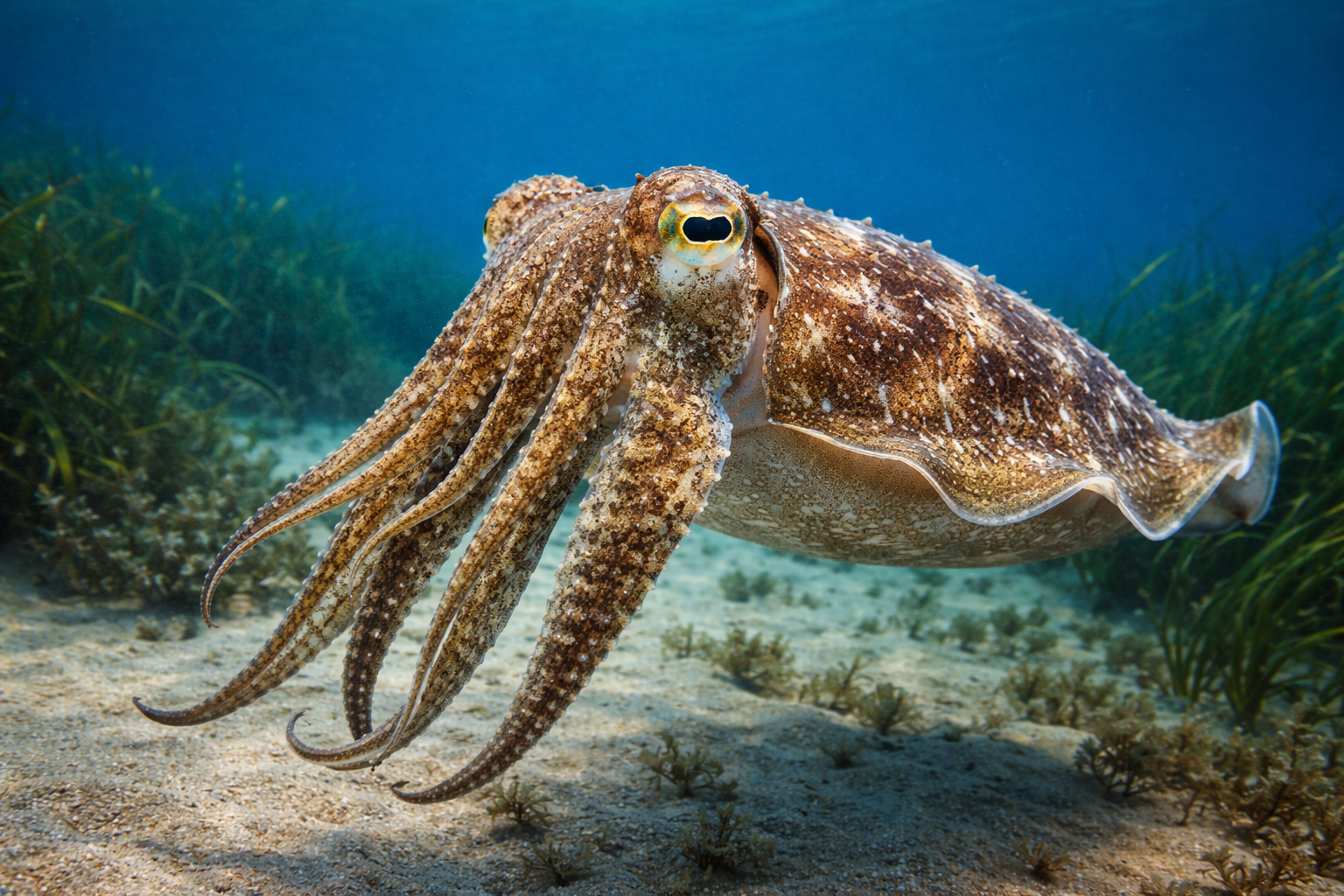
So-called cuttlebone (German: Sepiaschulp) is not an artificial product, but a natural part of the body of cuttlefish — true cuttlefish of the order Sepiida, within the ten-armed cephalopods (Decabrachia).

What Is a Cuttlefish?
Cuttlefish are often casually lumped in with „squid“ or „octopus“ in everyday speech, but they differ clearly from octopuses:
- Ten arms: eight short arms and two long feeding tentacles
- An internal calcareous shell: the cuttlebone
- Highly developed camouflage: colour and texture change within seconds
- Active predators: lightning-fast hunting of crustaceans and small fish
They live mainly in shallow coastal waters, often over sandy ground or in seagrass meadows, and are mostly nocturnal. Their lifespan is short, with many species living only about a year.

Cuttlebone regulates buoyancy: gas- and fluid-filled chambers adjust the cuttlefish’s specific gravity, allowing it to hover in the water with very little energy expenditure.
Distinguishing Cuttlefish from Other „Squid-Like“ Animals
- Cuttlefish vs. octopus: octopuses have eight arms and no internal shell.
- Cuttlefish vs. squid: squid also have ten arms, but only a thin, chitinous support structure (the gladius), not a calcareous cuttlebone.
Significance for Humans
- Culinary: cuttlefish meat is boiled, fried, or deep-fried; its ink is used to colour foods such as pasta black.
- Aquaria: keeping them is suitable only for very experienced marine aquarists.
- Reptile keeping: cuttlebone has been a proven, natural calcium source for birds and reptiles — tortoises in particular — for decades.
Cuttlebone: Structure and Function
Cuttlebone is an internal, porous calcareous structure made almost entirely of calcium carbonate (aragonite).
Its function for the cuttlefish:
- Acts as a buoyancy aid
- Regulates specific gravity via gas- and fluid-filled chambers
- Allows energy-efficient hovering in the water
After the cuttlefish dies, the cuttlebone separates from the soft body and can rise to the water’s surface.
How Does Cuttlebone Reach Us?
Cuttlebone sold for tortoises‘ calcium supply comes from two main sources:
1. Bycatch and Processing of Cuttlefish
Cuttlefish are caught as food in many Mediterranean and Atlantic regions.
During processing:
- the soft body is used for food
- the cuttlebone is removed as a by-product, cleaned, and dried
👉 So the cuttlebone isn’t produced specifically for the pet trade — it’s a sensible use of a by-product.

2. Washed-Up Cuttlebone
Some of the cuttlebone sold commercially comes from:
- naturally washed-up cuttlebone fragments
- collected on coastlines after storms or strong currents
These are likewise cleaned, dried, and sorted.
Why Is Cuttlebone So Valuable for Tortoises?
For tortoises, cuttlebone is a close-to-natural calcium source, especially for fast-growing juveniles and egg-laying females:
- very high calcium content
- free of artificial additives
- self-regulated intake: the tortoises gnaw on it themselves, as needed
- supports shell growth, bone metabolism, and egg-laying
For Mediterranean species in particular, this form of calcium intake matches their natural behaviour.

Conclusion
Calcium is an essential mineral for tortoises, not an optional „extra“. It is needed for bone, shell, muscle and nerve function, and, in females, in connection with reproduction and eggshell formation. What matters is not just calcium intake itself, but its interplay with phosphorus (in German), magnesium, vitamin D₃, UVB radiation (in German), suitable temperatures, and seasonal metabolic changes. An inadequate calcium supply or an unfavourable calcium-to-phosphorus ratio (in German) can lead to disorders of bone metabolism in reptiles, up to and including metabolic bone disease. Cuttlebone is therefore valuable above all as a freely available, calcium-rich supplement, but it does not replace an overall natural, fibre-rich diet or suitable UVB (in German) and warmth provision (in German).
Literature with Brief Abstracts
LIESEGANG, A., HATT, J.-M. & WANNER, M. (2007): Influence of different dietary calcium levels on the digestibility of Ca, Mg and P in Hermann’s tortoises Testudo hermanni. Journal of Animal Physiology and Animal Nutrition 91: 459–464. DOI: 10.1111/j.1439-0396.2007.00676.x.
This study examines, in adult Hermann’s tortoises, the effect of different dietary calcium levels on the apparent digestibility of calcium, magnesium, and phosphorus. The results show that the amount of calcium intake can affect the uptake and use of other minerals. The paper establishes calcium and phosphorus as relevant components of tortoise nutrition.
GEISLER, G., LEINEWEBER, C., PEES, M., ÖFNER, S. & MARSCHANG, R. E. (2023): The effects of sex, season, and natural sunlight on plasma vitamin D₃ levels in two chelonian species Testudo hermanni and Trachemys scripta and their interaction with calcium, phosphate, and magnesium as associated plasma compounds. Frontiers in Amphibian and Reptile Science 1: 1268801. DOI: 10.3389/famrs.2023.1268801.
This paper examines vitamin D₃, calcium, phosphate, and magnesium levels in Hermann’s tortoises and red-eared sliders, taking species, sex, season, and access to natural sunlight into account. The results show that these blood values are influenced by several biological and environmental factors. When assessing calcium metabolism, its relationship with vitamin D₃, UVB exposure, season, and sex therefore needs to be considered.
SELLERI, P. & DI GIROLAMO, N. (2012): Plasma 25-hydroxyvitamin D₃ concentrations in Hermann’s tortoises Testudo hermanni exposed to natural sunlight and two artificial ultraviolet radiation sources. American Journal of Veterinary Research 73(11): 1781–1786. DOI: 10.2460/ajvr.73.11.1781.
This study examined 25-hydroxyvitamin D₃ concentrations in Hermann’s tortoises after exposure to natural sunlight and two artificial UVB sources. The paper addresses the importance of UVB radiation for vitamin D₃ status. Since vitamin D₃ is involved in regulating calcium metabolism, the study contributes to understanding the relationship between UVB provision and mineral balance in tortoises.
HETÉNYI, N., LANG, Z., SÁTORHELYI, T. & HULLÁR, I. (2020): Effects of different vitamin D sources on blood biochemistry of bearded dragons Pogona spp. and Hermann’s tortoises Testudo hermanni. Berliner und Münchener Tierärztliche Wochenschrift 133. DOI: 10.2376/0005-9366-19024.
This study compares the effect of different vitamin D sources on blood biochemistry parameters in bearded dragons and Hermann’s tortoises, taking UVB exposure and oral vitamin D₃ supplementation into account. The study addresses the relationship between vitamin D supply, calcium metabolism, and blood values in reptiles under human care.
SCOPE, A., SCHWENDENWEIN, I. & SCHAUBERGER, G. (2013): Characterization and quantification of the influence of season and gender on plasma chemistries of Hermann’s tortoises Testudo hermanni. Research in Veterinary Science 95(1): 59–68. DOI: 10.1016/j.rvsc.2013.02.017.
This paper examines the influence of season and sex on various blood chemistry values in Hermann’s tortoises. The results show that physiological parameters can be subject to seasonal and sex-related variation. This should be taken into account when interpreting calcium values and other blood parameters.
LEINEWEBER, C., STÖHR, A. C., ÖFNER, S., MATHES, K. & MARSCHANG, R. E. (2019): Changes in plasma chemistry parameters in Hermann’s tortoises Testudo hermanni influenced by season and sex. Journal of Herpetological Medicine and Surgery 29(3–4): 113–122. DOI: 10.5818/18-07-159.1.
This study describes changes in various blood chemistry parameters in Hermann’s tortoises depending on season and sex. The results make clear that reference values and individual findings should be interpreted in light of biological variation — this also applies to mineral-balance parameters.
MATHES, K. A., HOLZ, A. & FEHR, M. (2006): Blood reference values in European tortoises Testudo spp. kept in Germany. Tierärztliche Praxis Kleintiere/Heimtiere 34: 268–274.
This paper records blood reference values in European tortoises kept in Germany. It provides comparison values for various blood parameters and serves veterinary assessment of clinical findings. In relation to calcium, the study is relevant when blood values and mineral status are evaluated diagnostically.
KLAPHAKE, E. (2010): A fresh look at metabolic bone diseases in reptiles and amphibians. Veterinary Clinics of North America: Exotic Animal Practice 13(3): 375–392. DOI: 10.1016/j.cvex.2010.05.007.
This review covers metabolic bone diseases in reptiles and amphibians. It describes, among other things, disorders of calcium and vitamin D metabolism, an unfavourable calcium-to-phosphorus ratio, and husbandry-related contributing factors. The paper establishes these as relevant causes of bone-metabolism disorders in reptiles.
MANS, C. & BRAUN, J. (2014): Update on common nutritional disorders of captive reptiles. Veterinary Clinics of North America: Exotic Animal Practice 17(3): 369–395. DOI: 10.1016/j.cvex.2014.05.002.
This review summarises common nutrition-related disorders in captive reptiles. Among other topics, it covers disorders related to calcium, vitamin D₃, and other nutrients, and describes secondary nutritional hyperparathyroidism as a relevant consequence of an unbalanced diet and unsuitable husbandry.
DONOGHUE, S. & MCKEOWN, S. (1999): Nutrition of captive reptiles. Veterinary Clinics of North America: Exotic Animal Practice 2(1): 69–91. DOI: 10.1016/S1094-9194(17)30140-8.
This paper gives an overview of reptile nutrition in captivity. It discusses various nutrition-related problems, including the supply of calcium, vitamin D₃, vitamin A, energy, and fibre. For tortoises, the source is relevant as a general basis for understanding nutrient supply and feeding mistakes.
SAHOO, G., SAHOO, R. K. & MOHANTY-HEJMADI, P. (1998): Calcium metabolism in olive ridley turtle eggs during embryonic development. Comparative Biochemistry and Physiology Part A 121(1): 91–97.
This study examines calcium metabolism in olive ridley sea turtle eggs during embryonic development. It describes the transfer of calcium from the eggshell to the developing embryo. The paper does not deal with tortoises, but illustrates the general importance of calcium for the development of chelonian embryos.