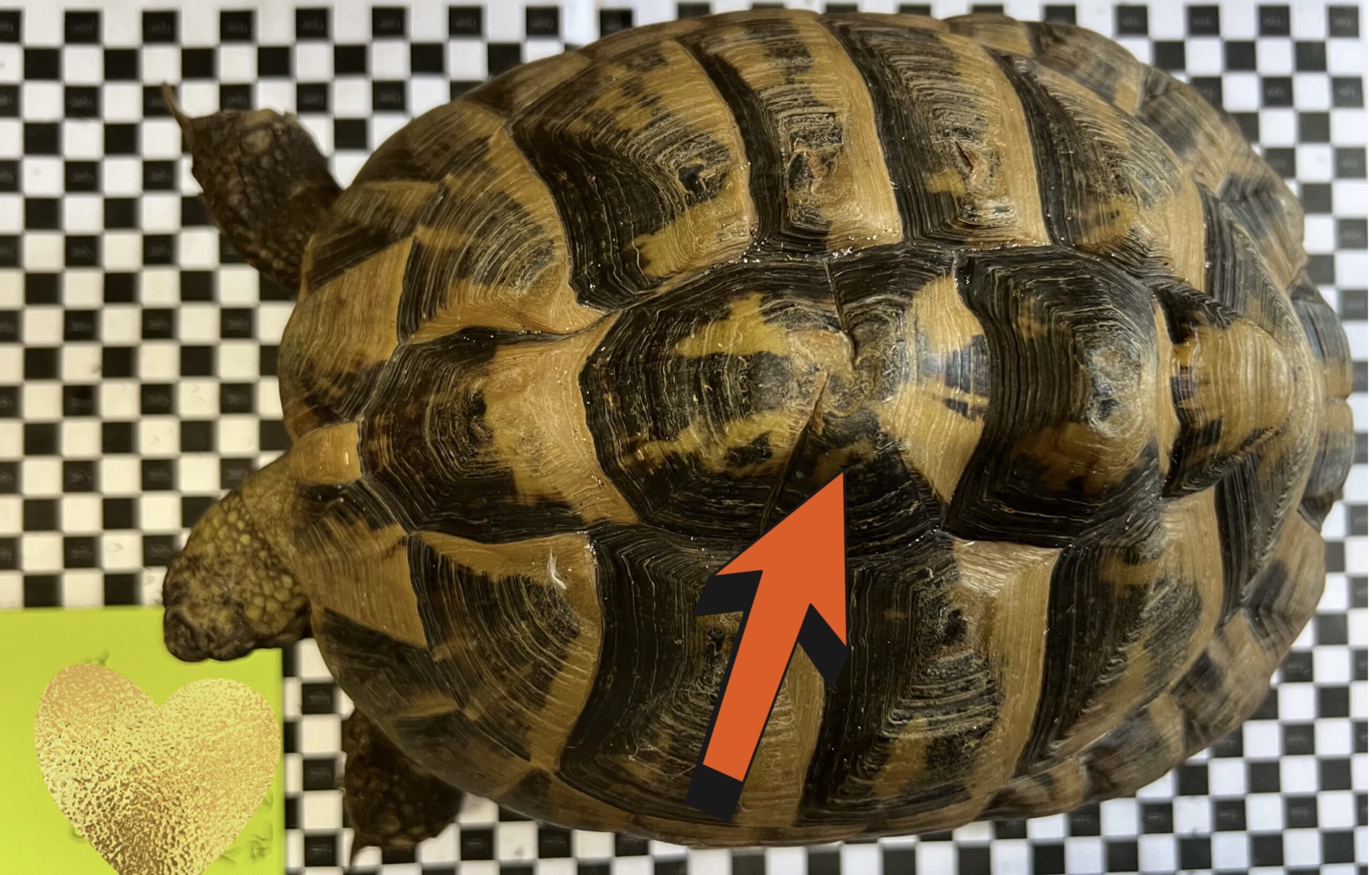
Shell anomalies in tortoises – unusual features on the shell – are fairly common. They occur at different frequencies in different species.

In the wild, comparatively few Hermann’s tortoises show such anomalies, whereas studies suggest the rate is several times higher in spur-thighed tortoises.
In captive-bred tortoises, the frequency of anomalies is many times higher than in the wild – reportedly up to a third of Hermann’s tortoises are affected.
There are many theories as to what might cause these anomalies. Suggested factors include genetic causes, random mutations, environmental conditions during incubation such as fluctuations in temperature and humidity, and jolts or other mechanical impacts on the eggs. External influences such as pollutants or bacteria entering through the eggshell may also play a role.
Incubation temperature is one confirmed factor: high temperatures appear to increase the risk of anomalies, probably because they favour the growth of bacteria that produce harmful substances. However, anomalies can also occur at lower temperatures, which suggests that several factors influence the risk together. In recent years, naturally incubated clutches with anomalies have also turned up in German-speaking countries (in German).
As a rule, shell anomalies pose no health risk – they are simply distinctive markings that make a tortoise unmistakable.
Occasionally, however, particularly in combination with husbandry-related carapace deformities such as humping, they can mean that a tortoise is unable to right itself after flipping onto its back, because the shell lacks the curvature needed to do so. Such tortoises should be watched closely, and the enclosure should offer plenty of graspable hiding plants and stones so that the tortoise can right itself if needed.
Right angles should be avoided in enclosure boundaries, as they invite climbing.
A tortoise lying on its back can suffocate, because the lungs sit at the top of the shell and then bear the animal’s entire weight. This is especially dangerous under heat sources and in full sun. A slightly tilted, graspable stone slab should therefore always be placed under the warm, bright basking spot, so that in an emergency the tortoise can roll off rather than remaining directly in the radiant heat.