Temperature Management for European Tortoises in Summer
During very hot weather, preventing heatstroke is essential for tortoises.


In high temperatures, water the enclosure and cold frame well, open the cold frame’s lid wide by hand, and provide shade with tarpaulins, bast matting, or similar materials. The shading can be dampened with water to create evaporative cooling.
Greenhouses can be darkened with purpose-made shade netting. If you use a fan heater on cold days, its „fan-only“ setting is ideal in summer for a cool breeze in the cold frame or greenhouse. A fan can help prevent heat building up.
In new, still-bare enclosures, shade can easily be provided with sun sails or parasols. A large pile of leafy branch cuttings also makes a nice, shady hiding place.
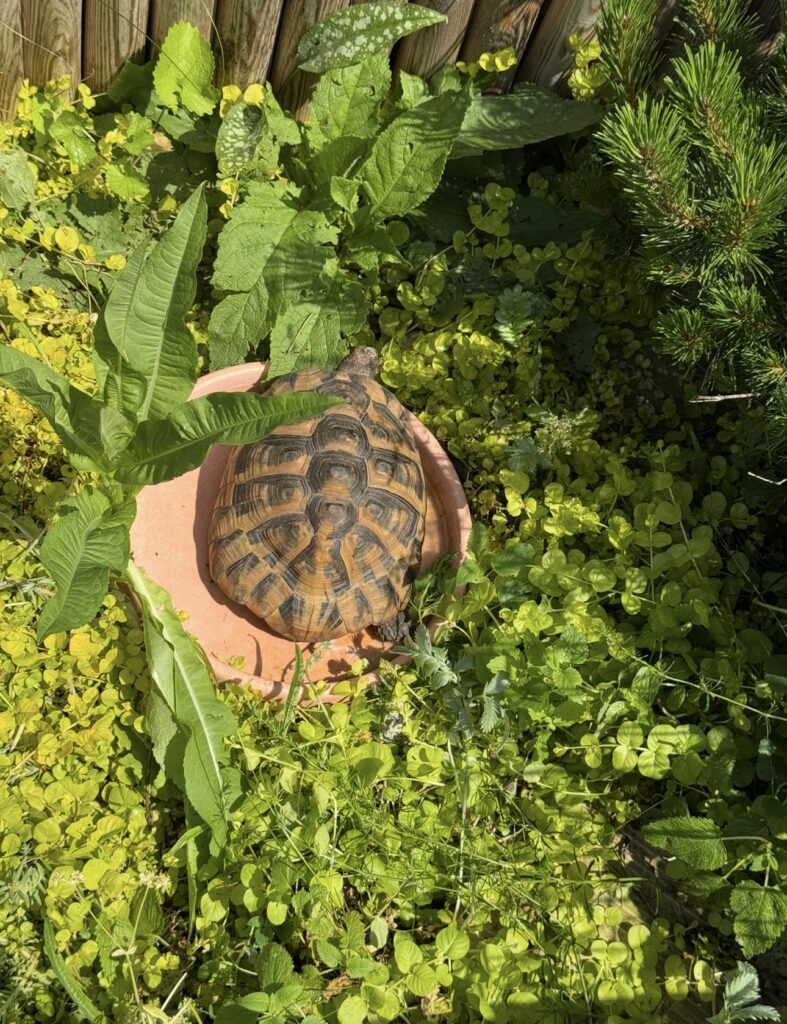
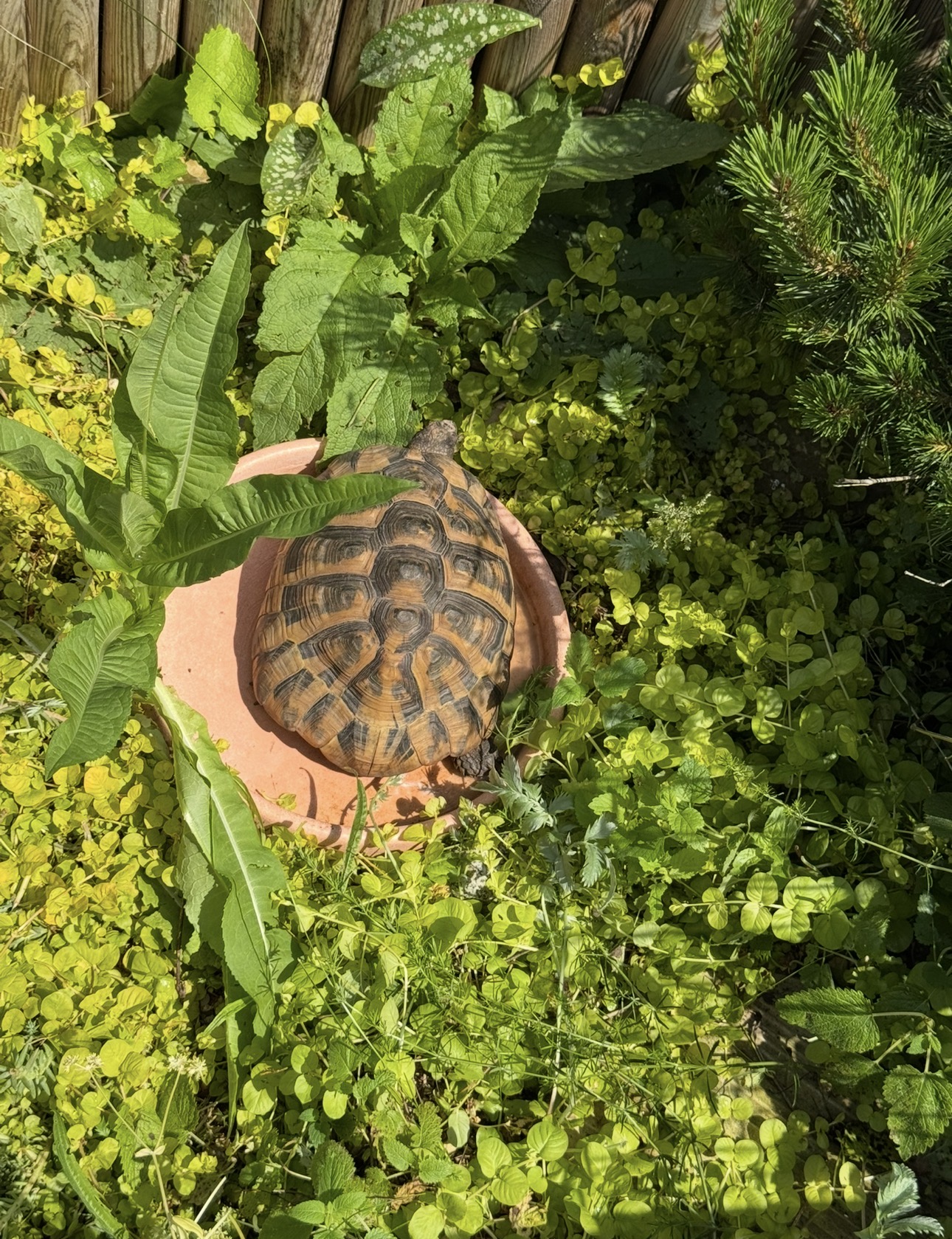
It’s also important to provide cool hiding spots, ideally stone hides, and plenty of bathing opportunities.
The technology can of course be switched off completely on hot days, though this usually isn’t necessary since it should be temperature-controlled anyway.
If the tortoises still go into the cold frame, you can keep them out during the day if it gets too warm in there.
Occasionally spraying water into the enclosure and onto the shading creates evaporative cooling and helps keep hiding spots cool. Usually, though, watering the hiding plants and dampening the hides is enough.
Automatic Cold Frame Openers
Automatic cold frame openers (in German) are unhooked in very hot weather, and the lids propped wide open by hand.
An important note on this: all automatic cold frame openers are mechanical components and need regular maintenance and function checks. This includes a regular drop of oil, and checking that they are working and fastened correctly.
As a general rule, not only on hot days, temperatures in the cold frame should be monitored with smart thermometers that have a temperature alarm. Temperatures above 40°C can already cause circulatory collapse and heatstroke in our tortoises. It is therefore essential to monitor temperatures closely. Ground-level temperatures should also be kept in view using an infrared thermometer.
In hot weather, cold frame lids should be propped wide open by hand, and shaded.
Warning ⚠️
An important warning in this context about so-called „roller openers“:
In recent years, those of us active in husbandry advice have received many messages from keepers whose „roller openers“ had „flipped over“ in extreme heat, causing the lids to fall shut and the cold frames to severely overheat. Unfortunately, this has even led to deaths of tortoises caught in overheated cold frames as a result. Conventional cold frame openers that are fastened to the lid itself do not carry this particular risk (e.g. Beckmann, Einhell).
In recent weeks, the following fixes for this risk with roller openers have emerged:


Fix 1: Attach a length of mason’s line to the end and hook it onto the lid’s handle. This stops the roller opener from flipping over, and also lets the lid open a little wider.
Fix 2: Screw in the black piston just far enough that the thread barely catches.
Fix 3: Fit a special rail as a „stopper“ for the opener.
You’ll find a few examples in the photos — thank you to Bettina Wagner, Gaby Westermann, Melanie M. Niral, Petra Schwanda, and Kim Schembecker.
Keep an eye on your tortoises, and always monitor the temperature at tortoise height. Here’s to a lovely summer for all tortoises 🍀🌞
Providing Water, in the Enclosure and All Around It
A reliable water supply is one of the most important basic elements of good tortoise husbandry. European tortoises don’t take in water only by drinking. Damp areas also support fluid balance, digestion, and thermoregulation. Especially in warm, dry spells, water is therefore far more than a nice extra — it’s an essential part of a well-functioning enclosure.
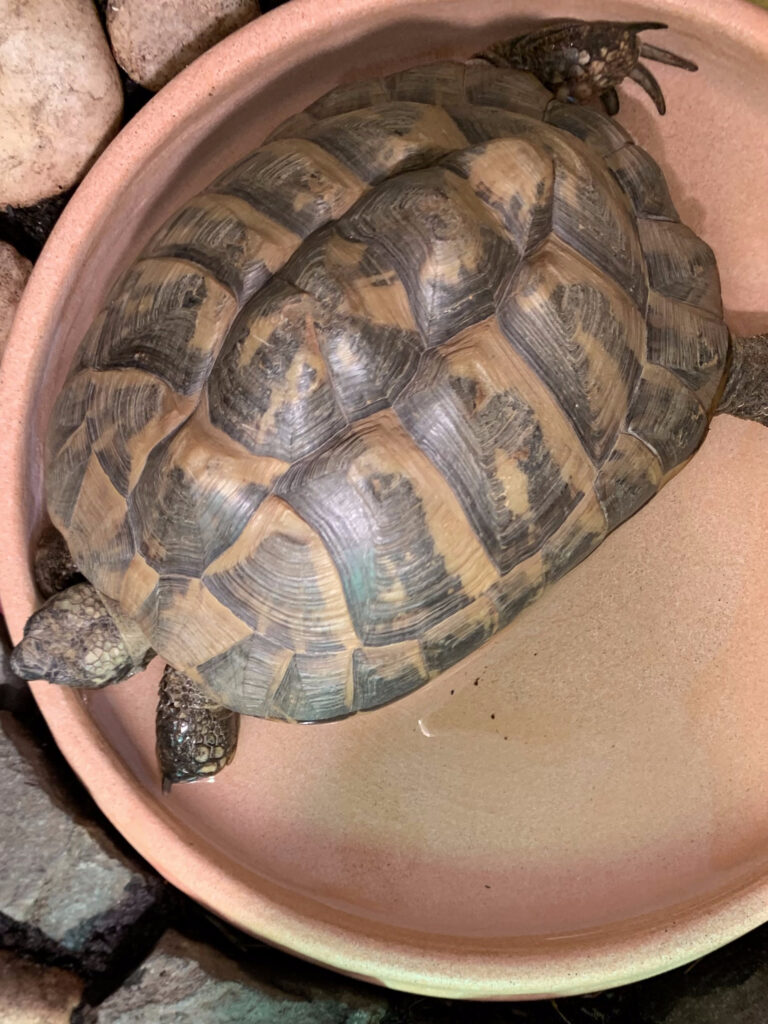
A shallow, easily accessible water dish should always be available for the tortoises. It needs to be low enough that the tortoises can comfortably walk in and back out again. Deep containers, steep sides, or smooth inner surfaces are unsuitable, because they can turn into a trap. Heavy, shallow terracotta dishes, plant-pot saucers, or shallow natural-stone dishes have all proved reliable. The water should be changed daily and the dish cleaned regularly, so that germs, algae, or food residue don’t build up.
It’s worth thinking beyond the tortoises themselves here. A garden planted close to nature around the tortoise enclosure can also be a valuable little habitat for wildlife and insects. Shallow water sources help birds, wild bees, butterflies, beetles, hedgehogs, and many other garden residents, especially during longer dry spells.
A clear separation is important here. The water dish for the tortoises belongs inside the enclosure. Additional water sources for wildlife should, where possible, be set up outside the tortoise enclosure. That way, birds and other wildlife aren’t specifically drawn into the enclosure, and direct contact between wildlife and tortoises is avoided.
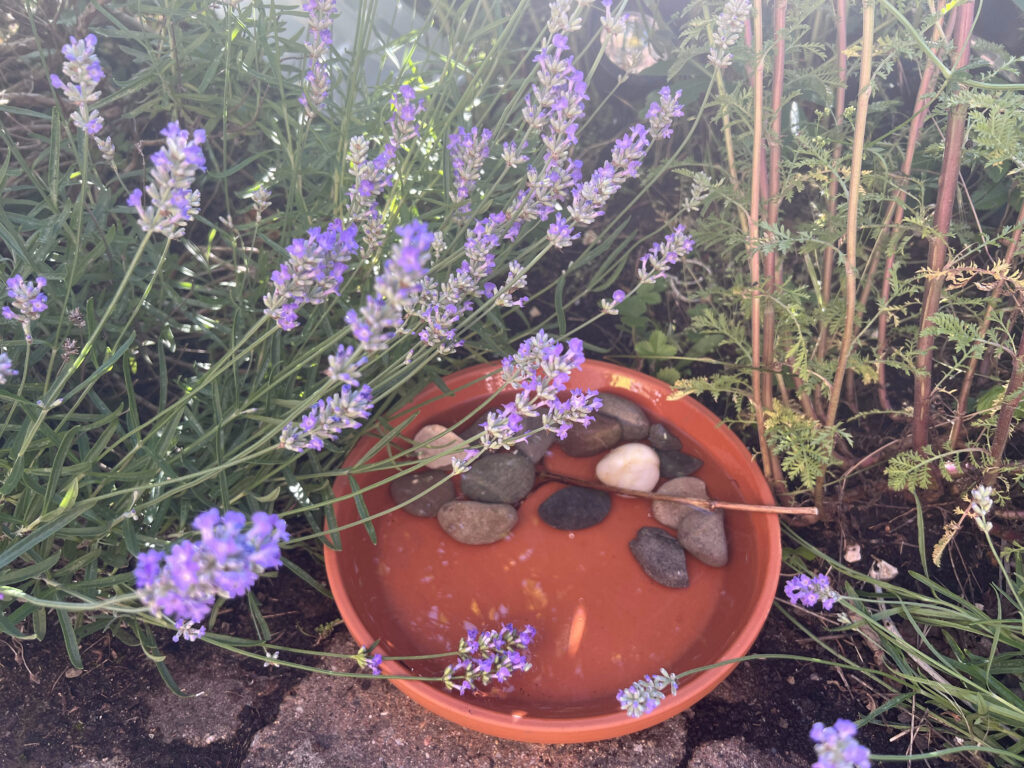
A bird bath should stand securely, be easy to reach, and be cleaned regularly. It mustn’t be too deep, so that smaller birds can drink and bathe safely. An insect-watering spot is very easy to set up: a shallow dish with stones, pebbles, moss, pieces of cork, or small twigs is enough. These provide safe landing spots and exit aids, so wild bees, butterflies, and beetles don’t drown.
Water is also very important for hedgehogs in summer. A hedgehog watering spot should stand outside the tortoise enclosure, ideally close to the ground, in a quiet, semi-shaded spot, and secured against tipping. A shallow, heavy dish with fresh water is suitable. Milk is not suitable for hedgehogs — only water should be offered. This dish, too, should be checked daily and cleaned regularly.
A small mini-pond can further enrich the garden. Even a shallow mortar trough, a watertight planter, or a small pond basin with stones, marginal plants, and exit ramps can help many animals. It’s important that no steep, smooth walls are created. Every water feature needs to be designed so that any animal that falls in can climb back out on its own.
Suitable Water Sources In and Around the Enclosure
Inside the tortoise enclosure
A shallow, heavy water dish with a low rim, fresh water daily, cleaned regularly.
Outside the tortoise enclosure
A bird bath, insect-watering spot, hedgehog watering spot, and small mini-ponds as additional water sources for native wildlife.
For insects
A shallow dish with stones, moss, cork, or twigs as landing spots and exit aids.
For hedgehogs
A shallow, tip-proof ground-level dish with fresh water, outside the tortoise enclosure, never milk.
For birds
A stable, shallow water source in a clear, open spot, cleaned regularly and topped up daily on hot days.
Water sources make an enclosure and its surroundings livelier. They support a more stable microclimate, help the tortoises on hot days, and create valuable drinking spots for many of the garden’s smaller residents. Especially in a time of increasing heat and longer dry spells, a well-planned water supply is therefore a simple but highly effective contribution to animal welfare and biodiversity.