
The story of little Hans, who nearly drowned in a pond and was resuscitated
A personal account by Sabine Voßkamp
We had taken Hans in together with another tortoise from a rescue centre and did not want to believe that tortoises might be interested in garden ponds and could fall into them. We had relied on the animals’ natural instincts — a trust that, in this situation, proved dangerously misleading. After all, Gerd, who was 63 years old and had also come to live with us, had previously lived with a pond in his enclosure, and nothing had ever happened.
Hans disappears
One day we searched for Hans in the garden, but he was nowhere to be found. The next day, the search continued. When I happened to look into the garden pond, I discovered his shell at a depth of about 30 centimetres.
We felt goosebumps and sheer horror at the sight. We could hardly believe it.
18 hours in the water
When we pulled him out of the water after an estimated 18 hours, he was showing hardly any signs of life. We did not hesitate and immediately went to a reptile vet nearby.
At first, the vet wanted to wait and see whether he would show any further signs of life. Later, she called me with her assessment that Hans was fighting for his life and that she wanted to keep him at the practice for further treatment.
Eyes as if blind

When we were able to collect him the next day, it was a distressing sight. His eyes were white and looked blind. We were given antibiotic eye drops and treated him for quite some time.
He did not eat for more than a week, and at first his eyes did not improve much either. We decided to give him one more day before considering euthanasia.
The miracle

Then the miracle happened. Blind Hans began to eat and move around. We were overjoyed, because now we had hope again.
I then treated his eyes daily with Bepanthen eye and nasal ointment. It felt as though he could not really find or see his food, because he kept snapping beside it. We were unsure whether he had also suffered cognitive damage. But little by little, everything improved.
Brumation as a test
We were worried about whether he would survive brumation. He lives in an outdoor enclosure with a cold frame and brumation pit. But everything went well, and he woke up again on time in spring.

Once again, we were delighted, because he seemed to have recovered during brumation. His eyes were no longer white, but they were very dry. Here too, the Bepanthen eye ointment helped a great deal.
A second life
Today, Hans is a very lively and curious little tortoise who survived this accident.
It is a miracle, and one can only thank this vet for her dedication. Without treatment, he would not have made it.
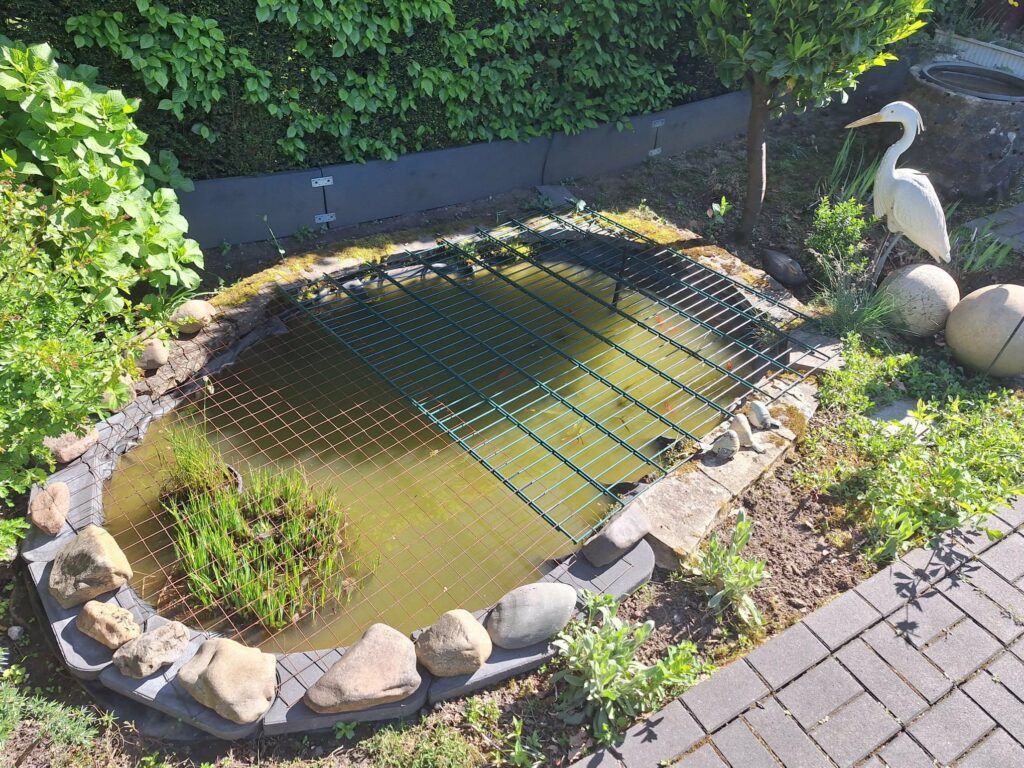
Securing garden ponds to protect tortoises
The pond was secured immediately. We strongly advise all tortoise keepers to do the same.
What lies behind Hans’s story
Experience meets science
An incident like this is an acute emergency in tortoises and not an isolated case.
In my many years of experience in husbandry advice, I have encountered numerous tragic deaths of European tortoises in unsecured ponds. The importance of reliably securing ponds cannot be emphasised enough. There have also occasionally been tragic cases of animal cruelty, in which tortoises were deliberately thrown into ponds, or cases in which this happened through ignorance. Only in very few individual cases, such as this one, have the animals survived.
Divers (1998) notes that tortoises particularly often drown in unsecured garden ponds and are frequently only recovered from the pond after several hours.
That this does not necessarily have to be a certain death sentence is shown by Colon (2020) in a remarkable case: a 60-year-old male Hermann’s tortoise, 𝘛𝘦𝘴𝘵𝘶𝘥𝘰 𝘩𝘦𝘳𝘮𝘢𝘯𝘯𝘪, missing for two days in a garden pond, was found on the pond floor: cold, not breathing, unresponsive, but with a heartbeat of 28 beats per minute. After intubation, oxygen ventilation and targeted warming to the species-specific preferred temperature, spontaneous breathing resumed; the tortoise made a full recovery. The explicit conclusion of the case report was that reptiles can survive even prolonged periods of apnoea.
Why can tortoises survive this?
The reason lies in their physiology: tortoises are ectothermic; their metabolism is only around one seventh that of a mammal (Divers 1998). Their oxygen requirement is therefore correspondingly low, and their hypoxia tolerance, meaning the body’s ability to withstand oxygen deficiency without irreversible damage, is significantly higher than in warm-blooded animals.
However, this does not mean that all danger has passed once the animal has been recovered. Aspirated water can continue to place a serious burden on the airways and lungs, even if the animal appears externally stable. Secondary pneumonia is not uncommon after drowning incidents, which is why Divers (1998) recommends prophylactic broad-spectrum antibiotic treatment as part of veterinary care.
Possible signs of subsequent damage include laboured breathing, nasal discharge, breathing noises or persistent weakness, although damage to the airways, eyes, circulation or nervous system often only becomes visible after a delay.
The veterinary procedure immediately after recovery follows a clear protocol: hold the animal head-down, pump the limbs to evacuate water from the lung fields, then provide oxygen ventilation and doxapram to stimulate breathing until spontaneous respiration returns, which may take minutes or hours (Divers 1998). Brown (2022) adds that further care includes thermal management, fluid therapy and close monitoring.
All of this belongs in the hands of a vet experienced in reptile medicine, and incorrect handling may cause additional harm.
Unfortunately, such cases are the exception. Most tortoises that sink into garden ponds are found dead. That Hans and the 𝘛. 𝘩𝘦𝘳𝘮𝘢𝘯𝘯𝘪 described by Colon (2020) survived was due to fortunate circumstances and, above all, rapid veterinary intervention.

The whitish, dry-looking eyes and the refusal to eat for several days described by Sabine in Hans’s case fit the picture of severe impairment after such an incident. A precise diagnosis can no longer be made retrospectively, but one thing is certain: even if an animal appears, almost miraculously, to start eating and walking again, it should be examined by a vet experienced in reptile medicine.
Anyone wishing to share similar experiences is welcome to get in touch.
Sources
BROWN, S. (2022): Providing critical care to sick tortoises. In Practice: Continuing Education in Veterinary Practice 44(4): 214–227. Available at: https://onlinelibrary.wiley.com/doi/10.1002/inpr.199 [Accessed 27 May 2026].
BRITISH CHELONIA GROUP (n.d.): Care Sheets and Chelonian Knowledge Hub. Available at: https://www.britishcheloniagroup.org.uk/caresheets/index [Accessed 27 May 2026].
COLON, V. (2020): Critical care of tortoise found in pond. Vet Times 50(26). Available at: https://www.vettimes.com/clinical/exotics/critical-care-of-tortoise-found-in-pond-cpdreptiles [Accessed 27 May 2026].
DIVERS, S. J. (1998): Emergency care of the critically ill tortoise. Testudo 4(5). Available at: https://www.britishcheloniagroup.org.uk/testudo/v4/v4n5care [Accessed 27 May 2026].
MERCK VETERINARY MANUAL (2025): Disorders and Diseases of Reptiles. Available at: https://www.merckvetmanual.com/all-other-pets/reptiles/disorders-and-diseases-of-reptiles [Accessed 27 May 2026].