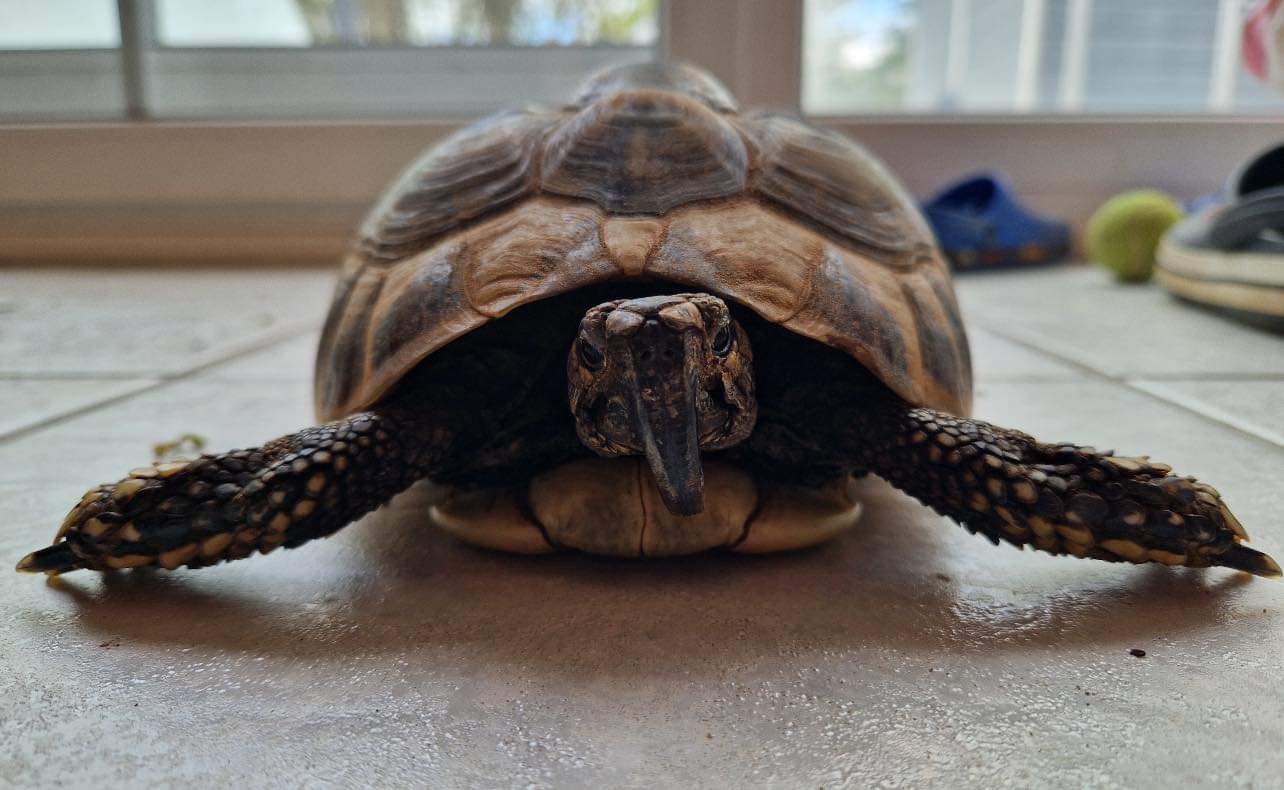
Why This Disease Is So Common, and How Keepers Can Avoid It
Metabolic Bone Disease (MBD) is one of the most common illnesses in European tortoises such as Testudo hermanni. It is particularly tricky because it develops gradually and is often only noticed once permanent damage has already occurred.
The good news is that MBD is avoidable in most cases, once the underlying factors are understood.
What Metabolic Bone Disease Is
MBD is an umbrella term for disorders of bone metabolism. Bone and shell are not sufficiently mineralised and lose their stability.
In juveniles the condition appears as rickets. During this growth phase it leads especially quickly to permanent deformities.
Understanding the Real Causes
MBD has multiple contributing factors. What matters is the interplay of several aspects of husbandry.
Calcium and Phosphorus
An unbalanced ratio is one of the most common triggers. Many unsuitable foods contain too much phosphorus and too little calcium.
Vitamin D₃
Vitamin D₃ is needed so that calcium can be absorbed by the body and built into bone.
UVB Radiation
Without UVB radiation, not enough effective vitamin D₃ can be produced. Good nutrition on its own is therefore not enough.
Temperature
Metabolism only works optimally within suitable temperature ranges. If conditions are permanently too cool, calcium is processed less effectively. For more on this, see our article on keeping tortoises warm (in German).
Several small deficits combine to cause the disease.
Why Juveniles Are Especially at Risk
Juveniles grow quickly and have a high demand for minerals. At the same time, they are especially sensitive to husbandry mistakes.
Typical consequences are a soft shell, uneven growth, and deformed limbs. These changes are generally permanent.
Spotting the Symptoms Early
MBD often begins inconspicuously.
Early Signs
A slightly soft shell, reduced activity, and unsteady movement can be the first clues.
Advanced Symptoms
Noticeable shell deformities, bent bones, spontaneous fractures, and neurological deficits appear at later stages.
Acting early is crucial.
Diagnosis and Its Limits
Blood values can remain unremarkable for a long time, even though changes are already taking place in the bone.
Imaging techniques allow earlier diagnosis, but are not always available in everyday practice. For keepers, assessing the husbandry conditions themselves is therefore especially important.
The Decisive Role of Husbandry
In European tortoises, MBD is usually a husbandry-related condition.
Natural Sunlight and UV Radiation
Keeping tortoises in a cold frame (in German) made of Alltop Plexiglas (in German) with a UV lamp (in German), combined with an outdoor enclosure, offers the best basis for adequate UVB exposure (in German).
Species-Appropriate Diet
Wild forage plants should form the basis of the diet. Calcium-rich plants and free access to calcium via cuttlebone and algae lime are essential.
Warmth and Temperature Gradients
Metabolism only functions correctly under suitable temperature conditions.
Exercise
Regular activity supports the development of stable bone structure.
Can a Tortoise Recover?
In early stages, bone density can improve once husbandry is optimised.
However, deformities that have already developed usually remain permanent.
The Most Important Takeaway
Metabolic Bone Disease is not a random illness, but almost always the result of husbandry conditions that are not optimal.
Keepers who consistently orient their husbandry towards the natural living conditions of European tortoises can significantly reduce the risk.
Note
The information in this article is intended solely for general information about Metabolic Bone Disease in European tortoises. It does not replace a proper diagnosis or treatment by a vet specialising in reptiles.
If you notice anything unusual, or suspect illness, a reptile vet should always be consulted.
References
Bauer, Thomas Christian, Analyse der Ernährung und der Haltungsbedingungen von in Deutschland gehaltenen paläarktischen Landschildkröten (Testudo spp.) (Dissertation, Ludwig-Maximilians-Universität München, 2018).
Ferguson, Gary W., Ellen S. Brinker, W. H. Gehrmann, John Baines, M. J. Mackin, and T. C. Chen, ‚Voluntary Exposure of Some Western-Hemisphere Snake and Lizard Species to Ultraviolet-B Radiation in the Field: How Much UVB Should a Lizard or Snake Receive in Captivity?‘, Zoo Biology, 29.3 (2010), 317–334.
Hetényi, Nikoletta, Tamás Sátorhelyi, Szilvia Kovács und István Hullár, ‚Variations in Blood Biochemical Values of Male Hermann’s Tortoises (Testudo hermanni)‘, Veterinaria, 65.1 (2016), 15–21.
Holick, Michael F., ‚Vitamin D Deficiency‘, New England Journal of Medicine, 357.3 (2007), 266–281.
Hörmann, A., J. Hetterich, T. Neubert, G. Campbell, K. Merhof und M. Pees, ‚Advancing Bone Health Evaluation in Hermann’s Tortoises (Testudo hermanni) Using Spectral Detector Computed Tomography‘, Frontiers in Veterinary Science, 13 (2026), Art. 1772226.
Klaphake, Eric, ‚A Fresh Look at Metabolic Bone Diseases in Reptiles and Amphibians‘, Veterinary Clinics of North America: Exotic Animal Practice, 13.3 (2010), 375–392.
Mader, Douglas R. (ed.), Reptile Medicine and Surgery, 2nd edn (St. Louis: Saunders Elsevier, 2006).