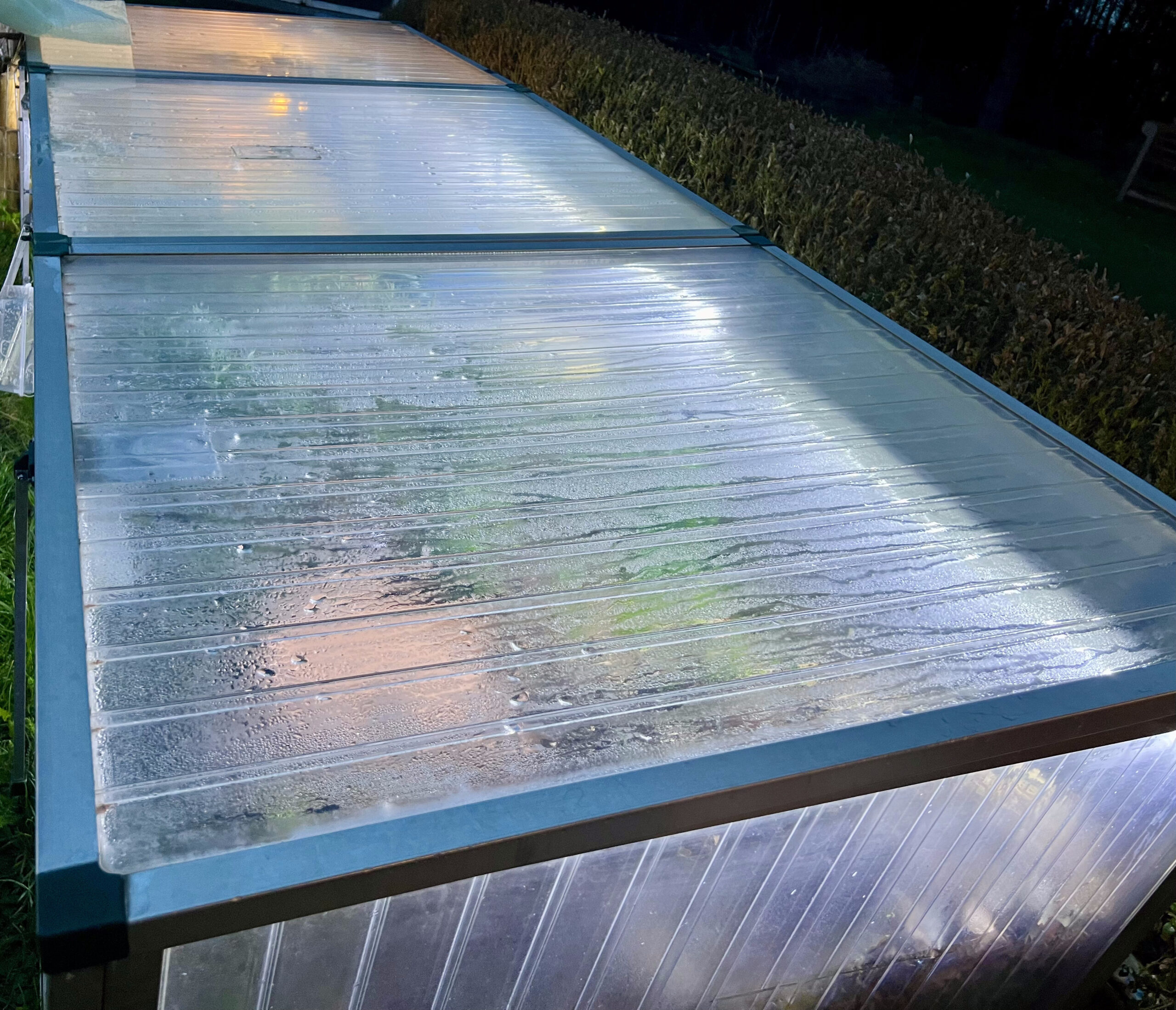
Why Alltop is the ideal material for keeping tortoises

There are many manufacturers of greenhouses and cold frames, in varying quality. Standard cold frames are really intended for raising vegetables and flowers – not for tortoises. That is why they are usually made of slightly bluish polycarbonate (PC). This is fine for plants, but unsuitable for our sun-loving reptiles, because important parts of the light spectrum are missing.
For tortoise houses, acrylic glass (PMMA) – known under names such as Plexiglas or Perspex – is the better choice. This material is much clearer, lets in more light, and helps the cold frame warm up better. It also makes it easy for us to observe our tortoises. The multi-wall sheets, also known as twin-wall sheets, consist of two layers. The upper layer is supported by a series of ribs resting on the lower one, creating sealed air chambers that act as an insulating layer. The still air trapped inside conducts heat far less well than solid materials, so twin-wall sheets insulate much better than single glazing. This can cut heating energy use by around 40 per cent compared with conventional single-glazed cold frames.
Acrylic is more expensive than the more widespread polycarbonate, but the investment pays off:
- better light transmission
- greater warmth
- a much longer lifespan
Important to know:
Not all acrylic automatically lets UV radiation through. Yet tortoises need precisely these UV rays for a healthy metabolism and shell growth. Only specially UV-transmitting grades of PMMA are suitable. These grades let through a very high proportion of UV radiation – often more than 80–90 % – particularly around 300 nm. For comparison, standard acrylic or ordinary window glass absorbs almost all UV radiation below 300–350 nm.
👉 The right choice for tortoises is UV-transmitting acrylic twin-wall sheet.
👉 This grade can be reliably identified by the name “Alltop”.
For tortoise keepers, then, it is important that the multi-wall sheets (also called twin-wall sheets) of the cold frame or greenhouse are made of Alltop acrylic at least 16 mm thick wherever possible, as this is the only material that transmits a proportion of UVB radiation. That makes Alltop the ideal material for tortoise cold frames.

The investment is worthwhile, as these cold frames last for decades – acrylic is known to last more than 30 years.
Cold frames fitted with Alltop are brighter, and the tortoises inside are usually more active – especially in the low-light transitional seasons of spring and autumn.
High-quality LED background lighting alongside the UV spot can further support the tortoises’ activity.
If Alltop is not an option, the cheaper bluish 16 mm polycarbonate remains. A compromise is to choose at least the lid in Alltop acrylic and the side walls in polycarbonate.
Twin-wall sheets are sold not only as part of kits or ready-made cold frames, but also separately for building a cold frame yourself. When cutting, always use new saw blades and tape the cut edges well so that the material does not splinter. Alternatively, sheets cut to size can be bought for DIY projects.

Further reading: Warm Husbandry · The Greenhouse Heater · Outdoor Enclosure, Cold Frame and Hibernation Pit