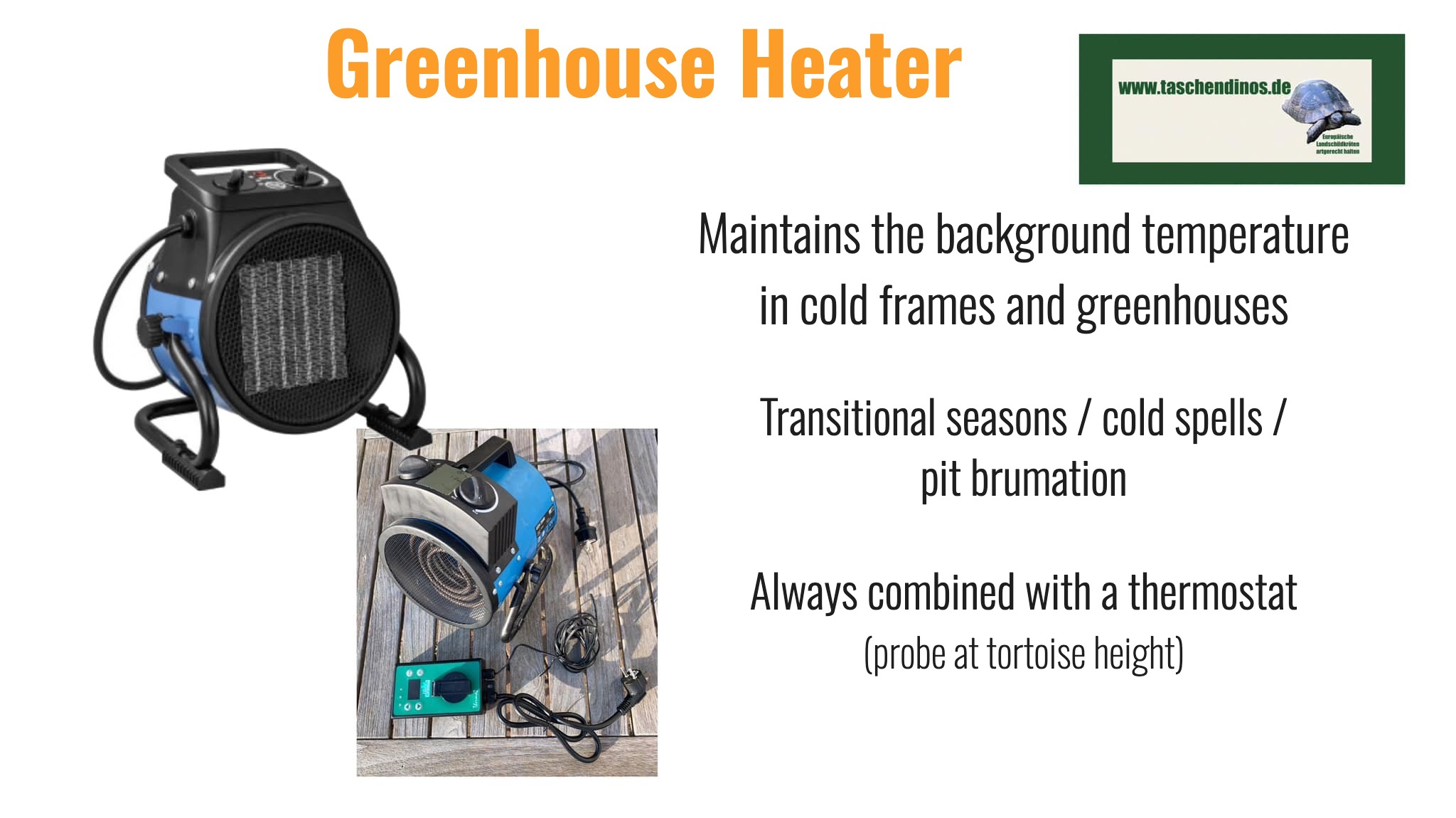
Safe heating technology for species-appropriate husbandry
For many years, electric greenhouse heaters have proved their worth in the species-appropriate warm husbandry of European tortoises. They are an indispensable part of the technology used to simulate the Mediterranean climate in the cold frame.
With the heater, we recreate the minimum day and night temperatures of the natural habitat.
In other words, the heater stops temperatures from falling too low. A night-time drop of 5–10 °C should always be maintained.
How greenhouse fan heaters work and their advantages
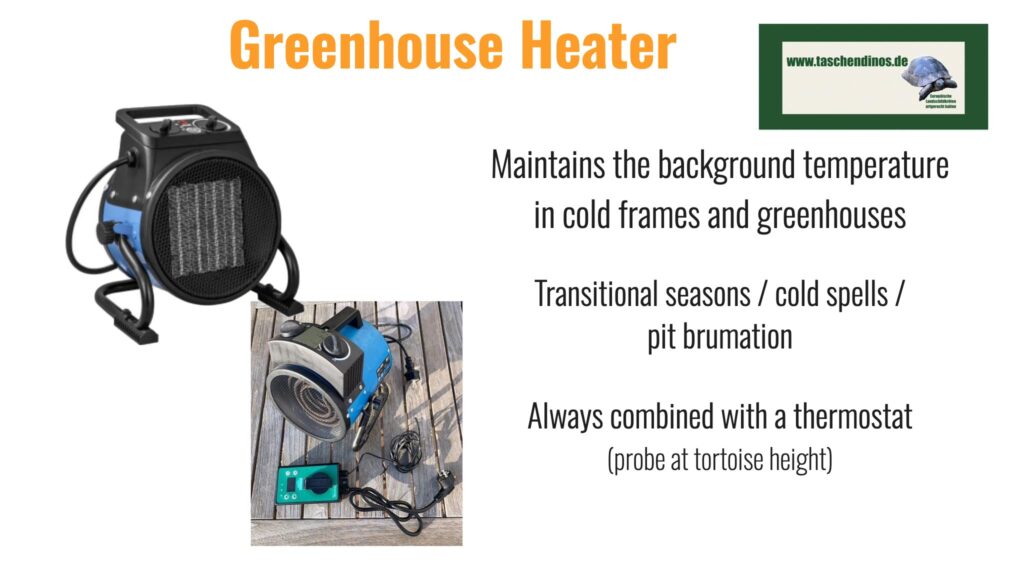
Greenhouse fan heaters bring cold frames and greenhouses up to temperature quickly and reliably. They are designed specifically for use in greenhouses and cold frames, are often splash-proof, and are extremely robust. They can also be hung up, which makes them easier to fit into small cold frames.
Metal chains or stainless-steel cable ties should be used for hanging. Some keepers also place the heater on top of the tortoises’ shelters or hides. In that case, a stone slab should be placed underneath for safety.
Control via an external thermostat
Greenhouse heaters are always controlled by a reliable external probe thermostat. The thermostat probe is mounted at tortoise height so that it records realistic temperatures.
The Biogreen Thermo 2 thermostat has proved particularly reliable. It is the only thermostat on the German market officially approved for use in cold frames. According to their manufacturers, all other thermostats are not intended for this purpose.
Uses throughout the year
A greenhouse heater can also reliably safeguard pit brumation beneath the cold frame. The heater prevents critical sub-zero temperatures and reliably keeps the pit at 5–6 °C, even in cold winters.
Recommended heating output
For standard cold frames, an output of 1,000 to 2,000 watts is recommended. For larger cold frames and greenhouses, more powerful units from 3 kW upwards are available.
A heater with more capacity than strictly needed runs more smoothly and therefore lasts longer. A low-powered unit that has to run constantly to reach the desired temperature is a poor choice, as this can lead to overheating and premature failure.
Reserve capacity instead of continuous operation
It makes more sense to choose a more powerful unit and turn its output down. This leaves a reserve, for example for very cold frosty nights. The heater then switches on only intermittently to reach the set temperature, and switches off again until the temperature falls.
Further reading: Warm Husbandry · Alltop Acrylic · What Is a Thermostat?