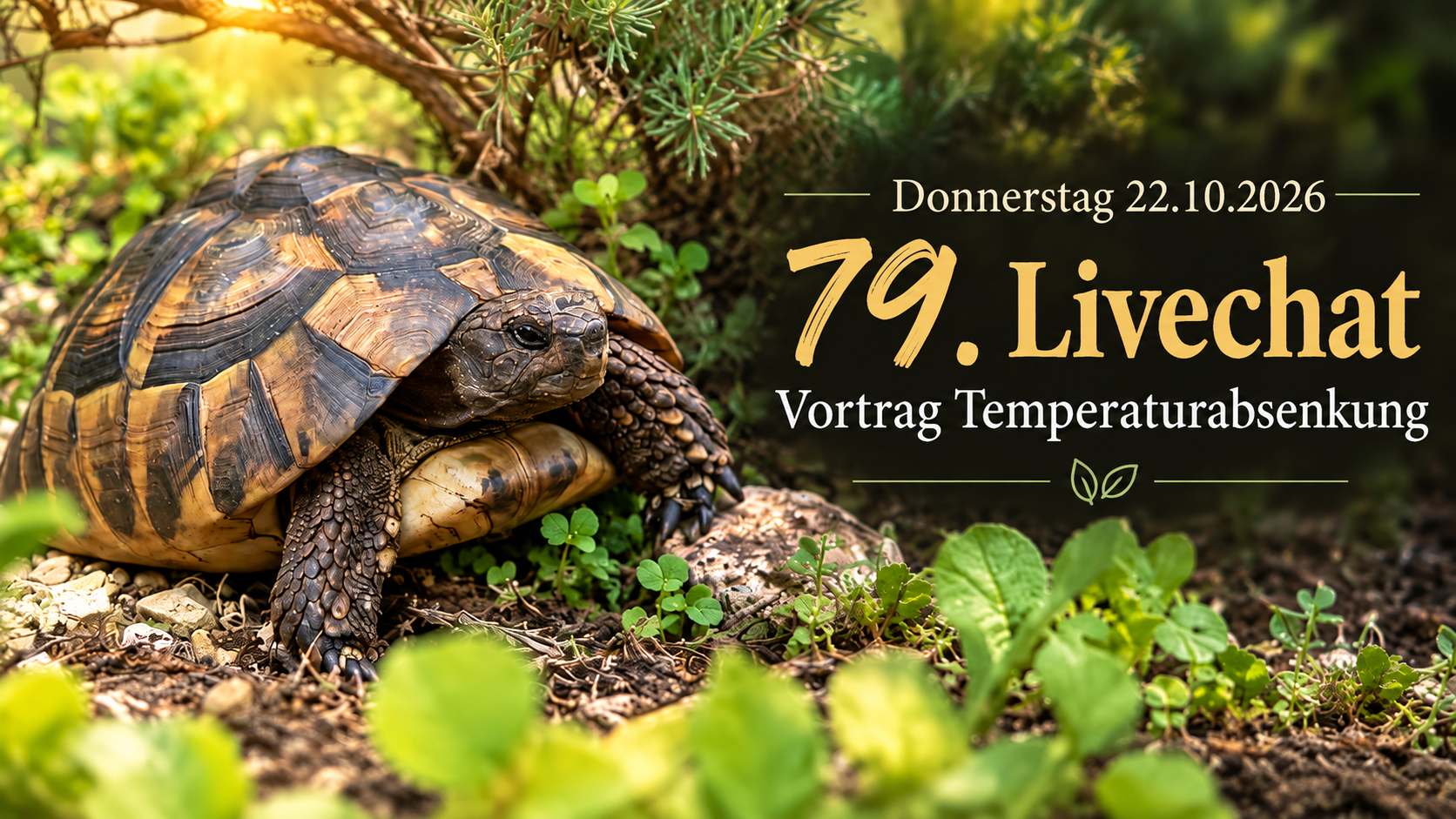
Talk · Temperature Reduction and Refrigerator Brumation
This page accompanies my talk „Temperature Reduction and Refrigerator Brumation“, for reading up on and linking to. European tortoises do not enter brumation overnight. In the Mediterranean, autumn cools down very gradually – and we reproduce this slow transition in the heated cold frame. This page summarises the entire process: from the climate in the habitat and the four-week temperature reduction to safe checks during refrigerator brumation.
The slides from the talk are available here: Temperature Reduction and Refrigerator Brumation (PDF, in German)
1. The Mediterranean climate sets the pace
Our European tortoises come from the Mediterranean subtropics – a winter-rain climate with damp, mild winters and hot, dry summers. In Greece, average temperatures over the year range from about 5 to 33 °C; in Germany, from 1 to 23 °C. Ambient temperatures here are therefore generally too low. Then there is the light: Athens has around 2,700 hours of sunshine a year, the Antalya region around 3,000 and Palma de Mallorca around 2,850 – whereas North Rhine-Westphalia has only about 1,500 (climate normal period 1991–2020).
Everything else follows from this annual rhythm of light, warmth, drought, rain and wind. In spring, warmth and fresh wild plants start activity. In summer, heat, drought, shade and microhabitats become central. Autumn brings rain, a second growing season and preparation for brumation. Winter is the cooler, damp phase – for Testudo, the basis of brumation. In the habitat, it lasts about 12 weeks, from December to March. Technology in cooler regions should therefore make basking, warm microclimates, retreat, dry phases and safe brumation possible.
End of October: habitat and Germany compared
| Region | Day | Night | Range |
|---|---|---|---|
| Greece – THB, Platamonas | 21 °C | 12 °C | 7–24 °C |
| Corfu – TM | 19 °C | 16 °C | 14–22 °C |
| Mallorca – THH, Pollença | 20 °C | 14 °C | 9–26 °C |
| Turkey – TGI, Marmaris | 28 °C | 15 °C | 11–33 °C |
| Braunschweig – October | 13.8 °C | 7.1 °C |
In the habitat, the reduction only begins at the end of October or beginning of November – as soon as there are fewer than 150 hours of sunshine a month, daytime temperatures fall below 20 °C and nights below 15 °C. Here, it cools down much earlier and faster. Without technology, our tortoises would be forced too early and too abruptly into a resting phase that is too long.
Use climate data with care: Weather stations measure at a height of 2 m in the shade – not at tortoise height on the ground. Because of its high limestone content, the soil in the Mediterranean is usually several degrees warmer, sometimes by as much as 10 °C. Where available, soil temperatures are therefore more meaningful.
2. Why not overnight?
Tortoises are not machines that we can send into brumation at the push of a button. Simply switching off the heating or bringing the tortoise into the warm house creates exactly the condition we want to avoid.
The body adjusts slowly
Brumation is initiated hormonally: the pineal gland registers the shorter days, and the thyroid slows down the metabolism – over several weeks (Olvera-Maneu et al. 2024).
Digestion needs warmth
Food in the gut must be fully digested, and faeces and urates must be passed. This only works with warmth – without a basking spot, digestion comes to a standstill.
35 °C to the very end
Right to the end, the tortoises must be able to bring themselves up to their preferred temperature of about 35 °C: a basking spot for at least 5 hours a day, 35 °C at shell height.
Danger: twilight state
Neither warm enough for activity nor cold enough for genuine brumation: the metabolism keeps running and reserves are used up – liver damage, dehydration and starvation are the risk.
Genuine brumation only sets in at temperatures permanently below 8 °C. Metabolism and muscle activity decrease, and heartbeat and breathing are reduced to a minimum. Brumation is important for the immune system, growth, hormonal balance and life expectancy. The target range is 4.5 to 7 °C. There is a clear lower limit: temperatures must not fall below 4 °C – 3.7 °C proved fatal for Hermann’s tortoises of the subspecies THH (Testudo hermanni hermanni) (Bonin et al. 2007). Hatchlings also brumate from the very beginning, and for just as long as adult tortoises.
3. The schedule at a glance
The process is the same for refrigerator and pit brumation. The temperature reduction and the first 1–2 weeks of brumation always take place in the heated, safeguarded cold frame. Only after that do the two methods differ.
- Sept. – end Oct.Staying activeMediterranean late summer: about 20 °C at night, 25–27 °C during the day (2–3 °C more for spur-thighed, or Greek tortoises).
- End Oct. – end Nov.Reduction over about 4 weeksNo more than −1 °C per day, basking spot reduced from 8 to 5 hours, always 35 °C at shell height.
- End Nov. – early Dec.1–2 weeks of brumation in the cold framePermanently below 8 °C, target range 5–6 °C, never below 4 °C.
- around St Nicholas’ Day (6 Dec.)Moving into brumation quartersInto the refrigerator (4.5–7 °C) or the secured pit – only tortoises in deep brumation.
Important: A tortoise that digs itself in in October is only resting – it is not yet brumating.
4. Week by week to brumation
The example begins at the end of October. We lower day and night temperatures and the hours of sunshine over four weeks until brumation temperatures are reached. Greek tortoises (TGI) from southern regions of origin are brought down somewhat more slowly, following their original climate – for them, only the night temperature is lowered at first.
| Week | Hermann’s night / day | Greek (TGI) night / day | Basking spot Hermann’s / Greek | Phase |
|---|---|---|---|---|
| 1 | 14 / 19 °C | 14 °C / still warm | 8 h / 8 h | Reduction |
| 2 | 10 / 15 °C | 15 / 20 °C | 7 h / 7 h | Reduction |
| 3 | 5 / 11 °C | 10 / 16 °C | 6 h / 7 h | Reduction |
| 4 | 5–6 °C | 5 / 11 °C | 5 h / 6 h | Reduction |
| 5 | 5–6 °C | 5–6 °C | 5 h* / 5 h* | Brumation in the cold frame |
| 6 | 5–6 °C | 5–6 °C | up to 5 h* / up to 5 h* | Brumation in the cold frame |
No more than −1 °C per day · basking spot always 35 °C at shell height · *lamp off only once all the tortoises have been inactive for a week · move into brumation quarters after 1–2 weeks permanently below 8 °C
The tortoises eat less, rest longer and respond more sluggishly to light. They drink more and pass more faeces and urates – relieving the liver and kidneys. Food and water remain freely available. Tortoises that have been wormed are kept at summer temperatures for a few more weeks. We lower the temperature by no more than 1 °C per day and reduce the basking time by one hour a day until 8 hours are reached.
Activity now varies greatly: some tortoises are still eating, many are resting. The tortoises’ behaviour sets the pace. We offer food and water until all of them have fully withdrawn. Healthy tortoises are not bathed – unless a reptile vet advises it. Only now do temperatures fall noticeably in the habitat, and we follow this rhythm.
The tortoises slow down, and some dig themselves in. Nevertheless, they still bask or bathe – even after several days of rest. Withdrawal does not mean brumation; they are only resting. No forced bathing, no withholding of food. Do not move them into their brumation quarters yet: moving them too early is one of the most common beginner’s mistakes.
We measure the temperature at the tortoise: probe in the soil, infrared thermometer on the shell, thermometer at tortoise height. Never below 4 °C. The lamp stays on as long as the tortoises bask, bathe or eat – switch it off only once all of them have been inactive for several days, preferably a week. A separate temperature alarm is strongly recommended.
Once the temperature at the tortoise is permanently below 8 °C, we wait at least one, preferably two weeks. Only tortoises in deep brumation are moved into their brumation quarters; tortoises that are awake continue to prepare in the cold frame. Southern Greek tortoises may be brought down more slowly. Better to move them too late than too early.
Individual tortoises surface once more, bask, bathe or pass faeces and urates – this is normal. We do not intervene and let the tortoises go at their own pace. The heater needs sufficient output, the hysteresis must be right, and reserve equipment is to hand. It is not enough to rely on the thermostat: what counts is the temperature at the tortoise.
5. The tortoises prepare themselves
If we provide the right parameters, the tortoises prepare for brumation entirely on their own. They know best when to eat, bask or bathe – we just have to create the conditions for it.
Possible to the very end
- eating
- basking – 35 °C at shell height
- bathing, if they want to
- passing faeces and urates
Not necessary – and outdated
- forced bathing to „empty“ the gut
- withholding food or fasting
- switching off heating and light abruptly
- bringing tortoises into the warm house
A bathing opportunity is provided in the cold frame, but bathing is never forced. Tortoises that have been bathed „empty“ are prone to problems getting going after brumation, such as post-brumation anorexia, because the gut flora suffers. As long as a tortoise is basking and eating, the basking spot stays on for 5 hours a day. Exception: bathing on the instructions of a reptile vet.
Healthy into brumation
Before brumation, a faecal examination for intestinal parasites and a pre-brumation check-up at a reptile veterinary practice are essential – especially for tortoises brumating with us for the first time or coming from poor husbandry. Brumation should only take place after consultation with the vet. After worming, the tortoise must be kept at high-summer temperatures for a further 6 weeks.
6. In parallel: preparing the refrigerator
While the temperature is being lowered for the tortoises in the cold frame, we run in the refrigerator. If you do not have one yet, get one now.
Larder fridge
Without a freezer compartment or freezer section, with a no-frost function. The larger the appliance, the more constant the temperatures. In appliances with a freezer section, everything can freeze through within a short time if there is a fault.
Heated room at 16 °C or more
No garage, no garden shed, no unheated cellar – otherwise the thermostat will regulate unreliably. Check the back, keep the drain clear and clean the appliance thoroughly.
Sturdy boxes
Each tortoise brumates individually in a plastic box in which it can turn round comfortably. The matching lids are cut out and fitted with mesh – for air exchange and to stop the tortoise falling out. Hatchlings kept together can share a box.
Substrate and leaves
Three shell heights of loose, sieved garden soil or tortoise soil, topped with the same amount of beech, hornbeam or oak leaves. These leaves keep their shape, insulate, do not stick and do not go mouldy. Sand irritates the eyes and does not belong in the box.
Why no sphagnum moss for beginners? It is usually far too damp. This leads to evaporative cooling, hoar frost directly on the tortoise and temperature drops in the refrigerator. Leaves are the safe choice – wet leaves are left to dry off in a laundry basket first.
Running in without tortoises
The refrigerator is placed in the heated room and started on the warmest setting. We then put in the prepared boxes with soil and leaves and gradually set the temperature to 4.5–7 °C. Measurements are always taken at the back of the boxes, the coldest area: with a probe in the substrate under the leaves, or without a probe in the lower layer of leaves. Temperatures outside the boxes are irrelevant. Every day, we note the minimum and maximum in all boxes and reset the values. After a week, a stable pattern emerges. All adjustments to the refrigerator and emergency cut-off are always made without tortoises – changes in steps of 0.1 °C, then observe for a few days.
The life insurance: the emergency cut-off
An emergency cut-off thermostat such as the UT300 switches off the refrigerator before it gets too cold. Its sensor sits in the coldest box, at the back under the leaves, slightly inserted into the substrate. The OFF temperature is 0.2 °C below the measured minimum temperature – OFF never below 4.3 °C, ON never above 5.8 °C. Ideally, the refrigerator is set so well that the emergency cut-off never has to intervene. For calibration, we first let it run alongside without plugging in the refrigerator.
| Reduction | Refrigerator in parallel |
|---|---|
| Weeks 1–2 | obtain, clean, set up |
| Week 3 | run in with boxes, note min/max daily |
| Week 4 | all levels at 4.5–7 °C |
| Weeks 5–6 | after a stable week, run the emergency cut-off alongside |
| around St Nicholas’ Day | move tortoises in deep brumation into the refrigerator |
7. Moving into the refrigerator
Very important: No tortoise is moved into brumation quarters until it has been in deep brumation in the cold frame for at least 1–2 weeks at temperatures permanently below 8 °C.
The tortoises stay where they are until they are in deep brumation. If a tortoise is still looking around, it is not brumating. Tortoises are site-faithful and sensitive: tortoises that are moved while awake or merely resting experience great stress, panic and wake up in the refrigerator – such „forced“ brumation almost always fails. The tortoises should not notice the move at all, and in spring they return to the cold frame in deep brumation and free of stress in the same way. If a tortoise stays awake despite permanent brumation temperatures, we have the cause investigated.
How we recognise deep brumation
The tortoise does not wake during the check-up and weighing, moves only very slightly, as if in slow motion, and keeps its eyes firmly closed. Finally, we lower the temperature in the cold frame to 5 °C – the move usually takes place around St Nicholas’ Day.
Health and weight check
Before the move, we weigh each tortoise and note its starting weight. We check the shell, nose, beak, eyes and cloaca for mucus, discharge and redness, and the limbs for swelling. Only tortoises without abnormalities are moved into the refrigerator. The final check: is the refrigerator running stably and safeguarded? Is the UT300 sensor positioned correctly? Are the tortoises healthy and in deep brumation? Then they can be moved in safely.
How the move works
- Cool the room down well.
- Take the boxes out one at a time, remove the leaves and form a small hollow.
- Health check and weighing in subdued light.
- Place the tortoise in the hollow – head and front legs slightly raised.
- Cover the carapace with soil and fill up to the top with leaves.
- Fasten the mesh lid, slide the box in carefully without knocking it. Close the refrigerator door in between.
- Measure further back in the substrate; the emergency cut-off sensor stays in the coldest box – check its position.
8. Checks during refrigerator brumation
After the tortoises have been moved in, the refrigerator stays closed for two days. After that, we air it every two days for about 10 seconds – small and fully loaded appliances daily. It is better to air briefly more often. A temperature alarm monitors the values. Every two weeks, we feel the soil under the leaves: it should be slightly moist, but not wet. If it is too dry, we spray a little water onto the leaves from the side. Moistening too much can cause a drop in temperature.
The tortoises are weighed and briefly checked every four weeks, and every two weeks in the last third of brumation. We note the weight with the date and check appearance, movement and smell: does the tortoise respond to touch as if in slow motion? Are the nose, mouth and eyes normal? Emergence follows after about 12 weeks, or after 16 weeks at most for large adult tortoises.
When to end brumation early? If the tortoise is awake, has breathing noises or sits with its beak open; if there is redness, discharge or swelling; if it loses more than 1 % of its body weight per month; and if there are technical problems.
In the case of activity despite brumation temperatures, redness, swelling, discharge or an open beak, we place the tortoise in its brumation box in a cool room and discuss with the reptile vet what temperature to bring it up to. If the abnormalities are minor, we first put the tortoise back in the refrigerator and send a photo to the vet.
Further reading on Taschendinos
- Temperature Reduction Weeks 1–6
- Around the Tortoise Year: Preparing for Brumation in Autumn
- What Is Brumation?
- Pit Brumation
- Refrigerator Brumation Shopping List
- The Brumation Refrigerator and Brumation Boxes
- Stabilising the Brumation Refrigerator
- Refrigerator Brumation Checklist
- Moving Tortoises into the Refrigerator
- Checks during Refrigerator Brumation
- Taschendinos Refrigerator Brumation Handbook
Sources: Olvera-Maneu et al. (2024) · Bonin et al. (2007): Encyclopedia of Turtles · Climate data: DWD, Environment Ministry of North Rhine-Westphalia, MGM Turkey, HNMS/EMY Greece (climate normal period 1991–2020) · Monthly habitat values: iten-online.ch, wetter24.de.
This page is based on the talk „Temperature Reduction and Refrigerator Brumation“ given by Frauke Hustinx in the 79th live chat of the Starregruppe (German brumation group). With heartfelt thanks to all the Starregruppe admins for their tireless voluntary commitment! We wish all tortoises a safe brumation.