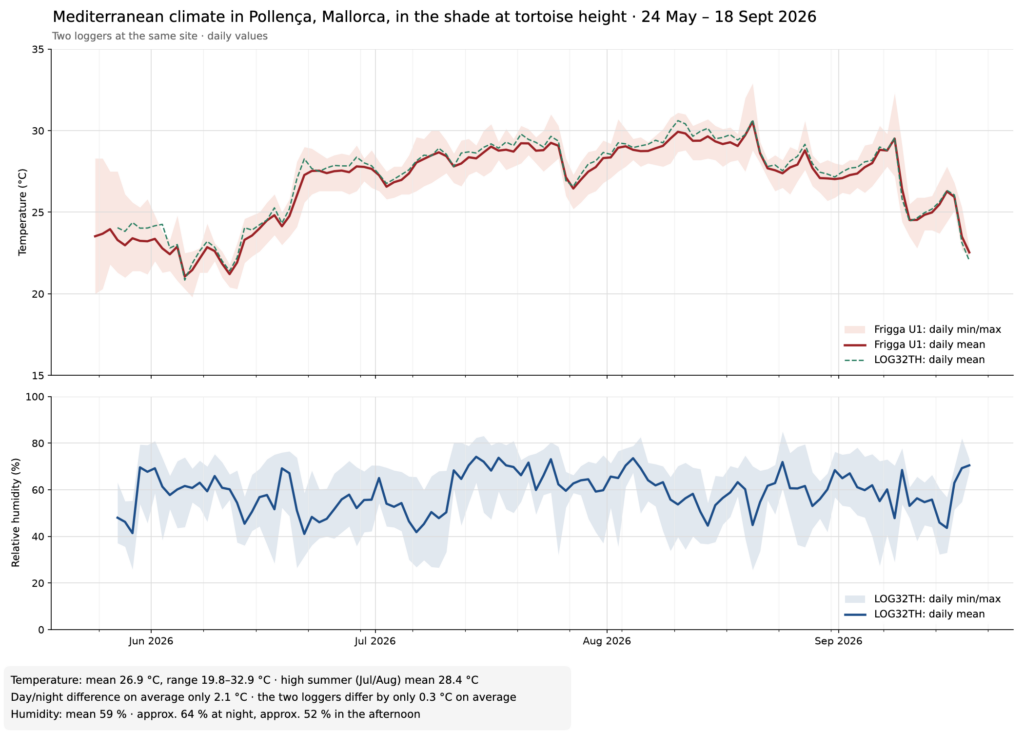
What does the microclimate that European tortoises actually experience look like? Climate tables answer this question only indirectly. They are based on weather stations that measure air temperature to a standard, in the shade at a height of 2 m. Tortoises, however, live in the layer of air close to the ground. To record this microclimate, we placed two data loggers at a Mediterranean site on Mallorca, in Pollença, from the end of May to mid-September 2026 – in the shade, at the height of the tortoises. One (Frigga U1) recorded the temperature every 10 minutes; the other (LOG32TH) also recorded relative humidity every 5 minutes. For the evaluation period from 24 May to 18 September, almost 50,000 readings are available. On average, the daily means of the two devices differ by only 0.3 °C, so the measurement is readily reproducible.
Shade as a warm ambient temperature
In high summer (July/August), the shade temperature averaged 28.4 °C. Afternoon values mostly reached 29 to 30 °C, with an absolute maximum of 32.9 °C. In these months, the early-morning lows hardly fell below 27 °C.
In the habitat, then, shade is not a place to cool down, but protection from overheating – while the temperature level remains consistently high. This is central to understanding thermoregulation. Tortoises are ectothermic and regulate their body temperature mainly through their behaviour, that is, by moving between sunny and shaded areas. The temperature differences an animal is exposed to over the course of the day therefore arise mainly in space – through its choice of location – and only to a small extent over time. For the outdoor enclosure, it follows that, in addition to basking spots, tortoises need shaded areas whose temperature is itself still within their activity range.
Small daily range close to the ground
The mean daily range – the difference between the coolest hour, around 6 a.m., and the warmest, around 4 p.m. – was only 2.1 °C. In the shaded zone close to the ground, day and night therefore hardly differ.
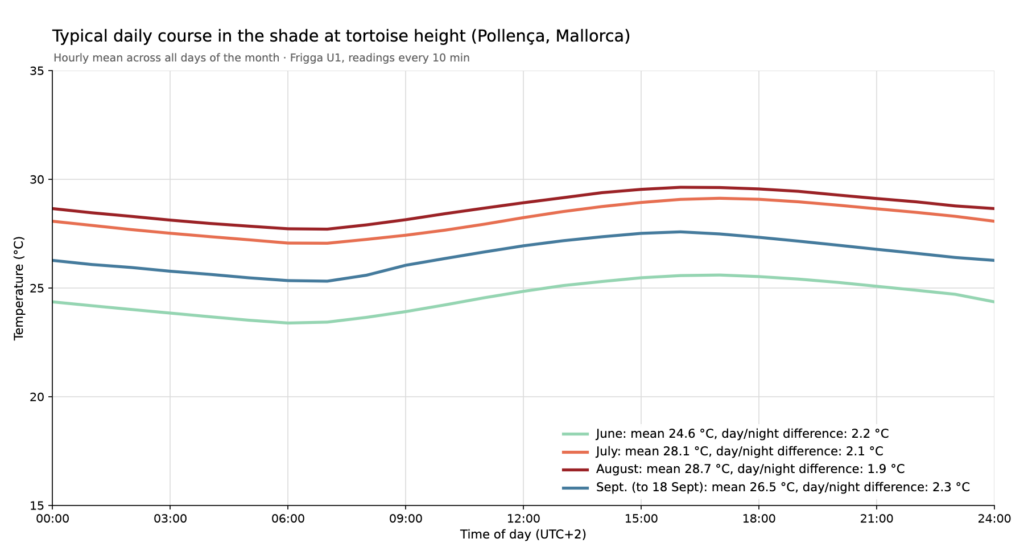
There is a good physical explanation for this. The soil has a high heat capacity; it absorbs energy during the day and releases it to the adjacent layer of air at night, with a time lag. At the same time, the vegetation reduces long-wave radiation into the night sky and dampens direct radiation during the day. Both effects considerably smooth the daily course close to the ground. As a result, night-time temperatures at tortoise height in July and August were 25 to 28 °C.
This is an important finding for husbandry. Climate data measured at 2 m overestimate the night-time cooling to which the tortoises are exposed in the habitat. In Central European outdoor enclosures, summer nights often drop to 10 to 15 °C – a considerably greater departure from the habitat than a comparison with climate tables suggests. Cold frames and greenhouses with heat-storing elements such as stones, soil or water containers effectively reduce this difference.
Seasonal course and autumn cooling
In June, the mean temperature was 24.6 °C. At the end of June, it rose within a few days to a summer plateau that lasted until the end of August. With a mean of 28.7 °C, August was the warmest month. Cooling set in from September – not continuously, but in steps. Individual weather events lowered the daily mean by 2 to 3 °C within a single day, followed by a partial recovery. By 18 September, the daily mean had fallen to 22.5 °C.
With regard to brumation, this pattern is revealing. In the habitat, the transition into autumn takes place as a sequence of cold snaps and recovery phases. Such fluctuations are part of the seasonal signals to which the tortoises respond. Husbandry that follows the habitat allows for them. A cold frame that fully compensates for every drop in temperature weakens these signals.
Humidity: a pronounced daily rhythm
Relative humidity averaged 59 %. It followed a clear daily rhythm, with about 64 % at night and around 52 % in the afternoon. This pattern is mainly temperature-driven. As the temperature rises, the saturation vapour pressure increases and relative humidity falls – even when the absolute water vapour content of the air stays the same. At night this effect reverses, up to the point of dew formation in the early morning.
On individual days, the daily humidity range was considerable, at 30 to 50 percentage points. The shade under vegetation close to the ground is therefore considerably more humid than the common image of a dry Mediterranean summer would suggest. In the outdoor enclosure, comparable microhabitats can be created with dense planting, leaf litter and hides in direct contact with the ground.
Small-scale heterogeneity
A side finding from the first days of measurement illustrates how finely structured the microclimate is. Until 27 May, the low evening sun evidently fell directly on the measuring point for a short time. The temperature rose by up to 5 °C within a few minutes and then fell again just as quickly. A single patch of sunlight therefore changes the thermal conditions at a given point abruptly. This mosaic of sunny and shaded areas is the basis of behavioural thermoregulation. A structurally rich outdoor enclosure with varied planting reproduces it; a uniform area does not.
Interpretation and limitations
The data come from a single site over a single season and describe the shaded zone only. Temperatures at basking spots and in the soil were not recorded, and the humidity data are based on a single logger. The values from the first few days are partly influenced by the evening sun. Measurements at further sites and over several years are needed before general conclusions can be drawn.
Within these limits, a consistent picture nevertheless emerges. The microclimate at tortoise height is warmer, more balanced and more humid than standard climate data suggest. For the design of outdoor enclosures and cold frames, this climate close to the ground is the actual frame of reference.
Further reading: Warm Husbandry · The Greenhouse Heater for Ambient Temperature · Around the Tortoise Year